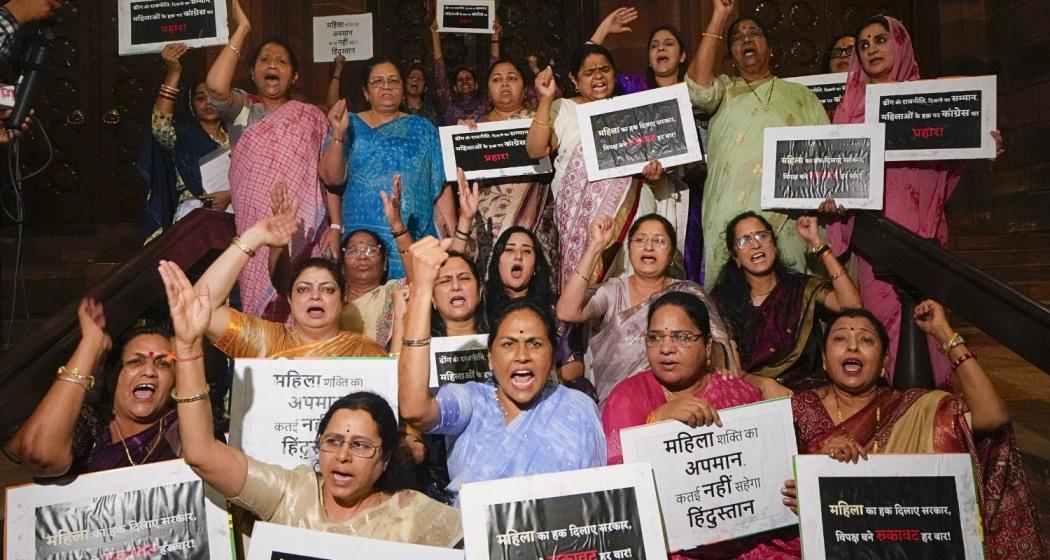
The jury is still out on who gained and who lost in the defeat of the amendment to the Women Reservation Bill of 2023. While the opposition, which displayed a rare show of unity, believes it defeated the government’s design to stealthily introduce delimitation, the government, on its part, has maintained that it “exposed” the opposition’s real face of being “against women’s reservation”.
How much the debate appeals to or concerns the common man is a million-dollar question. For the time being, the issue of women’s reservation in Parliament and state assemblies has been put on hold. It will take time and considerable effort to revive it.
The Women Reservation law was unanimously passed by Parliament in September 2023. There were certain conditions attached to the implementation of the 33 per cent reservation for women. It was to be implemented from the 2034 General Elections. The government had stated that for implementing the 33 per cent reservation, the strength of all legislatures, state assemblies and the Lok Sabha, would be increased. For that, a census had to be carried out first. Accordingly, the reservation could only be implemented after the delimitation of parliamentary and assembly constituencies, which would follow the census. In that sense, the government was within due process.
However, the government, for reasons best known to it, suddenly announced advancing the implementation from 2034 to 2029. It did not remove the condition of delimitation. Instead of waiting for a fresh census, it proposed to carry out delimitation based on the 2011 census so that the process could be expedited.
The scheduled 2021 census was delayed due to COVID. The government has now initiated a fresh census. At present, the only authorised data available is from the 2011 census, and hence it was made the basis of the proposed delimitation, which has now been rejected by Parliament for procedural reasons. Although the government secured 298 votes in favour of the amendment and the opposition 211, it fell short of the two-thirds majority required to pass a constitutional amendment.
The opposition, led by the Congress, has asserted that there should be reservation for OBC women within the 33 per cent quota. For that, a caste census is required, which is being conducted along with the ongoing general census. The opposition also alleged that the government intended to deny OBC women the benefit of reservation due to the lack of caste data in the 2011 census.
The parliamentary division on April 17 revealed deep fault lines on the issue, making it difficult for any government to legislate it again unless it secures a two-thirds majority or builds consensus. Both options currently appear unlikely.
Also read: Congress walks into BJP trap over delimitation
Just as parties like the Samajwadi Party and Rashtriya Janata Dal withheld support over the issue of “reservation within reservation” for SC/ST women, other issues may emerge in future to stall implementation. Samajwadi Party leader Akhilesh Yadav has already raised the demand for including Muslim women. Although the Constitution does not permit religion-based reservation, the issue may influence future debates.
Congress leader Rahul Gandhi has also hinted at extending reservation to minorities, often stating that it should be proportionate to population, including SCs, STs, OBCs and minorities.
The issue now appears to be in cold storage and may be difficult to revive soon. It also does not strongly resonate at the grassroots level for several reasons.
Even if implemented, it is unlikely that women from ordinary backgrounds without political lineage will benefit. Instead, women from established political families are likely to dominate, as parties may prefer familiar candidates.
This trend is already visible in reservations for SCs and STs, where political influence often remains within established families. A similar pattern may emerge in women’s reservation, as seen in local bodies where male relatives frequently exercise de facto control.
The issue may continue to generate headlines and political rhetoric, but its actual implementation in the near future appears unlikely. Until then, it remains more symbolic than substantive.

 Follow us