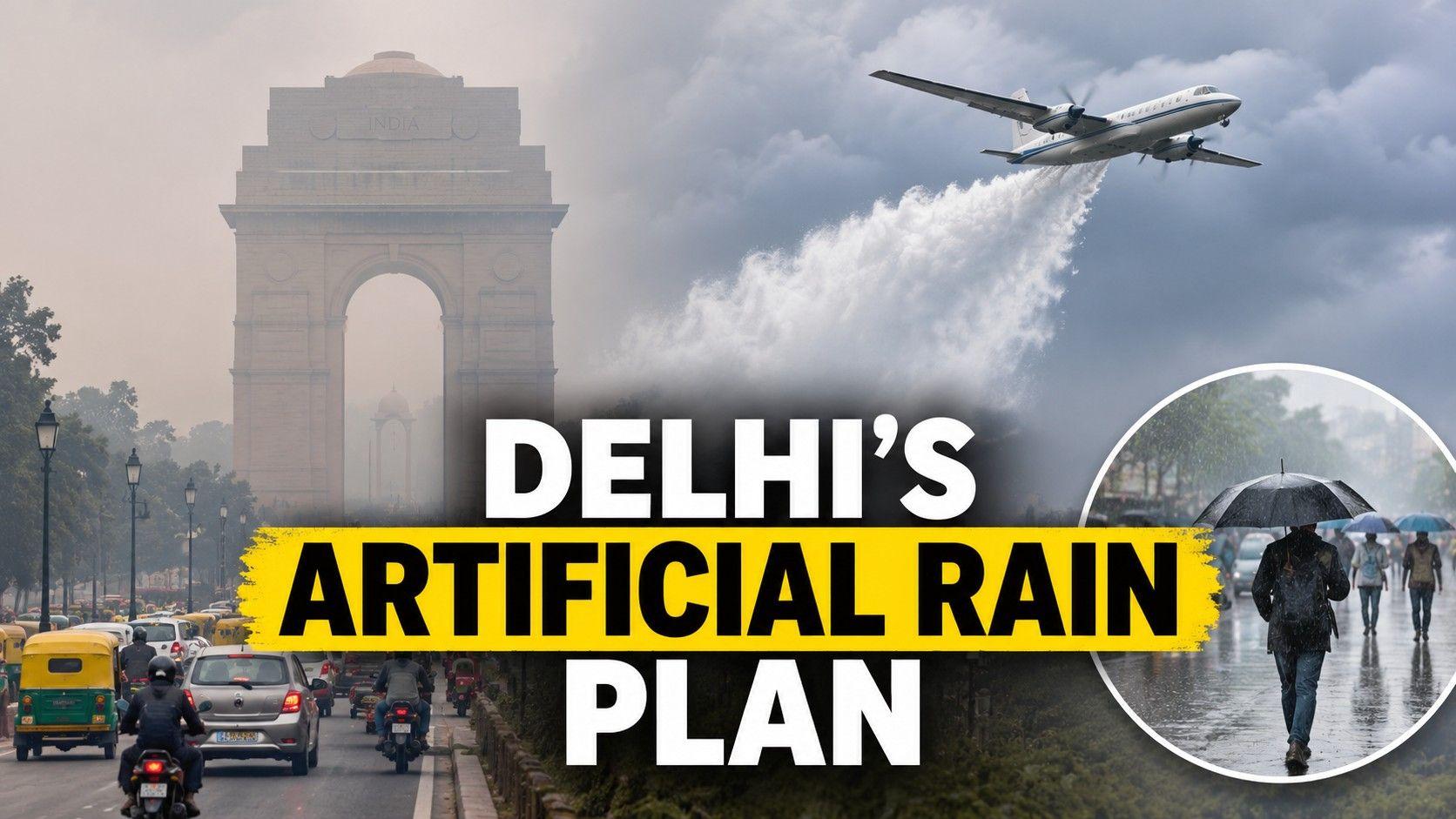
The Delhi government is preparing to use artificial rain if air pollution worsens after Diwali and Chhath Puja, with the city’s air quality already in the very poor category.
Delhi’s air quality index (AQI) stood at 367, while some parts of the city recorded pollution levels in the severe category. Jahangirpuri in North Delhi registered the highest AQI at 459, followed by IIT Delhi and Punjabi Bagh, where the AQI reached 445. PM2.5 was the main pollutant.
Dense haze has sharply reduced visibility and sunlight across the capital. Residents have also reported respiratory discomfort, while prominent landmarks, including India Gate, have remained covered by smog.
The government has carried out two artificial rain trials during the past 15 days as part of efforts to manage the pollution situation. One of the trials took place near Delhi Airport.
The cloud-seeding exercises were conducted at an altitude of around 30,000 metres, compared with 10,000 metres during trials held last year.
How cloud seeding works
Cloud seeding involves introducing substances such as silver iodide and dry ice into clouds to trigger rain or snowfall. The technique is used in areas facing water scarcity or reduced snowfall, and may also help in reducing hail and clearing fog. It can be carried out through aircraft, rockets or ground-based machines.
Artificial rain may temporarily bring down pollution levels by washing pollutants from the air, but it does not address the sources of emissions.
Sunil Dahiya, Founder and Lead Analyst at Envirocatalysts, said cloud seeding could be considered on days when pollution rises sharply, such as the day after Diwali, but would not provide a long-term solution because pollution sources remain unaddressed.
Supreme Court permits certified green crackers
The Supreme Court on Monday allowed the use of certified green firecrackers in Delhi-NCR on November 7 and 8. The court said there was insufficient data to determine whether a complete ban would solve Delhi’s annual pollution problem.
The court directed that the complete ban on firecrackers would return on November 9. On the two permitted days—the day before Diwali and Diwali—the use of firecrackers will be restricted to 6:00 AM to 7:00 AM and 8:00 PM to 10:00 PM.
GRAP Stage II restrictions in force
The Commission for Air Quality Management has implemented Stage II of the Graded Response Action Plan across Delhi-NCR.
The measures include restrictions on dust-generating construction and demolition work, with limited exemptions for essential projects, and a ban on diesel generator sets except for emergency use. Authorities have also been instructed to intensify mechanised road sweeping and water sprinkling.
Other measures include doubling parking charges and restricting non-BS-VI vehicles coming from outside Delhi. Public transport services have been increased to discourage the use of private vehicles.

 Follow us