Prime Minister Narendra Modi has accused the Opposition of attempting to reduce reservation for Other Backward Classes (OBCs) to create a quota for Muslims, describing the alleged proposal as “most appalling” in an opinion article published on Constitution Day.
Marking the adoption of the Constitution by the Constituent Assembly on November 26, 1949, Modi said the Opposition was advancing an approach that had been rejected by the framers of the Constitution. Although he did not name the party, the reference appeared to be directed at the Congress.
“It is most appalling that the biggest party in the Opposition wants to reduce OBC reservation and bring Muslim reservations, something the makers of our Constitution, notably Dr Babasaheb Ambedkar, were totally against,” the Prime Minister wrote.
Modi also accused the Opposition of becoming an “avrodh paksh” or obstructionist force instead of functioning as a “virodh paksh”, meaning the Opposition. He said disruptions in Parliament could not replace the constitutional duties of elected representatives.
He referred to the failure of the women’s reservation legislation to secure the required majority in the Lok Sabha earlier this year and alleged that the same Opposition party had blocked its passage while showing “disdain for constitutional values”. Modi assured women across the country that no force would stop his government from ensuring justice for them.
The Constitution (131st Amendment) Bill, 2026, which proposed 33 per cent reservation for women in the Lok Sabha and state assemblies along with delimitation, failed to obtain the required two-thirds majority in the Lok Sabha in April. Opposition leaders had objected to linking women’s reservation with delimitation. Congress MP Shashi Tharoor had described the proposal as a “shift in political power” and “political demonetisation”.
Criticism of past constitutional amendments
In the article, Modi also criticised those who had governed India for five decades, alleging that they had weakened the Constitution. He noted that 2026 marks 75 years since the First Amendment of 1951 and 50 years since the 42nd Amendment enacted during the Emergency, which curtailed judicial review.
The Prime Minister said the First Amendment was enacted by an unelected provisional Parliament months before India’s first general election and was intended to restrict fundamental freedoms and suppress public opposition. He urged young people to study the 38th and 39th Amendments to understand what “power-hungry and anti-constitutional leadership” could do.
Modi cited the repeated use of Article 356 to dismiss elected state governments, alleging that one party had invoked the provision almost 100 times and that one former Prime Minister had “scored a half-century” in doing so.
He said Articles 370 and 35A had kept Jammu and Kashmir outside the full application of the Constitution for more than 70 years. According to Modi, the provisions deprived Scheduled Castes, Scheduled Tribes, OBC communities and women in the region of their rights until 2019.
Referring to the end of Maoist violence this year, the Prime Minister said the development was particularly heartening because tribal citizens could now exercise their constitutional rights without fear. He also warned against what he called “dimagi Naxals”, alleging that they remained detached from present-day realities while trying to derail India’s growth.
Constitution and social justice
Describing the Constitution as an inseparable part of people’s life journeys, Modi recalled growing up in modest circumstances. He said the Constitution had helped create a society in which a person’s circumstances of birth no longer determined the limits of their future.
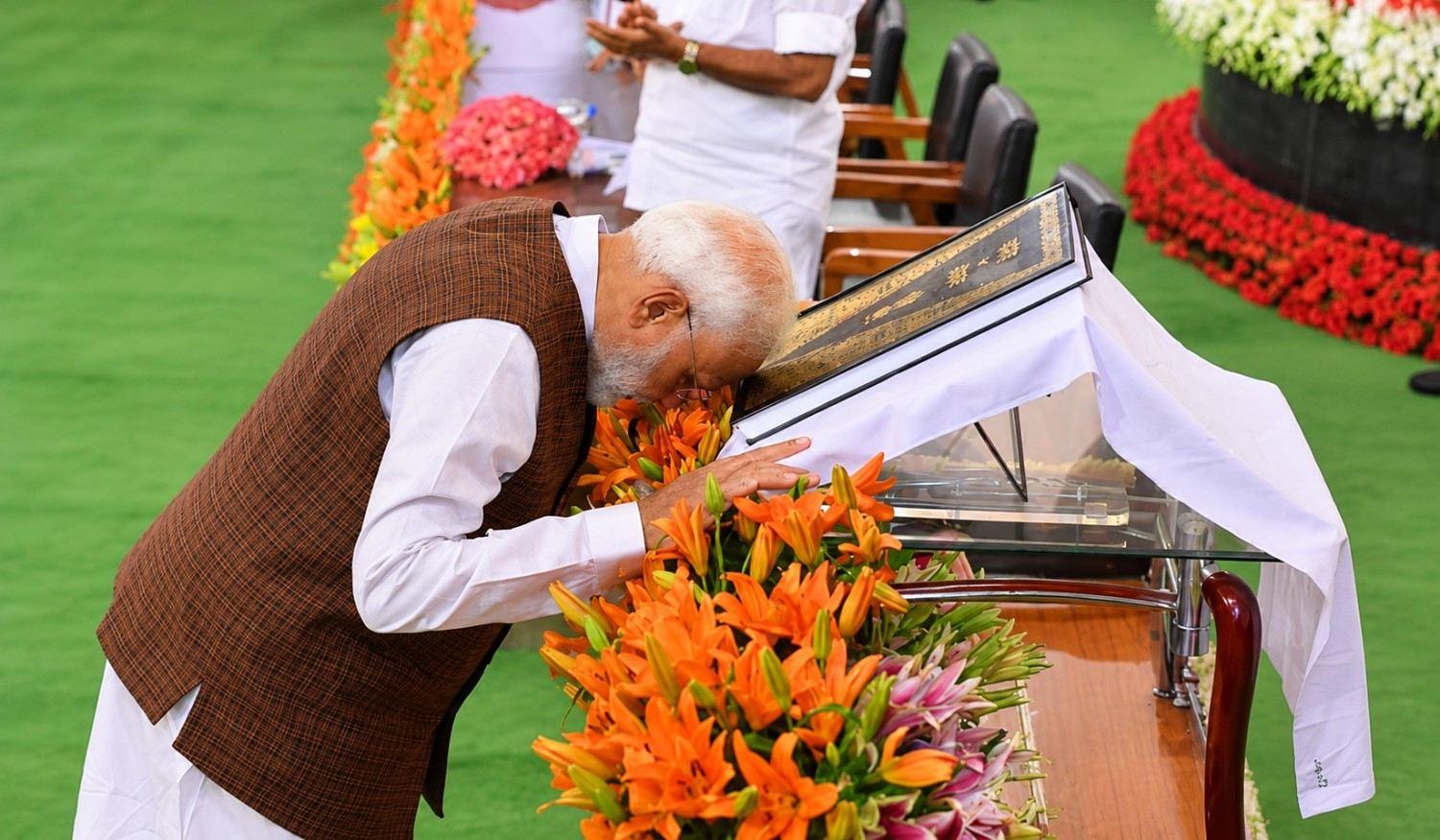
He paid tribute to former President Rajendra Prasad, Dr B R Ambedkar and the members of the Constituent Assembly. Modi also noted that his government began observing November 26 as Constitution Day more than a decade ago to strengthen citizens’ connection with the constitutional document.
Quoting scholar Granville Austin’s description of the Constitution as “first and foremost a social document”, Modi referred to a World Bank report which stated that nearly 50 crore Indians had moved out of poverty.
He listed welfare programmes implemented by the National Democratic Alliance government, including Pradhan Mantri Awas Yojana, Ujjwala Yojana and Ayushman Bharat, among other initiatives, as measures aimed at advancing social and economic justice.

 Follow us