
Trending:
Singur: From land row to industrial revival ahead of PM's visit
Didi kept her first promise but not the second one. Follow us
News Arena Network - Kolkata - UPDATED: January 16, 2026, 04:09 PM - 2 min read
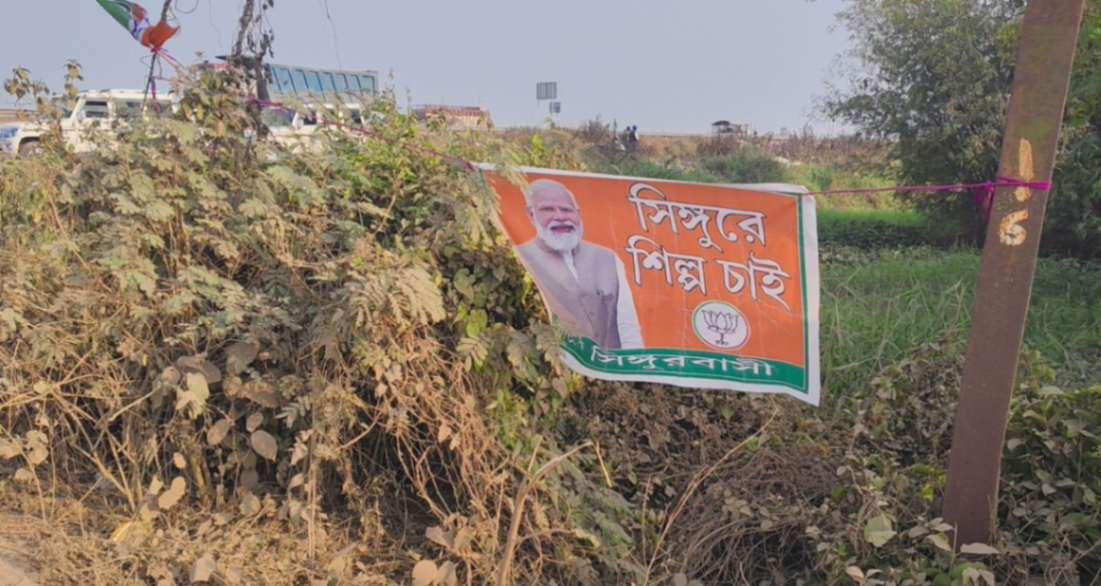
The Prime Minister’s visit, the party claims, will be the catalyst.
By Pranab Mondal
Two decades ago, Bengal’s political and social lexicon absorbed two emotionally charged terms—willing and unwilling farmers. Born out of the fierce resistance to land acquisition for Tata’s Nano factory in Singur, the phrases came to symbolise protest, displacement and a fractured rural conscience. The factory never came. But 18 years later, as Singur prepares for Prime Minister Narendra Modi’s visit on January 18, the mood on the ground tells a markedly different story.
Tata Motors pulled the plug on the Nano manufacturing plant in 2008. The then firebrand opposition leader Mamata Banerjee was at the forefront of the stir using the land acquisition issue as one of her key tools to derail Left Front’s 34-year regime in 2011 Assembly elections. Her promise to return of all acquired land in Singur to farmers and make it ready for cultivation helped the Trinamool Congress (TMC) overpower its political rivals in all electoral exercises since 2011 in Singur Assembly constituency.
Didi kept her first promise but not the second one.
While the once “unwilling” farmers have not abandoned their faith in agriculture, their hostility towards industry appears to have softened significantly. Posters demanding industrial development have surfaced across the area, reflecting a broader shift in public sentiment, and the message is clear—if farming is no longer economically viable, industry must fill the vacuum.
From farmers who once consented to part with their land to local traders and small businessmen, the demand for industry is now near-unanimous. The BJP has seized upon this shift, asserting that Singur—where Mamata rose to prominence as an anti-land-acquisition crusader—will also mark the beginning of her political decline. The Prime Minister’s visit, the party claims, will be the catalyst.
As the visit draws closer, Singur is awash with stories of lost opportunities, broken promises and rekindled hope. Residents are flocking to the proposed rally site to witness the preparations firsthand. A portion of the erstwhile Tata project land have been cleared of weeds, hangars erected, and a helipad constructed. CCTV cameras dot the area as security is tightened. Apart from the public rally, the Prime Minister is scheduled to attend a government programme, for which a separate stage is under construction. The event will span nearly 130 bighas, with the police administration conducting regular reviews of security and logistics. Former BJP state president and Local party leaders are making frequent visits to oversee arrangements.
The ghost of the past, however, looms large. After securing its seventh consecutive Assembly victory in 2006, the Left Front government moved to bring Tata Motors to Singur, planning to acquire nearly 1,000 acres of farmland. Mamata opposed the move from the outset, even staging protests in Parliament with a sheaf of paddy in hand. Construction of the factory proceeded regardless. In December 2006, Mamata launched a hunger strike, but work continued. In January 2008, the Calcutta High Court upheld the land acquisition, but Mamata remained defiant.
Later that year, buoyed by electoral gains in the panchayat polls, Mamata escalated her agitation with an indefinite sit-in protest in Kolkata forcing Tata Motors to halt work in September 2008. Talks between the Left Front government and the opposition collapsed within days, sealing Singur’s fate as a symbol of industrial loss and enduring pain.
On Friday, this correspondent visited the rally venue to gauge the political temperature. BJP leaders Saroj Ghosh and Tushar Majumdar, among others, expressed confidence about both the arrangements and the expected turnout.
“Mamata Banerjee rode to power by leading the movement of those who refused to give land,” said Ghosh. “But after coming to power, she sold dreams of industrialisation she never fulfilled. People have now placed their faith in the BJP and the Prime Minister. If we win Singur this time, it won’t just be about winning an Assembly constituency. It will deliver a message across an industry-starved West Bengal.”
Echoing the sentiment, Majumdar said, “The Chief Minister organises industry conferences, but she does not truly want industry. The Prime Minister does. That is why people are rallying behind him.”
The TMC, however, remains sceptical. Anandamohan Ghosh, the party’s Singur block president, downplayed the significance of the Prime Minister’s visit. “The people here have wanted industry for years, not because of any one leader’s visit,” he said. “The Prime Minister will come, deliver speeches and leave. We have heard these messages before. Nothing concrete followed.”
Beyond political rhetoric lie the voices of those who have borne the consequences of two decades of uncertainty. Farmers and businessmen, whose lives have seen little transformation since the Singur movement, now speak with weary pragmatism.
Jaykali Santra, a farmer willing to give up his land, observed, “Many are shifting from TMC to BJP. This will increase after the Prime Minister’s rally. If he assures factories, people will believe him.”
Sanatan Kole, a businessman with deep roots in Singur, was more blunt. “Neither agriculture nor industry has survived here. We trusted Mamata Banerjee. Where did that trust take us? Now we are waiting to hear what the Prime Minister says,” said Kole showing the unutilised land where weeds run wild.
Even among the once-reluctant farmers, fear has given way to resignation. Mahadev Das, president of the Barren Land Committee, said, “The land was returned 10 years ago, but cultivation never resumed. For a year, we have asked the state to make it cultivable again. We will now appeal to the Prime Minister to think about this land.”
Singur, once the epicentre of resistance, now stands at a crossroads. The slogans have changed, the anger has mellowed, and the demand is clear. Whether this renewed clamour for industry will translate into concrete change — or remain another chapter of unfulfilled promise — may begin to unfold on January 18.
Also read: I-PAC raids: ED accuses Mamata of ‘direct act of theft’ in SC
