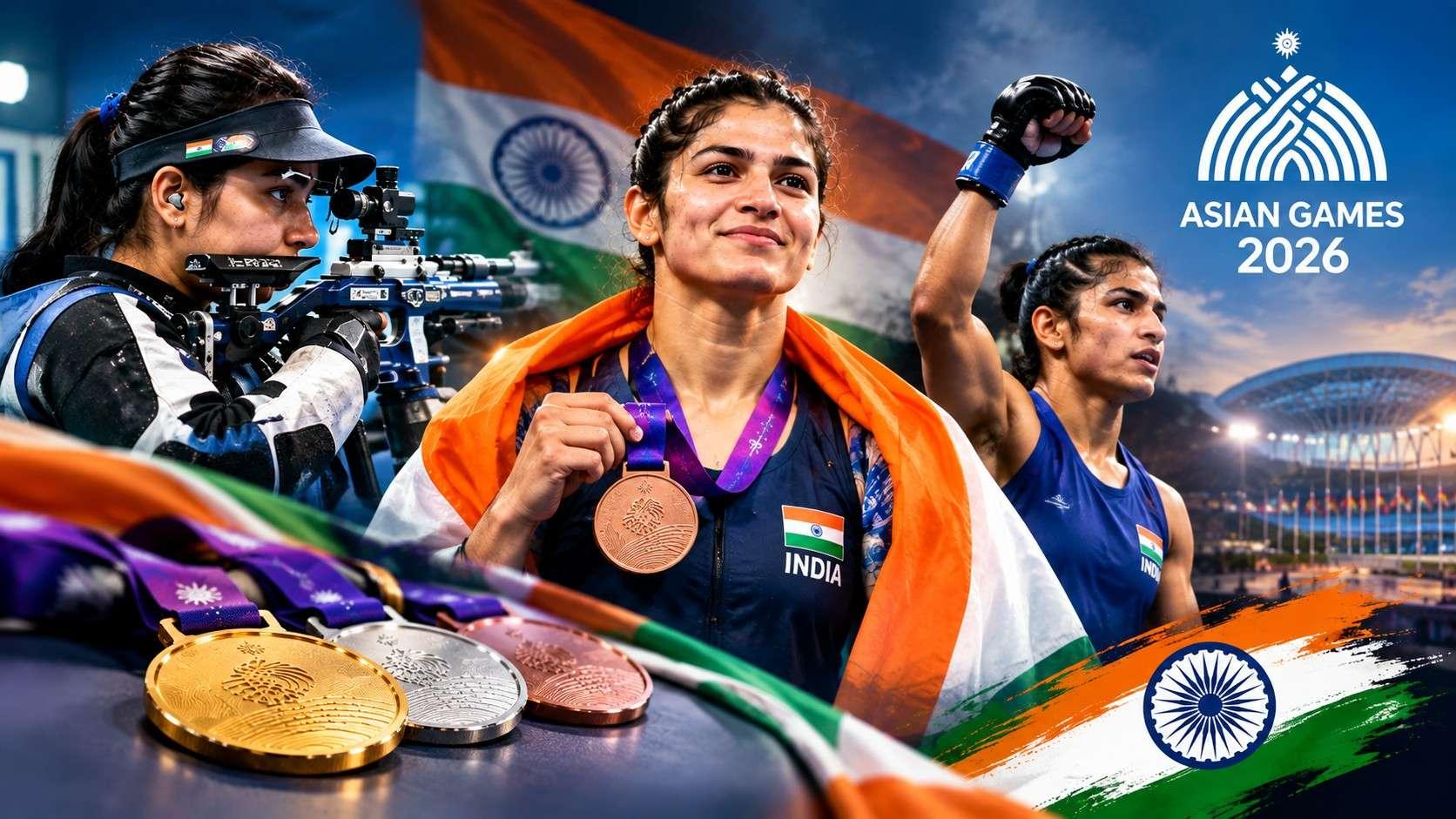
India added four medals on the second day of the Asian Games in Aichi-Nagoya, though the country continued to wait for its first gold. Shooting again played a central role in the medal tally.
Himanshu Dhillon won silver and Rudrankksh Patil took bronze in the men’s 10m air rifle individual event. The pair later teamed up with 18-year-old Parth Mane to win silver in the team competition with a score of 1898.4 points.
China’s Sheng Lihao, Changhong Zhang and Sihan Ma claimed gold after scoring 1899.0 points. Their performance also produced a new world record, surpassing the previous mark of 1898.4 set in Cairo last year.
For Dhillon, the two-medal performance was especially significant. He said winning for India was deeply emotional and described the achievement as a matter of great pride. The individual silver was also his first medal at senior international level.
“When you achieve something for the country, you naturally feel emotional. It is a moment of immense pride for me. In fact, this is my first individual medal at the senior international level, so holding two medals feels truly wonderful,” Dhillon said.
His coach, Kuldeep Nehra, recalled that Dhillon first encountered shooting during a school visit in 2019. After trying the sport, the youngster developed an immediate interest and eventually chose it over wrestling and kabaddi, which are traditionally favoured in Haryana.
Nehra said Dhillon’s parents were initially hesitant because of the cost involved in shooting. The family also questioned the decision when results did not come during the early years, but Dhillon remained committed and his performances improved gradually.
“I met Himanshu in 2019 during his school’s visit. The children had come over, and he tried firing a shot and really liked it. In Haryana, parents usually prefer sports like wrestling or kabaddi, sports that are less expensive and align with our local diet and lifestyle,” Nehra said.
He added that he explained to Dhillon’s parents that while a rifle and other equipment required an initial investment, the expense was largely one-time and the equipment could last a lifetime. Nehra said Dhillon’s persistence eventually changed the family’s view of the sport.
Patil, who secured bronze in the individual event and contributed to the team silver, said he was proud of winning two medals for India but acknowledged that the shooters had aimed for gold. He also highlighted the role of shooting in giving momentum to the country’s overall campaign.
“I feel very happy and proud to have brought home two medals for the country. Of course, it could have been better—we were hoping for gold—but something is better than nothing. We managed to secure bronze and silver; seeing both our flags on the podium makes me very happy,” Patil said.
Patil added that shooting often helps India get its medal campaign moving and said it was the team’s responsibility to build confidence across the contingent. He dedicated the medals to the country.
“The more medals we win, the stronger and more confident the whole contingent feels. I would like to dedicate this to the country. Medals are always for the country,” he said.
Rudrankksh’s father, DCP Balasaheb Patil, credited his son’s success to seven years of sustained hard work and determination. He said the shooter had always wanted to establish an identity through his own achievements rather than depend on his family background.
Balasaheb Patil said Rudrankksh remained focused on his long-term target of winning an Olympic medal for India. He recalled that his son travelled by rickshaw, taxi and train for training without referring to his parents’ names or positions.
“He has been working hard, relentlessly, for the past seven years. The excellent medals the country is winning are the result of that very hard work, and I am confident he will continue to perform exceptionally well,” he said.
“He is absolutely clear in his mind, whether he is an officer’s son or a farmer’s son, that he wants to make a name for himself. He wants to build his own reputation on his own merit. In fact, the situation now is such that we are recognised because of him,” Balasaheb Patil added.
Mane called the team silver a landmark achievement and an important learning experience. The medal, won alongside Patil and Dhillon, was his first at the Asian Games as well as his maiden senior international medal.
“This is definitely an important medal for me, and a valuable learning experience. It’s very special to me because it’s my first Asian Games medal and my first medal at a senior international event,” Mane said.
After two days of competition, India have six medals—four silver and two bronze—but are still seeking their first gold at the Asian Games 2026.

 Follow us