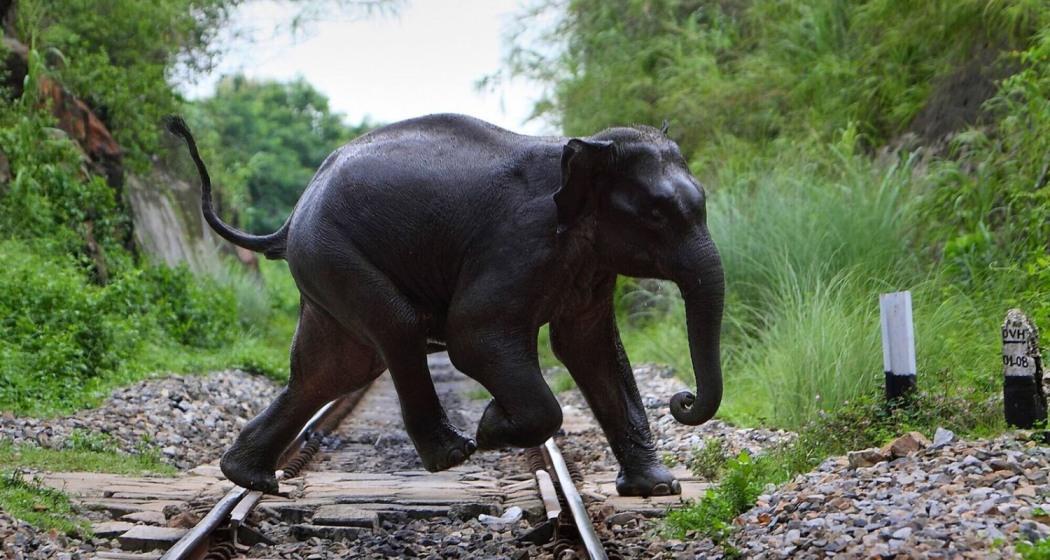
The Union Environment Ministry and the Railways have identified over 110 sensitive railway stretches across elephant habitats to curb wildlife–train collisions, officials said on Thursday, adding that several technology-driven solutions are also being tested to reduce animal fatalities.
According to officials, comprehensive joint field surveys conducted by teams from Project Elephant, the Wildlife Institute of India (WII), state forest departments and Indian Railways assessed ecological conditions along railway tracks passing through elephant landscapes.
The surveys evaluated 127 railway stretches covering 3,452.4 km. Of these, 77 stretches spanning 1,965.2 km across 14 states have been prioritised for mitigation measures based on wildlife movement patterns and the risk of elephant deaths.
A senior ministry official said the recommended mitigation package for these priority stretches includes a combination of structural and engineering interventions aimed at ensuring safer passage for wildlife.
“These include 503 ramps and level crossings, 72 bridge extensions and modifications, 39 fencing or trenching structures, four exit ramps, 65 new underpasses and 22 overpasses,” the official said.
“In total, 705 mitigation structures have been proposed to facilitate safe wildlife movement and reduce collisions between trains and animals,” he added.
Officials said the government is also experimenting with technology-based monitoring systems to alert railway authorities when elephants approach tracks.
One such system is the Distributed Acoustic System (DAS)-based Intrusion Detection System (IDS), which has been installed on a pilot basis along sensitive railway stretches in elephant habitats.
Pilot installations covering 64.03 km of elephant corridors and 141 km of railway block sections have already been commissioned under the North East Frontier Railway in Assam.
The system is now being replicated in sensitive railway sections in North Bengal and parts of Odisha under the East Coast Railway.
Another intervention is an artificial intelligence-based early warning system deployed at Madukkarai in Tamil Nadu. The system uses 12 tower-mounted cameras equipped with thermal and motion sensors to detect elephant movement within 100 metres of railway tracks and automatically alert forest and railway officials.
Officials said several railway expansion projects have also incorporated wildlife-friendly infrastructure, including the Gevra Road–Pendra Road line in Chhattisgarh and track expansion projects in Maharashtra.
A key intervention is planned along a 3.5-km stretch of the Azara–Kamakhya railway line in Assam, intersecting the Rani–Garbhanga–Deepor Beel elephant corridor, where the track will be elevated to allow safe elephant movement.

 Follow us