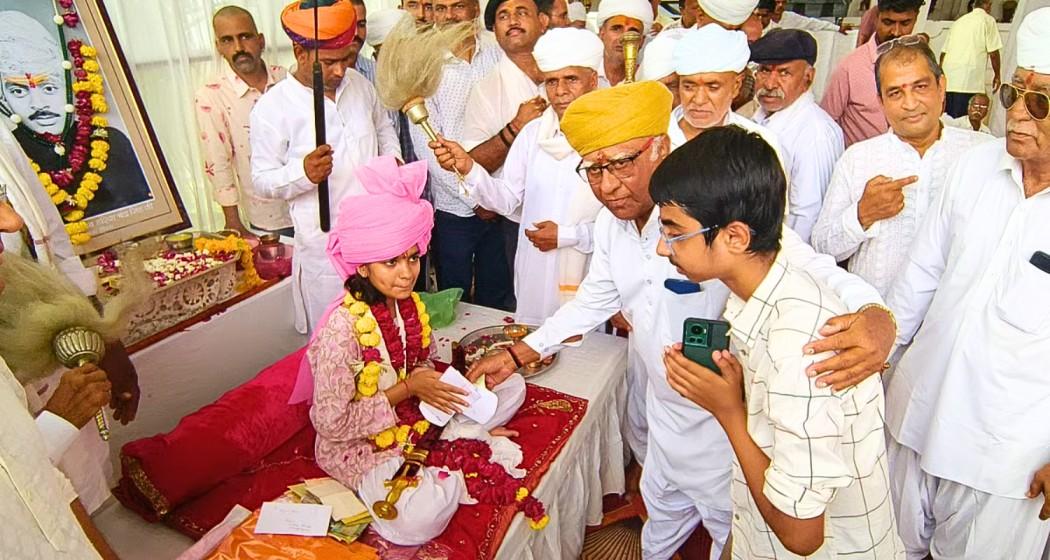
A 13-year-old girl has become the first female heir to the former Kherwagarh royal lineage in Rajasthan's Pali district, breaking a long-standing Rajput succession tradition that has historically recognised only male heirs.
Tejaswi Kumari Jodha was ceremonially declared the successor under the traditional "Paag Ka Dastoor" at Kherwa Fort on Thursday, following the death of her father, Harish Chandra Jodha.
The ceremony, attended by hundreds of villagers, marked the first time a girl had been recognised as an heir under the customary Rajput practice followed in the region, which was once part of the erstwhile Jodhpur kingdom.
During the ritual, Vedic chants were recited as Tejaswi participated in the ceremony. A ceremonial pink turban, symbolising the end of the mourning period and the assumption of family responsibilities, was placed on her head. The turban was reportedly sent by the former Jodhpur-Marwar royal family in keeping with tradition, while a tilak was also applied.
Also read: Burglar gang linked to 66 cases in 12 states held in Jaipur
The "Paag Ka Dastoor" signifies the transfer of leadership and responsibility within a family following the death of its head. Though widely observed in parts of Pali district, the ritual has traditionally been reserved for male successors.
Community elders said Tejaswi was chosen collectively as her father had no son. They noted that the family had not performed the ceremony for nearly 65 years because there had been no male heir, making the decision unprecedented in the family's recent history.
Residents described the move as a progressive step that preserved tradition while adapting it to changing social values and greater gender equality.
Tejaswi, a Class VII student, said she would continue to focus on her education while accepting the responsibilities entrusted to her through the ceremony. She also expressed her desire to fulfil her late father's vision for the development of Kherwa village.
The ceremony at the 17th-century Kherwa Fort has attracted attention as a rare example of a traditional Rajput succession custom evolving to reflect changing attitudes towards women's roles in leadership and inheritance.

 Follow us