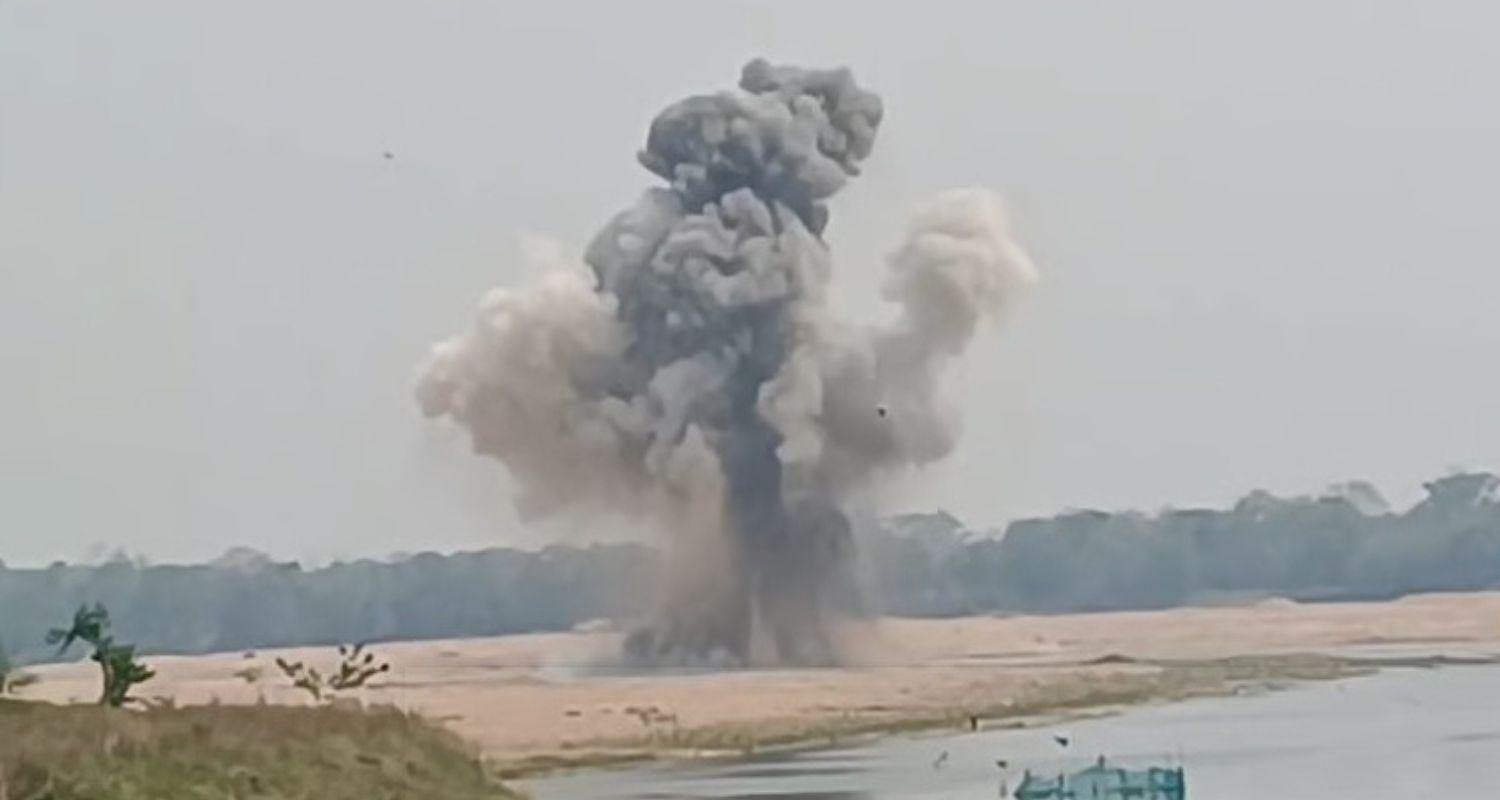
After several days of fear and uncertainty, residents of Baharagora block in East Singhbhum district of Jharkhand finally breathed a sigh of relief on Wednesday as the Indian Army’s bomb disposal team successfully defused a massive 227-kg explosive.
The bomb was recovered from the Swarnarekha River at Panipada Nagursai. Identified as an AN-M 64 model, the bomb dates back to the era of World War II.
The complex and high-risk operation was executed with remarkable precision, bringing an end to the tense situation that had gripped the area since the discovery of the explosive.
Senior officials, including East Singhbhum SSP Piyush Pandey, remained present on-site to oversee the proceedings.
Since early morning, the entire Panipada Nagursai region had been turned into a heavily secured zone, resembling a military cantonment. Authorities enforced stringent safety measures, adhering to a strict “zero casualty” strategy to ensure public safety.
Following recommendations from Army experts, all homes and farmlands within the potential danger zone were evacuated as a precaution. Access routes leading to the river were sealed off, and a heavy deployment of police personnel was put in place to restrict civilian movement near the site.
The administration also maintained a high level of emergency readiness throughout the operation. Fire brigade teams were kept on standby, while medical units equipped with ambulances were stationed nearby to respond swiftly to any emergency.
Before neutralizing the explosive, the Army’s bomb disposal squad carried out a detailed technical inspection to assess the condition and threat level of the device. It was then carefully relocated to a safe location, where it was destroyed through a controlled explosion in accordance with established safety protocols.
Officials confirmed that the entire operation was completed without any casualties or damage. Experts highlighted that such vintage explosives, often buried beneath sand or concealed in river currents, can remain active and dangerous for decades.
For villagers living along the banks of the Swarnarekha River, the past few days had been filled with fear and disruption. Many had avoided venturing near the river, impacting daily routines and livestock-related activities.
Also read: JMM to go solo on 19 seats in Assam after talks fail with Cong

 Follow us