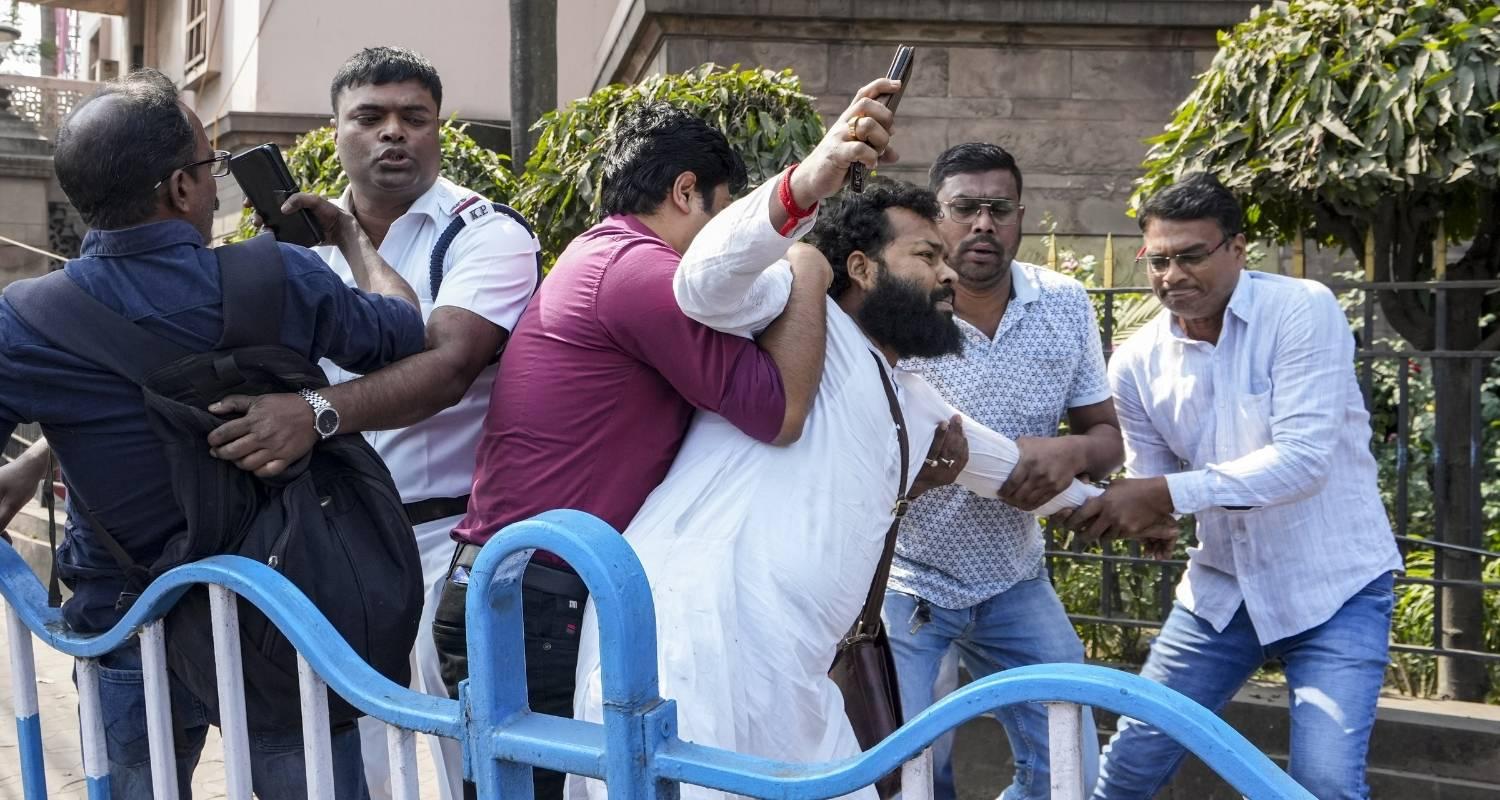
Political tensions surfaced even before the start of the West Bengal Assembly’s budget session on Thursday, with the House echoing with slogans from both the ruling and opposition benches as Governor CV Ananda Bose delivered his address.
Soon after the session began, members of the ruling Trinamool Congress (TMC) raised chants of “Jai Bangla,” while BJP legislators responded with “Bharat Mata Ki Jai,” filling the assembly hall with counter-slogans.
Before the Governor’s speech, however, a moment of formal courtesy was observed. Chief Minister Mamata Banerjee welcomed him by presenting a shawl, maintaining protocol despite the charged political atmosphere.
Tensions resurfaced as soon as the Governor began his address. Leader of the Opposition Suvendu Adhikari was heard remarking, “This is a political speech, sir.” Yet, after the speech concluded and the Governor prepared to leave, Adhikari was heard telling him, “Well done, sir.”
Also Read: In a first, LS clears Motion of Thanks without PM’s speech
Political circles later pointed to another development surrounding the address. According to sources, the Governor read out only the opening and concluding portions of the written speech. Some observers believe this may have prompted the opposition’s reactions.
After the address, Mamata personally escorted the Governor out of the assembly building, accompanied by Speaker Biman Banerjee.
Amid the political exchanges, attention is now focused on the state’s financial proposals. The government is set to present a Vote on Account rather than a full budget, as its current term runs until mid-May. The interim financial plan is intended to cover administrative expenses until then and will be presented by Minister of State for Finance Chandrima Bhattacharya.
Public interest around the budget has largely centred on two issues: whether financial assistance under the Lakshmir Bhandar scheme for woman will be increased and the extent of any hike in Dearness Allowance (DA). Both topics have been widely discussed across the state.
After nearly 15 consecutive years in power, political observers are watching closely to see whether the budget signals the government’s priorities for the next five years, and whether any new initiatives will be announced beyond existing welfare schemes and DA adjustments.

 Follow us