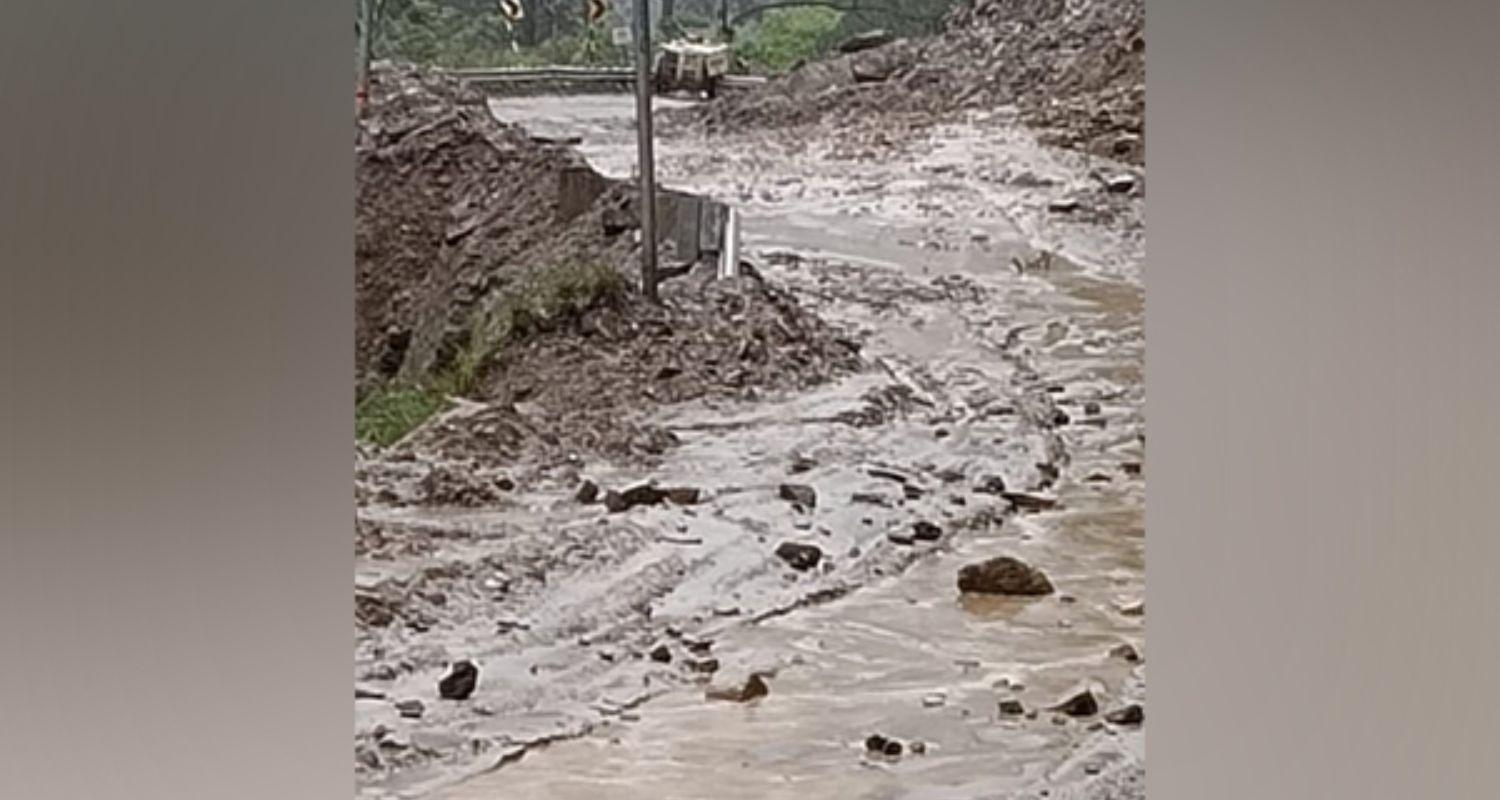
The Badrinath National Highway has been blocked after debris and stones from a nearby hillside fell near Nandprayag and Bhanerpani, following heavy rainfall in the region.
According to the Chamoli Police, the landslide has caused significant disruption, especially as the highway is a vital route for pilgrims heading to Kedarnath, making its clearance a top priority.
Meanwhile, neighbouring Himachal Pradesh is also grappling with extreme weather. Continuous heavy rainfall and cloudbursts have damaged several homes and swept away vehicles, leaving many residents in distress.
“Everything got washed away after a cloudburst. We are now staying at our relatives’ house,” shared a local resident affected by the calamity.
Meanwhile, the India Meteorological Department (IMD) had earlier issued warnings about widespread heavy rainfall across the country, due to active monsoon conditions.
IMD scientist Naresh Kumar explained that two low-pressure circulations — one over Madhya Pradesh and another over northern Odisha — are intensifying rainfall activity.
The IMD has issued alerts for central India and the western coast, warning of a strong possibility of heavy rainfall in these areas. Eastern Rajasthan is also likely to receive intense showers, with the forecast predicting substantial downpours in the region.
"A circulation has formed in Madhya Pradesh, and another circulation has formed in northern Odisha and surrounding areas. All these conditions are very favourable for the monsoon. An orange or red alert is in place for almost the entire central India and the western coast, due to which we estimate that heavy rainfall may occur in eastern Rajasthan today... Overall, we can say that the monsoon is in an active phase. Heavy rainfall will continue in most parts of India for almost the entire week," Kumar said.
Residents in vulnerable areas have been urged to remain cautious and follow safety advisories. For Delhi, the IMD has forecast overcast skies with rain over the next few days, as the monsoon is expected to reach the region shortly.
India officially welcomed the monsoon on June 29 — eight days earlier than usual — with the southwest monsoon now having covered all of Delhi, Rajasthan, western Uttar Pradesh, and Haryana.

 Follow us