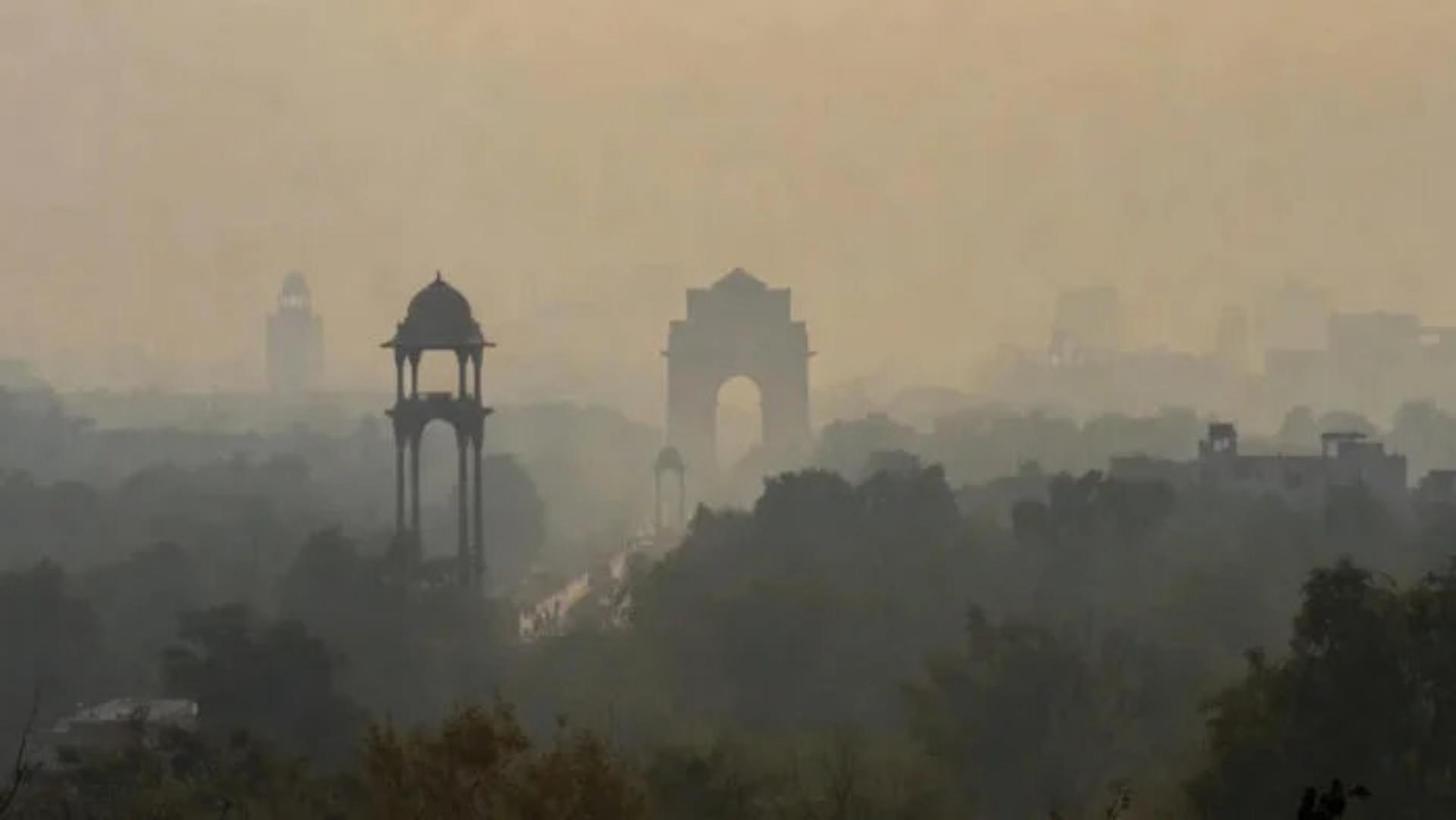
Even as the national capital saw brief relief from polluted air for a couple of days, the reprieve ended on Sunday, as air quality slid back to the “very poor” category, just two days after strong surface winds had led to a sharp improvement in pollution levels, official data showed. Forecasts indicate that air quality in Delhi is likely to remain in the “very poor” category for the next several days.
The air quality index (AQI) stood at 298 (poor) at 8am and worsened to 300 (poor) by 11am. The 24-hour average AQI was recorded at 307 (very poor) at 4pm, according to data from the Central Pollution Control Board’s daily national bulletin.The AQI further deteriorated to 310 by 7pm and was logged at 304 by 10pm.
This reversal came two days after strong surface winds of 15–20 kmph had significantly improved air quality, pushing AQI levels back into the “poor” range on Friday. Delhi’s 24-hour average AQI was logged at 236 (poor) at 4pm on Friday and 267 on Saturday.
The improvement had prompted the Commission for Air Quality Management to revoke stage-3 measures of the Graded Response Action Plan (Grap) across the National Capital Region with immediate effect on Friday. Despite the return of “very poor” air quality on Sunday, stage-3 measures remained lifted. However, stages 1 and 2 of Grap continued to remain in force.
Several Indian cities, including Delhi, Mumbai and Guwahati, woke up to a layer of fog on Monday morning. Air quality varied from ‘poor’ to very poor’ category across several parts of the national capital, while several flights were delayed at the IGI Airport.
According to the Central Pollution Control Board (CPCB), Delhi recorded AQI at 260 in the ‘Poor’ category by 8 am on Monday.
Visuals from Akshardham showed the Air Quality Index (AQI) at 294, falling in the ‘poor’ category, according to the Central Pollution Control Board (CPCM). At ITO, the AQI was recorded as 256, also categorised as ‘poor’, while Anand Vohar reported a sharper decline at 320, placing the area in the ‘very poor’ bracket.Chandni Chowk remained one of the worst-affected areas, recording an AQI of 337 under the ‘very poor’ category. The reduced visibility due to fog and smog disrupted flight operations at Delhi’s Indira Gandhi International Airport, with several flights delayed during the early hours of the day.
Meanwhile, Mumbai also woke up to hazy conditions, with visuals from the Bandra Kurla Complex and Bandra Reclamation showing a visible layer of smog engulfing the city. The AQI in the area stood at 132,Notably, in Delhi, the Sub-Committee on the Graded Response Action Plan (GRAP) under the Commission for Air Quality Management (CAQM) in NCR and adjoining areas revoked Stage-III restrictions on Friday evening, citing a significant improvement in air quality due to favourable meteorological conditions.

 Follow us