
Trending:
Delhi Vehicle Ban From November 1: Nearly 3.5 Lakh Noida Vehicles Affected
Delhi's non-BS-VI vehicle ban from November 1 raises concerns among Noida commuters over daily travel, medical emergencies and transport alternatives. Follow us
News Arena India - New Delhi - UPDATED: October 27, 2026, 09:26 PM - 2 min read
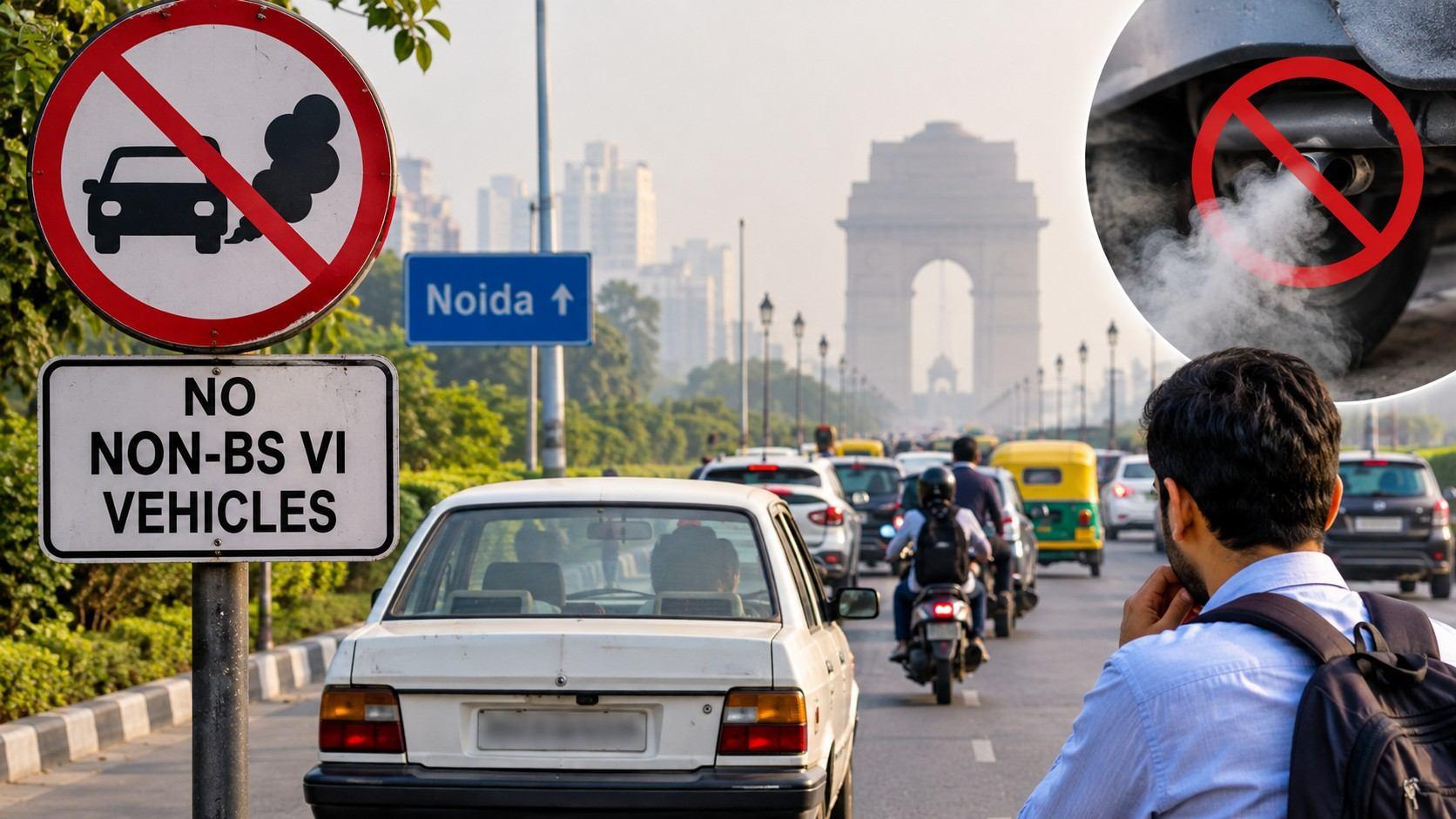
Delhi Pollution Rules: Non-BS-VI Vehicles From Noida Face Entry Curbs
Nearly 3.5 lakh vehicles from Noida and Greater Noida are expected to be barred from entering Delhi from November 1, when restrictions on non-BS VI vehicles come into force to address winter pollution.
The Noida transport department will begin enforcement against such vehicles from November 1. Officials said the drive would cover Gautam Budh Nagar, Ghaziabad and areas along the Delhi borders.
Data available with the Noida transport department showed that Noida and Greater Noida had 9.7 lakh registered petrol vehicles and 1.3 lakh registered diesel vehicles as of October 27. The figures included 1,11,867 BS IV vehicles and 2,46,993 end-of-life vehicles (ELVs).
The ELV figure comprises 1,99,549 petrol vehicles that are 15 years old and 47,444 diesel vehicles that are 10 years old. These vehicles are required to be scrapped under directives issued by the Commission for Air Quality Management (CAQM). BS I, BS II and BS III vehicles launched before 2010, along with a small portion of BS IV vehicles purchased between April 2010 and 2011, fall within the ELV category.
In August, the Gautam Budh Nagar transport department deregistered 601 ELVs, including 488 diesel and 113 petrol vehicles. Registration certificates of another 751 vehicles were cancelled during the month.
The district has 7,08,801 registered BS VI vehicles and 72,727 electric vehicles. In total, more than 13.5 lakh vehicles across categories are registered in Gautam Budh Nagar.
Enforcement and penalties
Siyaram Verma, Regional Transport Officer (Enforcement), said enforcement would begin against ELVs in Noida and Ghaziabad. Under Uttar Pradesh rules, driving a non-BS VI vehicle during the enforcement drive can attract a fine of ₹5,000, while operating a vehicle without a valid pollution under control (PUC) certificate can lead to a ₹10,000 penalty.
Verma said enforcement would be strengthened across Gautam Budh Nagar and Ghaziabad, including stretches near the Delhi border.
Police clarified that, apart from ELVs, BS IV and BS VI vehicles would continue to be allowed to operate in Noida, Greater Noida and other Uttar Pradesh districts of the National Capital Region without restrictions at present.
Syed Ali Abbas, Deputy Commissioner of Police (Noida Traffic), said the department had not received any official communication from Delhi Police regarding restrictions on non-BS VI vehicles travelling from Noida into Delhi. He said CAQM guidelines permit vehicles other than ELVs to operate until GRAP Stage 3 or Stage 4 is imposed.
Abbas added that authorities were currently checking only ELV movement within the district and at its borders, while BS IV vehicles that do not fall under the ELV category were not being restricted.
Daily commuters seek alternatives
The proposed restrictions have caused concern among NCR residents who use non-BS VI vehicles to travel to Delhi for work. Commuters have raised questions about the lack of convenient public transport and last-mile connectivity from their homes.
Brajesh Sharma, a resident of Sector 78 in Noida who works in Delhi, owns a 2018 BS IV Tata Tiago. He said the policy would create serious difficulties for him and other office-goers and suggested that shuttle or other transport services be arranged from the Noida border for owners of non-BS VI vehicles.
Sharma also suggested that BS IV vehicles carrying four people should be permitted to enter Delhi. He said allowing carpooling could reduce the number of vehicles on the road while helping commuters who comply with pollution-related requirements.
Sharma said he was considering parking his vehicle near the Noida border and paying for a cab to cover the remaining distance. He also raised concerns about emergencies, asking how families would manage if someone suddenly fell ill and required a BS VI vehicle or urgent treatment in Delhi. He said Noida, Ghaziabad and other NCR districts should also restrict non-BS VI vehicles entering from Delhi, instead of treating these districts as secondary.
Pankaj Gupta, a resident of Greater Noida West who works in Delhi, said the restriction would make his daily commute difficult because public transport was not easily accessible from his home. He said purchasing a new vehicle solely to meet the requirement was not financially practical for everyone and urged the government to offer relief to regular commuters or improve public transport connectivity between Noida and Delhi.
Residents have described the measure as forceful and said the difficulties faced by office-goers had not been adequately considered. The restriction on non-BS VI vehicles is scheduled to remain in place until January 31.
Other measures to reduce emissions
Delhi-NCR introduced the “No PUC, No Petrol” policy on October 1 to reduce vehicular pollution. Its implementation was less effective in Gautam Budh Nagar after the Uttar Pradesh Petrol Association approached the Allahabad High Court, citing forced implementation and additional costs for petrol pump operators.
Automatic number plate recognition cameras were consequently not installed at petrol pumps. An application named “PUC Status” was later provided to petrol pump attendants, but attendants said scanning every vehicle was practically impossible, limiting the effectiveness of the arrangement.
The restrictions and related measures are intended to cut vehicle emissions, including PM2.5 and carbon monoxide, before the winter pollution season. Delhi-NCR has recorded an Air Quality Index above 500 during the pollution season.
