


Trending:
Experts discuss Himalayan Agroecology at Shimla meet
The consultation formed part of the ongoing multi-country and multi-stakeholder HAI process aimed at co-developing practical, evidence-based pathways for sustainable, climate-resilient and nutrition-sensitive food systems in the Indian Himalayan Region. Follow us
News Arena Network - Shimla - UPDATED: January 20, 2026, 05:26 PM - 2 min read
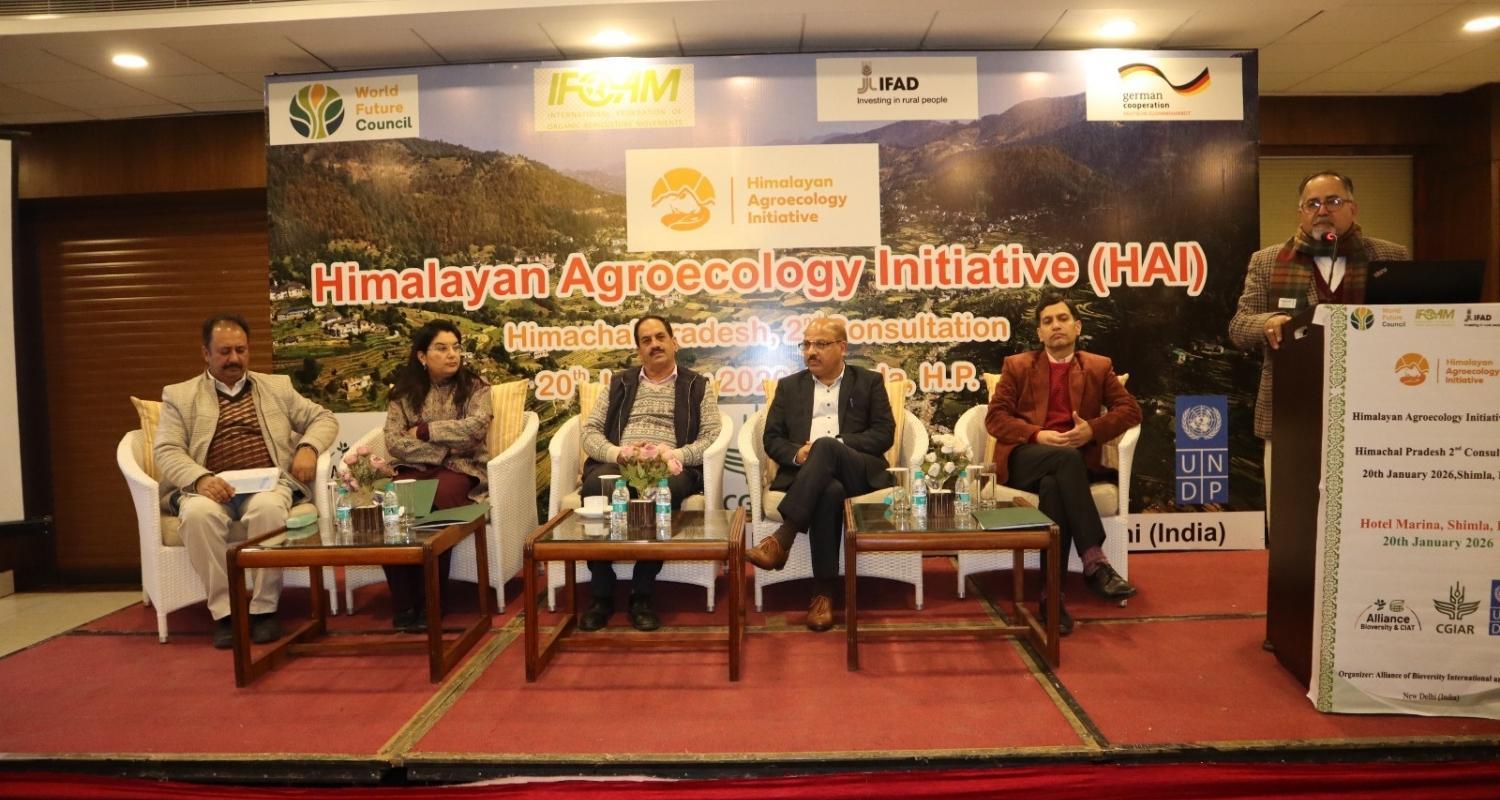
Experts during the Second Stakeholder Consultation on the Himalayan Agroecology Initiative (HAI) in Shimla on Tuesday.
The Second Stakeholder Consultation on the Himalayan Agroecology Initiative (HAI) was held here on Tuesday to deliberate on the draft HAI Roadmap for Himachal Pradesh and to strengthen policy convergence for advancing agroecological transitions in the state.
The consultation formed part of the ongoing multi-country and multi-stakeholder HAI process aimed at co-developing practical, evidence-based pathways for sustainable, climate-resilient and nutrition-sensitive food systems in the Indian Himalayan Region.
The consultation focused on presenting the HAI Roadmap and its seven strategic pillars, assessing their relevance to Himachal Pradesh, and aligning agroecology priorities with existing state initiatives, including natural farming, horticulture, livestock development, climate action, nutrition, and rural livelihoods programmes. The discussions underscored the roadmap’s role as a guiding framework for operationalising state and national schemes in ways that are responsive to Himalayan agro-ecological and socio-economic conditions.
In his keynote address, Dr Basu Sood, Advisor (Planning), Government of Himachal Pradesh, highlighted the strategic importance of agroecology in reducing climate and livelihood risks in hill agriculture. He emphasised the need for long-term policy commitment, convergence in planning, and stronger institutional coordination, while cautioning policymakers to ensure that the proposed strategies do not disturb the delicate balance between cash crops and food crops in the long run. He concluded his address by assuring that the state government would readily support and adopt such initiatives in the interest of the welfare and development of the agricultural sector in the state.
Dr Jai C. Rana, India Country Representative, Alliance of Biodiversity International–CIAT, presented the HAI Roadmap, outlining its food-systems approach, alignment with national missions on natural farming, climate change, nutrition, and biodiversity, and its potential to enhance farm viability, resilience, and livelihoods in hill regions. He said that the current food systems are not sustainable, and thus the transformation of food systems is not an option, but a must.
There is an urgent need to upgrade from the current sectoral (agriculture-centric) approach to a multisectoral participatory approach. Dr Rana elaborated in detail on the roadmap framework for all the seven strategic pillars of the National Mission on Natural Farming, and stressed that these are not separate initiatives but mutually reinforcing components of a unified pathway for transforming India’s food systems. He informed that the roadmap developed is in line with the Viksit Bharat initiative of the GoI.
Dr Suresh Sharma, State Nodal Officer-cum-Additional Director, RGPKKKY, Department of Agriculture, shared key insights into the current status and achievements of the Natural Farming programme in Himachal Pradesh and discussed possibilities for its convergence with the HAI framework.
He presented an overview of Natural Farming in the state and highlighted the major challenges faced by agriculture, including small landholdings and the predominance of rain-fed farming. He also pointed to socio-economic changes that have led to declining youth interest in agriculture. Expressing optimism, he noted that the HAI initiative has the potential to address these challenges effectively. He pointed to the effective linkage between the producer and the consumer. He reiterated the state government’s strong support for promoting organic farming in Himachal Pradesh.
During the open discussion, participants identified several key implementation challenges, including the need for stronger inter-departmental coordination, capacity building within extension systems, integration of agrobiodiversity and soil–water stewardship, development of short and equitable value chains, and increased support for women-led and community-based institutions. Emphasis was placed on adopting phased, farmer-friendly approaches supported by robust research–extension linkages and territorial markets tailored to the diverse agro-ecologies of the hills.
Raman, Conservator of Forests (HP Campa), asked whether the government was promoting certified, high-quality products to enhance consumer acceptance and whether there are initiatives to link these products with health benefits.
Questions were also raised regarding the value chain roadmap, stressing that branding should be strong and self-explanatory, given the discerning and well-informed nature of today’s consumers. Dr Mohar Singh highlighted the importance of awareness generation, with the tourism sector serving as the nodal agency.
The consultation meeting lauded the state government’s commitment to promote natural farming on a large scale and supplemented the views expressed by Chief Minister Thakur Sukhvinder Singh Sukhu, who had announced that the State government would formulate a State Nutrition Policy with the objective of ensuring the availability of balanced and nutritious food for all vulnerable sections of society, particularly children and lactating mothers.
The consultation was attended by senior officials from key state departments, representatives of NABARD, research and academic institutions, development partners, civil society organisations, farmer producer organisations, natural farming practitioners and progressive farmers. Padma Shri awardee Nek Ram Sharma, a farmer, also attended the meeting.
Inputs and recommendations emerging from the consultation will be incorporated into the final HAI Roadmap for Himachal Pradesh, which is envisaged as a practical tool for policy alignment, institutional coordination and investment planning to support resilient agroecological food systems and rural livelihoods in the state. Dr Lal Singh, HAI Consultant for Himachal Pradesh, coordinated the event.
HAI is funded by Germany’s BMZ and IFAD and is implemented in partnership with leading national and international institutions, including the World Future Council (WFC), IFOAM – Organics International, Alliance of Biodiversity International-CIAT, and UNDP (India).
