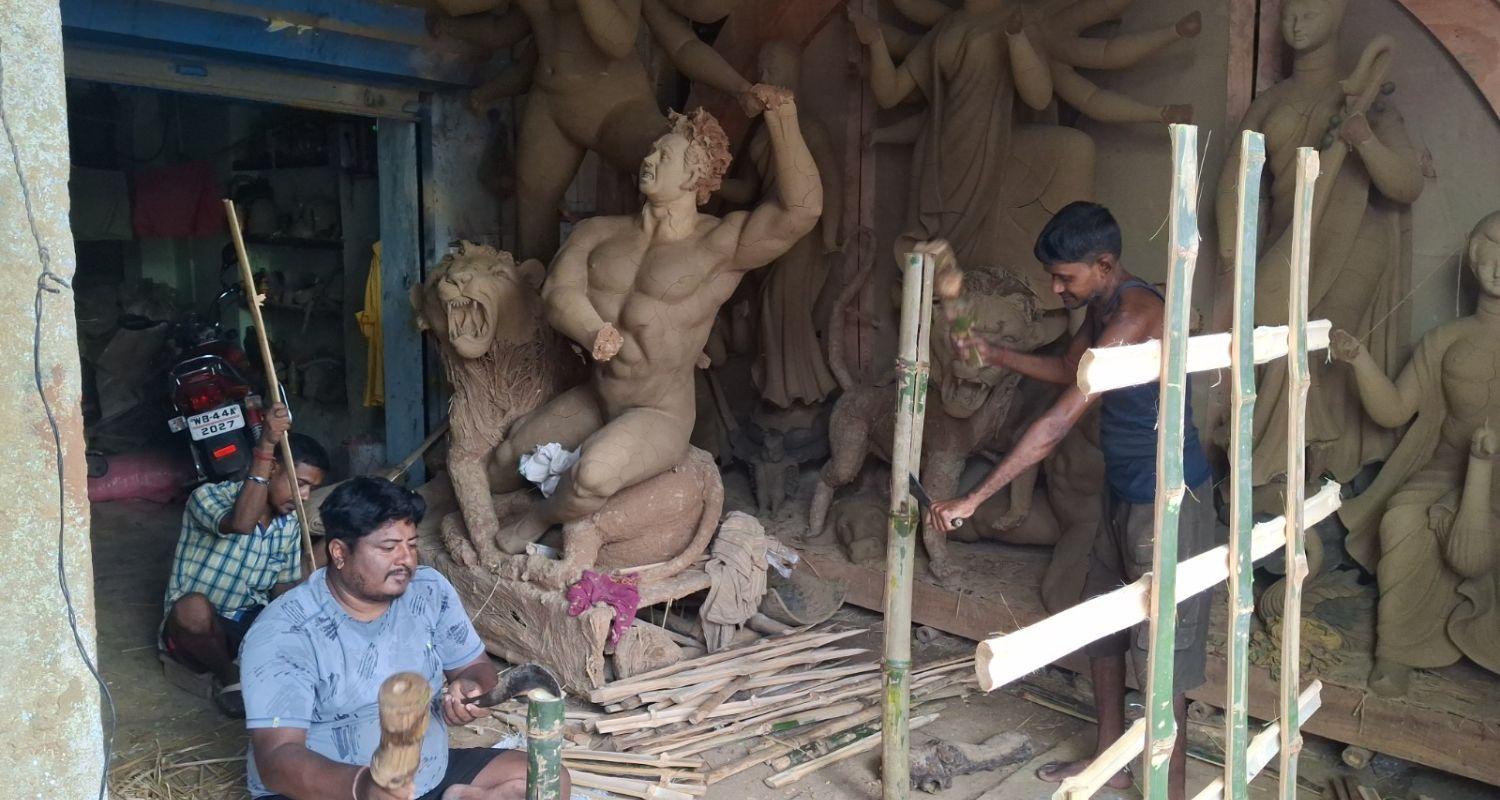
For Durga idol makers, Ganga clay is more than just mud. It is the finishing touch that brings a goddess to life. But this year, that essential ingredient has become increasingly difficult — and expensive — to procure, leaving artisans in Asansol’s ‘Kumartuli’ worried as Durga Puja draws closer.
In Mahishila Palpara, where around 10 to 12 idol-making workshops operate, artisans are working overtime following the Rath Yatra to meet orders from across Paschim Bardhaman, neighbouring Purulia, Bankura and Birbhum districts, as well as parts of Jharkhand. Yet, amid the familiar sights of bamboo frames, straw and half-finished idols, one concern dominates—where will the next load of Ganga clay come from?
Artisans say clay that once cost around Rs 35,000 for a truckload is now being sold for nearly Rs 60,000 amid a shortage and alleged black-market activity.
According to the idol makers, the problem stems from restrictions on clay extraction from land near the Ganga in the Diamond Harbour, South 24 Parganas. They claim that landowners are increasingly refusing permission for excavation, sharply reducing supplies of the clay traditionally used for fine detailing.
Abhijit Rudra Pal, an artisan from an idol-making unit in Asansol, said obtaining even a single truckload had become a struggle.
“Since the political change in the state, it has become difficult to source the right kind of clay. We used to bring clay from the banks of the Ganges at Diamond Harbour, but the government no longer permits its extraction. I managed to procure just one truckload with great difficulty, and we are making do with that. The price of clay has skyrocketed; the cost per lorry-load has nearly doubled,” he said.
The artisans say the irony is that they had faced difficulties even earlier. During the previous Trinamool Congress government, they alleged, sourcing clay involved demands for illegal commissions and harassment while transporting it. Despite those hurdles, they said, supplies were eventually arranged.
Now, they claim, the situation has changed from harassment during transportation to a shortage at the source.
And clay is not the only problem. The cost of bamboo, jute twine, paints and other materials used in idol-making has also risen. But artisans say they cannot pass the increased costs on to Puja committees.
Pal said committees were reluctant to increase their budgets, citing uncertainty over government grants following the political change. Even a request for an additional Rs 3,000 for an idol, he said, often meets resistance.
For the artisans, however, Ganga clay presents a more fundamental challenge. Ordinary soil can be used for the basic structure of an idol, but they say it cannot match the texture and finish of Ganga clay when it comes to delicate facial features and intricate detailing.
Srikrishna Pal, another artisan, explained that the clay was traditionally sourced not by digging directly into the riverbank, but from privately owned plots located some distance away from the river.
“Clay is not extracted directly from the riverbank itself, as doing so could trigger landslides. We used to source it from landowners whose plots were situated a short distance away from the river. However, most landowners are now refusing permission for clay extraction, so supplies from Diamond Harbour have stopped,” he said.
Without the clay, artisans fear that the idols they have promised to Puja committees may not have the fine finish associated with their craft.
They are therefore seeking a permanent mechanism for the regulated supply of Ganga clay at a reasonable price, arguing that environmental concerns and the livelihood of traditional artisans must be addressed together.
The South 24 Parganas district administration, however, maintains that restrictions were imposed for environmental reasons. An official, speaking on condition of anonymity, said illegal excavation and sale of clay from land along the Ganga had led to concerns over soil erosion.
“Clay was being illegally excavated and sold from various lands along the banks of the Ganges. Consequently, a ban on clay excavation was imposed because it was causing soil erosion. Excessive extraction of clay could also damage the environment. The matter is currently under review,” the official said.
For now, as the countdown to Durga Puja begins, the artisans of Asansol’s Mahishila Palpara are racing against time—and a shortage of the very clay they say helps give their idols their soul.
Also read: Bengal BJP suspends 22 workers over extortion allegations

 Follow us