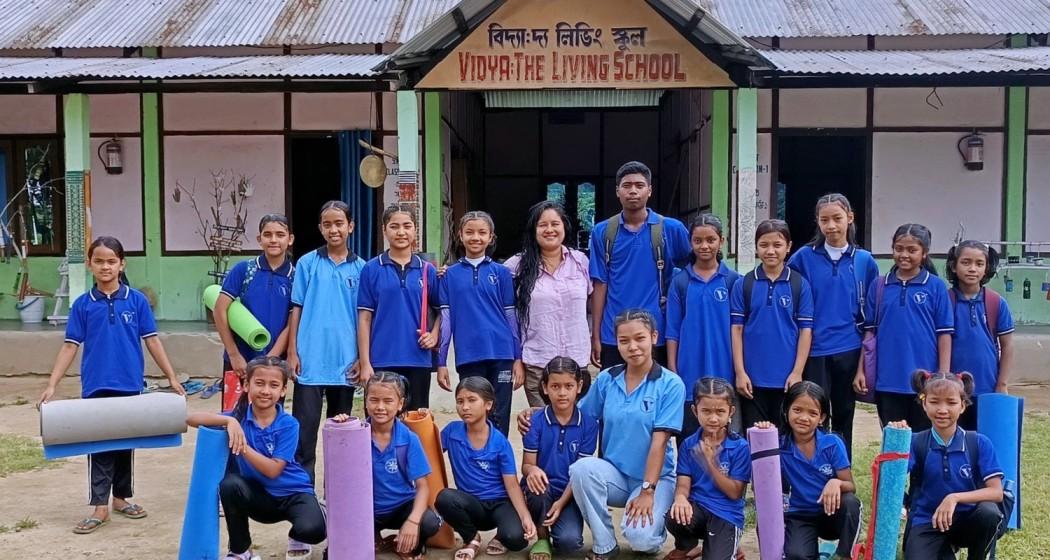
In a remote corner of Assam’s Dhemaji district, close to the Arunachal Pradesh border, an unconventional school is drawing attention for delivering education and social support despite operating without electricity, internet connectivity or all-weather road access.
Founded in 2020 by educator Dr Pranjal Buragohain, Vidya: The Living School in Subahi village has emerged as a refuge for children from some of the region’s most vulnerable communities. The institution currently caters to 189 students, including orphans and children from distressed families.
Located beyond a narrow iron bridge and surrounded by flood-prone terrain, the school remains difficult to access, particularly during the monsoon. Local residents recall a time when students and teachers had to swim across waterlogged stretches to reach the village.
Despite these challenges, the school has developed a distinctive education model that combines academics with practical life skills and community engagement.
More than 30 postgraduate-qualified teachers serve at the institution, many of whom have relocated from different parts of Assam. School authorities said several educators initially arrived for short assignments but chose to stay long-term after becoming involved in the project.
Also read: Guwahati mandates display of driving licences in green buses
Alongside classroom learning, students are trained in activities such as poultry farming, soap-making, weaving using banana fibre and food processing. They also participate in sports including football, volleyball, cricket, taekwondo and yoga, with some competing at the state level.
The school’s open-access library serves residents of around 15 tribal villages in Assam and Arunachal Pradesh, extending educational resources beyond the campus.
Education experts describe such institutions as “living schools”, where learning is integrated with everyday life, environmental awareness and community participation. The model aims to promote social-emotional development alongside academic achievement.
The school’s work has received regional recognition, including an award at the 2025 Sorai Sapori Children and Youth Film Festival for a documentary highlighting its impact on tribal children.
For many students, Vidya represents more than a school. In a region where geography and poverty often limit opportunities, it has become a symbol of resilience, inclusion and the transformative power of education.

 Follow us