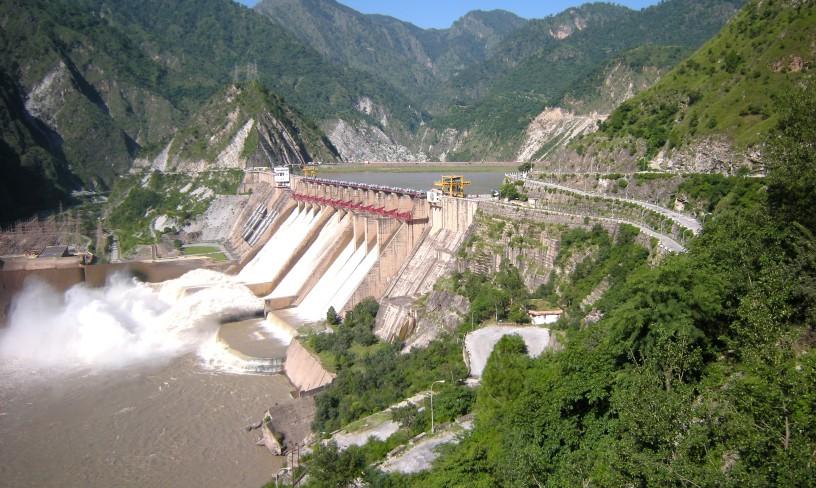
Consequent upon pause in the Indus Waters Treaty framework, India has initiated a major desiltation operation in the Chenab River near the Salal Dam in Jammu and Kashmir. The dredging at the 690 MW Salal Power Station on the Chenab river aims to remove decades of sediment buildup, restore reservoir capacity, and reopen six previously sealed undersluice gates to improve the efficiency of hydropower projects.
Sources said the large-scale desiltation exercise is aimed at improving water flow efficiency and enhancing the operational capacity of the hydroelectric project. The buildup of silt over the years had significantly reduced the reservoir’s storage efficiency and power generation potential.
Three different processes are being followed for improving the reservior capacity of the Salal hydropower station reservior, enhancing it from 9.91 Million Cubic Metres (MCM) to 284 MCM, as per the original design. Significantly, the under sluice gates of the dam, plugged with concrete in April 1978, are also likely to be unplugged and tender has been floated for this.
Officials indicated that the move is part of routine river and dam maintenance but gains strategic significance amid the current diplomatic backdrop. The Salal Hydroelectric Project, located in the Reasi district, plays an important role in power generation for the region.With the IWT being put in abeyance on April 23 last year, the government has been taking proactive steps to revive the Salal reservoir through sediment removal, ensuring enhanced reservoir capacity during winters.
Desiltation helps remove accumulated sediment from the riverbed and reservoir area, ensuring smoother water discharge and preventing long-term structural stress on dam infrastructure. Experts note that sediment management is critical for maintaining turbine efficiency and prolonging the lifespan of hydroelectric installations.
While authorities have not issued an elaborate public statement on the scale of the ongoing work, local administrative sources confirmed that machinery and technical teams have been deployed at multiple points near the dam site.The Indus Waters Treaty, signed in 1960 between India and Pakistan with World Bank mediation, governs the sharing of waters of the Indus river system. Developments related to projects on the western rivers, including the Chenab, often draw regional and international attention.

 Follow us