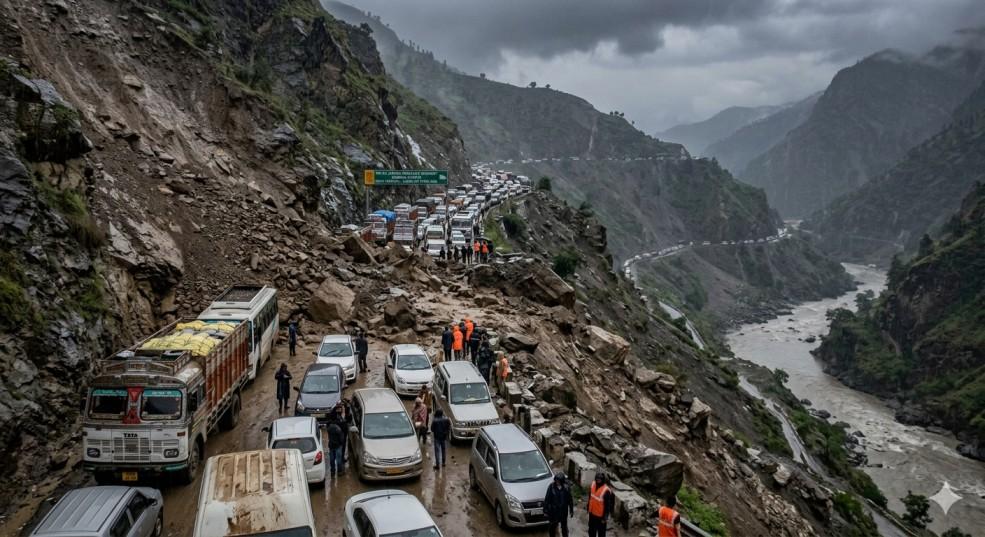
The Jammu-Srinagar National Highway which was reopened on Tuesday morning has been closed again for traffic on Tuesday due to multiple landslides in Ramban district of the UT, a few hours after its restoration.
Traffic authorities had issued advisory last night as regards strict enforcement of lane driving in order to avoid congestion and unnecessary delay in travel hours as a number of vehicles were set for movement from both sides. However, the officials said over 200 vehicles are stranded at different points on the 270-km highway, the only all-weather road in the region.
The highway was reopened for vehicular traffic early Tuesday morning after a day-long closure due to landslides on Monday."Traffic movement has been stopped in both directions — from Jammu towards Srinagar and vice versa — on the highway due to a heavy landslide between Digdol and Khooni Nallah. The road is completely blocked," a traffic police spokesperson said.
He said that people are advised not to travel on the highway until the road is fully restored. "Please don’t pay heed to rumours and check the status of roads on the traffic police Twitter handle, Facebook page and traffic control units." Officials said that work is on to reopen the highway but incessant rains in the Ramban-Banihal sector are making the task difficult.
Traffic department officials said this morning that passenger traffic has been allowed from both sides on the Jammu-Srinagar National Highway (NH-44).Senior Superintendent of Police (SSP), Traffic National Highway, Raja Adil, told reporters that vehicular movement has resumed on the national highway after the restoration of the strategic connectivity.
Pertinently, the nearly 300 km long highway is the lifeline for supplies for the landlocked Valley, as most essentials of life are still brought into Kashmir through this highway.LPG, petrol, diesel, kerosene, mutton, poultry products and vegetables are still brought into the Valley through tankers and trucks despite the fully operational all-weather rail link between Jammu and Kashmir.Unless cargo trains start bringing in essentials of life and carry out fruit, etc., from the Valley to national markets during the peak season, the dependence on the highway will continue.
With massive renovation and restoration carried out by laying new bridges, flyovers and tunnels, the travel time between Srinagar and Jammu has been brought down to five hours from the previous 10 to 12 hours.

 Follow us