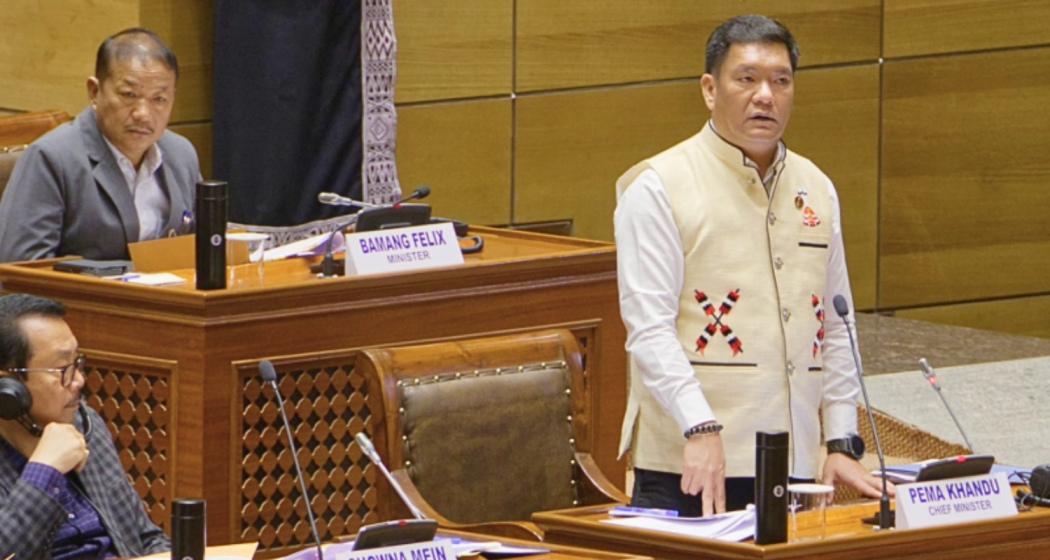
Arunachal Pradesh Chief Minister Pema Khandu on Tuesday said the process of surveying and demarcating the interstate boundary between Arunachal Pradesh and Assam has begun in phases, with the first boundary pillar already erected as part of efforts to resolve the decades-old dispute.
Replying to a written question from BJP MLA Wanglin Lowangdong, Khandu said Pakke-Kessang district has been selected as the first district where boundary pillars are being installed.
According to the chief minister, the demarcation exercise began on 9 February this year, while the first boundary pillar was erected on 27 February.
Khandu told the House that following the Namsai Declaration and the subsequent settlement process, Arunachal Pradesh has registered an overall net territorial gain along its interstate boundary with Assam.
He said the finalised settlement covering eight districts reflects a clear gain in territory for the state.
The chief minister also stated that issues relating to the Tirap sector have already been resolved under the Assam–Arunachal Pradesh MoU 2023 signed by the two state governments on 20 April 2023.
Also read: First Assam-Arunachal border pillar erected
Khandu clarified that the Arunachal Pradesh government has not surrendered any land or forest area to Assam. He said the settlement process was carried out through structured dialogue, joint verification by regional committees of both states and mutual agreement under the Namsai Declaration and the subsequent memorandum of understanding.
He added that the exercise aims to resolve long-pending boundary disputes through consensus, field verification and adherence to constitutional and legal procedures.
The chief minister further informed the Assembly that issues relating to the remaining districts — Kamle district, Papum Pare district, Lower Siang district, Lower Dibang Valley district and Longding district — will be addressed through regional committees set up by both states.
These committees are carrying out joint field verification and ground inspections to examine competing claims based on historical documents, administrative control, traditional usage and prevailing ground realities.
The Namsai Declaration, signed on 15 July 2022 by the chief ministers of the two states, marked a major step towards resolving the decades-old boundary dispute. The agreement initially sought to address disputes involving 123 villages along the interstate border, which was later reduced to 86 following negotiations and joint verification exercises.

 Follow us