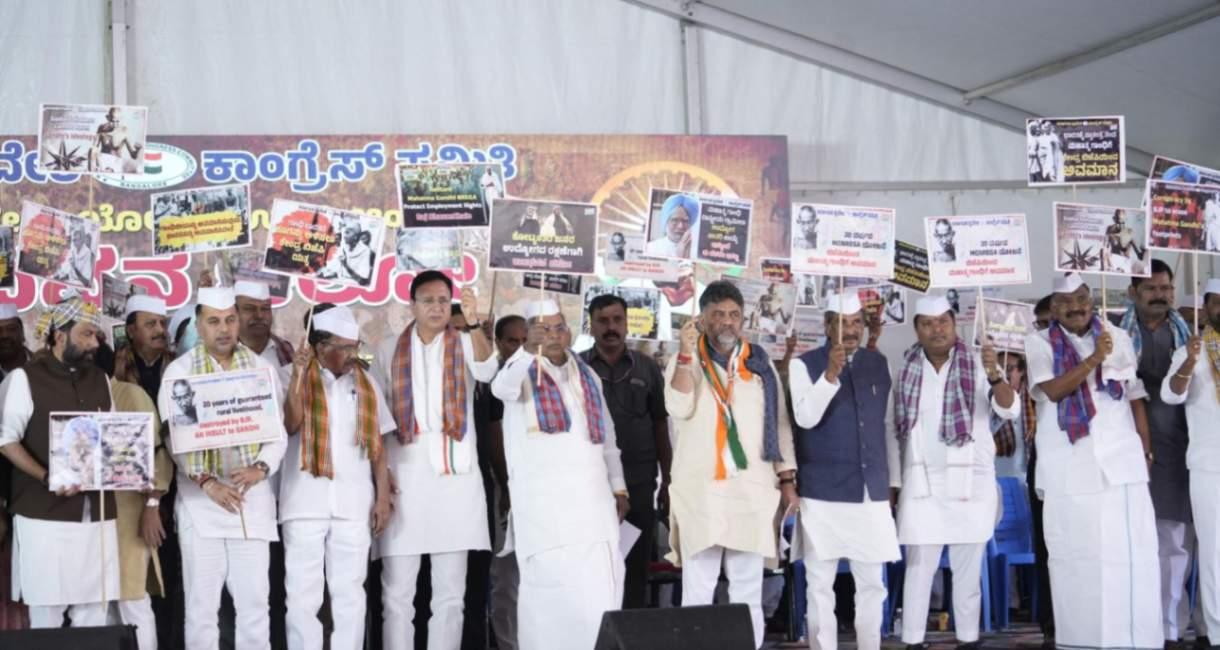
In a major show of political strength, Chief Minister Siddaramaiah and Deputy CM DK Shivakumar led a "Raj Bhavan Chalo" march through the streets of Bengaluru on Tuesday, protesting the Union government's decision to scrap the MGNREGA. Joined by AICC General Secretary Randeep Singh Surjewala and a sea of party workers, the leadership marched toward Lok Bhavan to voice their opposition to the new rural employment scheme, VB-G RAM G, which they claim dismantles a decades-old safety net for the poor.
Siddaramaiah didn't pull any punches during his address, specifically calling out the naming of the new act. He clarified that the 'RAM' in the new scheme has nothing to do with divinity but stands for "Viksit Bharat Guarantee for Rozgar and Aajivika Mission." He argued that while the UPA-era MGNREGA was a legal right to livelihood that empowered local Panchayats, the new system centralises control and strips villages of their autonomy. "By scrapping MGNREGA, the BJP has killed Mahatma Gandhi once again," the CM alleged, claiming that the shift will deprive each Panchayat of nearly ₹1 crore in funding and leave five crore rural workers in the lurch.
The Congress memorandum submitted to Governor Thaawarchand Gehlot highlights several technical and financial red flags. One of the biggest points of contention is the funding shift; under the old law, the Centre covered the full wage bill, but the new rules demand that states shoulder 40 per cent of the cost. The Karnataka leadership argues this is a deliberate move to bankrupt states already struggling with GST and Finance Commission issues. They also flagged the loss of the "demand-driven" nature of the work, meaning the government — not the worker's need — will now dictate when and if jobs are available.
Apart from the financial aspect, the protesters were also very concerned about the "digital-first" strategy in the new law. The protesters felt that the new law would lock out the most vulnerable section of workers, who are illiterate and cannot afford the high-end technology. The memorandum was also critical of the new 60-day "no-work" period in the harvest season, which it said was a divisive strategy that does not take into account the different cycles of agriculture in India. As the bus full of Congress leaders left the Governor's residence, the message was clear: the party intends to take this fight to every village in the state until the original employment guarantee is restored.
Also read: Wine merchants accuse K'taka govt of ₹6,000-crore excise scam

 Follow us