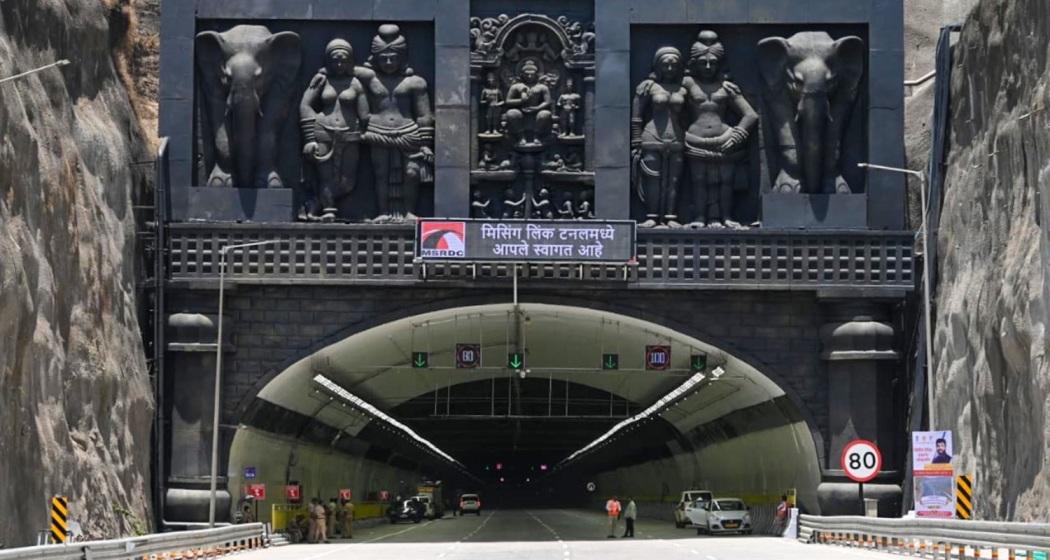
The long-awaited ‘Missing Link’ on the Mumbai–Pune Expressway was inaugurated on Friday by Maharashtra Chief Minister Devendra Fadnavis. The 13.3-km stretch, featuring two tunnels and a cable-stayed bridge, will bypass the 19.8-km Khandala ghat section, cutting the distance by around 6 km and reducing travel time by nearly 25 minutes. The project is expected to significantly ease chronic traffic congestion along the ghat stretch.

The new stretch addresses a long-standing gap in the expressway, where traffic from multiple lanes converged in a difficult terrain marked by sharp curves, steep gradients and frequent slowdowns, particularly during weekends and the monsoon.
Officials said the project shortens the distance between Mumbai and Pune by nearly 6 km and is designed for speeds of up to 100 km per hour, enabling smoother and more predictable journeys.
The development is expected to benefit daily commuters and freight operators by improving travel efficiency, reducing fuel consumption and lowering vehicle wear and tear.
Constructed through the rugged Sahyadri hills, the project comprises tunnels, viaducts and bridges engineered to balance durability with minimal environmental impact.
Also read: Maharashtra to begin digital Census from May 1
A key feature is a cable-stayed bridge over Tiger Valley near Lonavala, rising 183 metres and among the tallest in the country. Its design reduces the need for multiple pillars, helping preserve the surrounding forest landscape.
The project also includes an 8.9-km-long tunnel running up to 180 metres below ground level, with a width of 22.3 metres, making it one of the widest road tunnels.
Safety considerations have been central to the project. The existing ghat section has long been prone to accidents due to its alignment and heavy mixed traffic, with landslides during the monsoon further increasing risks.
The new alignment offers a straighter, controlled-access route, expected to reduce accident rates and improve reliability for motorists.
Estimated at Rs 6,695 crore, the project was first conceptualised in 1995, with formal approval granted in 2017. Construction began in 2019 but faced delays due to the Covid-19 pandemic and challenging terrain conditions.
Advanced engineering techniques, including the New Austrian Tunnelling Method, were used to excavate through basalt rock formations, supported by monitoring systems to ensure safety during construction.
The opening of the Missing Link marks a significant milestone in Maharashtra’s infrastructure development, aimed at strengthening connectivity between Mumbai and Pune and enhancing the efficiency of a key economic corridor.

 Follow us