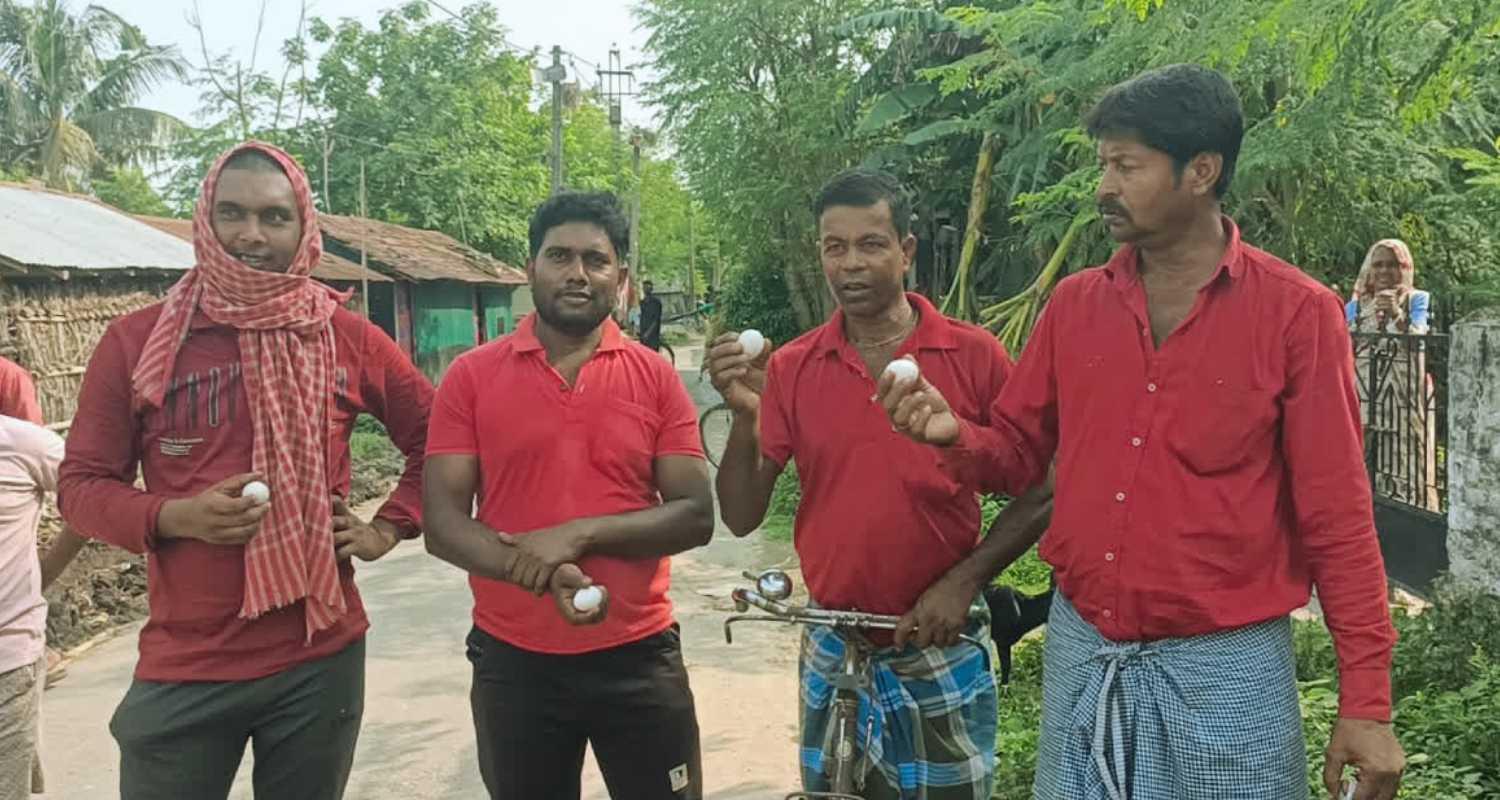
In a state where political symbolism often borders on spectacle, West Bengal has found itself gripped by an unlikely protagonist — the egg. Once a modest, unassuming staple of the Bengali kitchen, it has now been catapulted into the limelight as an instrument of protest, quite literally hurled across the state’s volatile political stage.
From Chandrakona’s bustling markets in West Midnapore to the charged atmosphere of Shantipur in Nadia, the narrative is as curious as it is disconcerting. Rotten eggs, long relegated to waste, have acquired a peculiar utility — repurposed as tools of dissent, their pungency now a political statement. But beneath the theatrics lies a more grounded concern — a tangible surge in prices that is unsettling both traders and consumers.
In the span of a mere fortnight, the cost of this once-affordable protein has edged upwards with surprising velocity. Eggs that recently sold for Rs 6-Rs 6.50 now command Rs 7-Rs 7.50 apiece, while a tray has leapt from Rs 180–Rs 185 to nearly Rs 210. For a commodity that traditionally served as the last refuge of financially strained households—a reliable companion to rice in times of austerity—this escalation is nothing short of jarring.
Traders in Chandrakona offer an explanation that straddles the line between incredulity and conviction. The burgeoning trend of what some wryly term “egg therapy” is, they claim, exerting unusual pressure on the market. Eggs are no longer purchased solely for consumption; they are being stockpiled, sorted, and in many cases deliberately left to rot in preparation for political demonstrations. Demand, therefore, is no longer dictated purely by appetite but by agitation.
The phenomenon was on vivid display in the Gayeshpur Gram Panchayat area of Shantipur, where political tensions have simmered for years. On Friday, BJP workers assembled outside the Panchayat building—not with placards or slogans, but with eggs in hand, poised to deliver an “egg welcome” to the Trinamool Pradhan, Shyamal Ghosh. The Pradhan, however, remained conspicuously absent, and the anticipated spectacle dissolved into a tense stalemate under the watchful eye of a police contingent that swiftly intervened to prevent escalation.
The political backdrop only deepens the intrigue. Gayeshpur Panchayat, once under BJP control, witnessed a dramatic shift when its Pradhan defected to the Trinamool Congress, altering local power equations. Against this shifting terrain, even the simplest objects seem to acquire symbolic weight—and in this case, market consequences.
Yet, not all observers are willing to attribute the price surge solely to political theatrics. Some point to more prosaic factors: a dip in production triggered by oppressive summer heat, tightening supply chains, and the familiar mechanics of demand and scarcity. In a market as sensitive as that of essential food items, even marginal disruptions can produce disproportionate effects.
For the average consumer, however, the cause offers little comfort. The impact is immediate and unambiguous. “Eggs were once the poor man’s protein,” laments Lakshmikanta Pan, his frustration echoing a broader sentiment. “Now, one hesitates before buying them. You switch on the television and see trays of eggs being carried to rallies—and we are the ones footing the bill.” Gour Adhikari, a trader, voices a similar irony, observing that eggs seem to be migrating from kitchens to political arenas with unsettling frequency.
Ironically, large-scale incidents of such ‘egg protests’ remain sporadic in districts like West Midnapore. Yet, perception — often as potent as reality — has already seeped into the market psyche. Traders insist that even limited political usage, amplified by visibility and speculation, is sufficient to distort demand patterns.
Thus, the egg finds itself suspended between two worlds—the quotidian familiarity of the frying pan and the charged symbolism of political confrontation. It is a transformation both absurd and revealing, underscoring how even the most ordinary commodities can be swept into the vortex of public discourse.

 Follow us