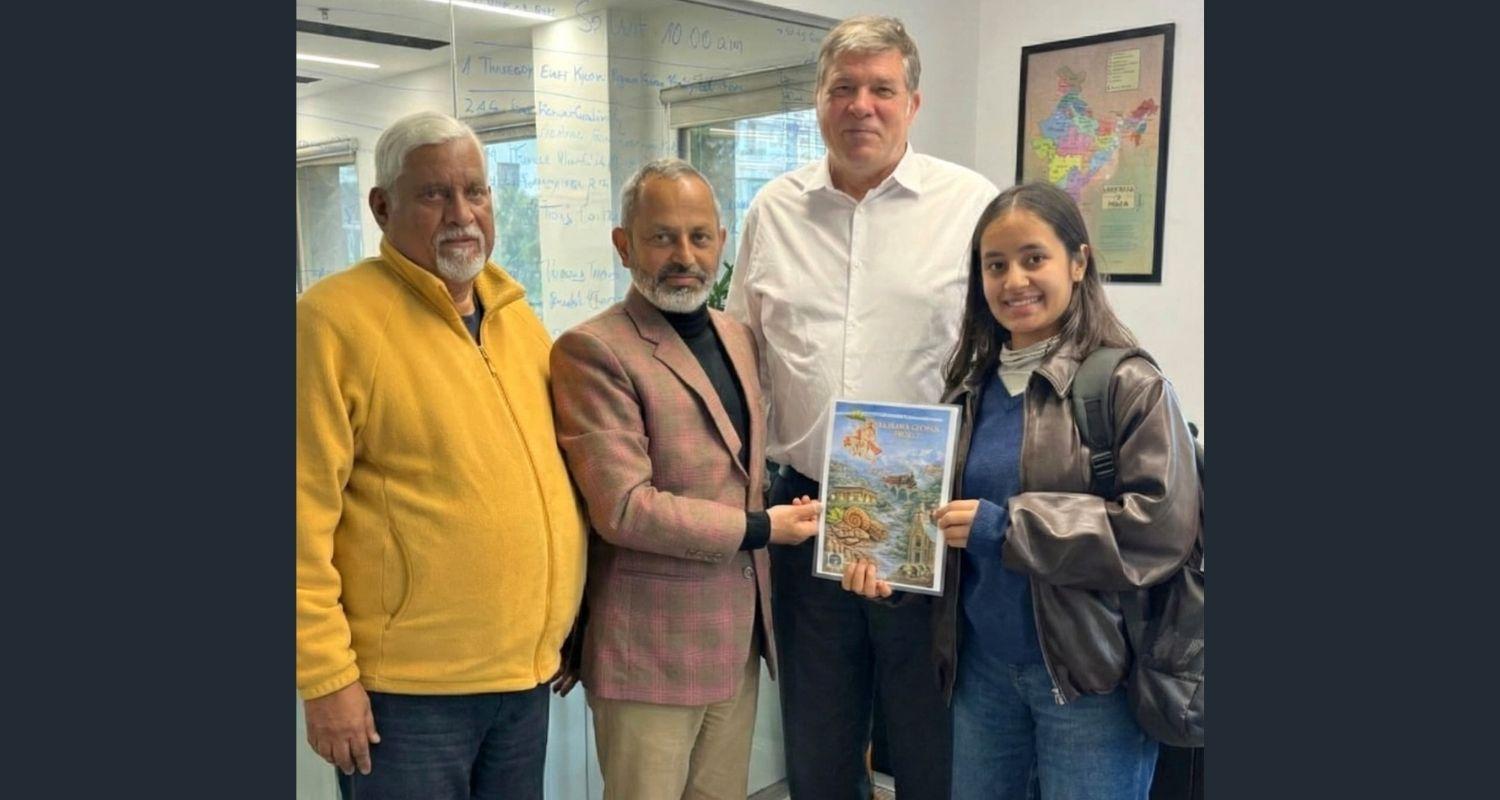
A major step towards the recognition of Kasauli as a UNESCO Global Geopark was taken during a high-level meeting held at the UNESCO Office, New Delhi with Benni Böer, UNESCO Programme Specialist, Natural Sciences Unit, responsible for Bangladesh, Bhutan, India, Nepal, Maldives, and Sri Lanka.
The meeting focused on the proposed inclusion of Kasauli (Himachal Pradesh) in the UNESCO Global Geoparks Network, highlighting its outstanding geological heritage, fossil wealth, cultural history, and potential for sustainable and inclusive development.
The delegation was led by Dr Ritesh Arya, a noted geologist and Founder of the Tethys Fossil Museum, Dangyari, Kasauli (Himachal Pradesh) along with Manmohan Khanna, Chairman, Indian Institute of Architects (Chandigarh Chapter) and consultant to the museum and Aamodini Arya, intern and design associate for the museum. A specially curated souvenir of the proposed Kasauli Geopark was presented to Böer during the meeting.
During the hour-long interaction, Dr. Arya presented the holistic vision of the Kasauli Geopark, integrating traditional wisdom with geology, geoheritage, history, mythology, culture, sustainable tourism and socio-economic empowerment of surrounding villages, with a strong emphasis on experiential learning and education through direct engagement with nature.
Dr Aamodini Arya emphasised that the complex and abstract geological concepts showcased in the museum must be simplified and made engaging for diverse audiences. She highlighted the use of animation, visual narratives, and storytelling to communicate Earth science effectively, in alignment with the National Education Policy (NEP) 2020, which promotes experiential, multidisciplinary, and learner-centric learning.
Manmohan Khanna, consultant to the museum, stated that the design and architecture of the geopark and museum infrastructure should remain rooted in traditional wisdom and harmony with nature. He emphasised the extensive use of local materials, climate-responsive design, and architectural elements reflecting the traditional Pahari style, ensuring that built structures blend seamlessly with the landscape while preserving the cultural identity of the region.
Dr Arya further stated that he has been collecting fossils in and around Kasauli since 1987 and has long advocated for the preservation of fossil sites in the region. He noted that his sustained efforts led to the preservation of a rare 20-million-year-old fossilised tree at Jagjitnagar, now recognised as an important geoheritage asset. However, he expressed concern that many fossil sites have been irreversibly lost due to road widening, construction of retaining walls, and rapid expansion of human settlements.
He emphasised that establishing geoparks is critical for safeguarding remaining fossils and rock formations, which are vital for reconstructing Kasauli’s paleo-environment nearly 20 million years ago, when the region was influenced by warm, humid, near-coastal vegetation, markedly different from today’s pine-dominated landscape at approximately 2,000 metres above sea level.
Dr Arya also highlighted the role of the Tethys Fossil Museum, which houses more than 500 fossils and stone tools from different parts of Himachal Pradesh, Ladakh, and Haryana, providing visitors with first-hand scientific insight and a holistic understanding of ancient life in the region. He stressed that while museums serve as vital repositories of knowledge, in-situ identification and preservation of fossil sites through geoparks would offer children unparalleled experiential learning opportunities and significantly boost local tourism, thereby strengthening education, conservation, and community livelihoods simultaneously.
Speaking during the meeting Böer observed that UNESCO has been providing invaluable long-term support for the coordination and establishment of UNESCO Global Geoparks in India over the past four years. India now has all the essential components in place to begin identifying and nominating sites, including through the coordination committee under the Ministry of Mines. India boasts an exceptional pool of professionals across various regions, a rich geo-heritage spanning its diverse states and territories, and a tremendous opportunity to approach this initiative in a coordinated and systematic way.
Establishing UNESCO Global Geoparks in India would yield numerous benefits, including economic, recreational, and educational advantages, as well as advancements in geo-heritage conservation, geo-ethics, and geo-tourism.”
Böer expressed appreciation for the progress made on the Kasauli proposal and agreed to act as an observer in the proposed working group being constituted to take the initiative forward. He further emphasised the importance of international collaboration, knowledge exchange, and capacity building, and encouraged integration with the UNESCO Global Geoparks Network.
The meeting marks a significant milestone in India’s journey towards global recognition of its geoheritage and positions Kasauli as a strong future contender for UNESCO Global Geopark status, with far-reaching benefits for conservation, education, tourism, and local livelihoods. Ends

 Follow us