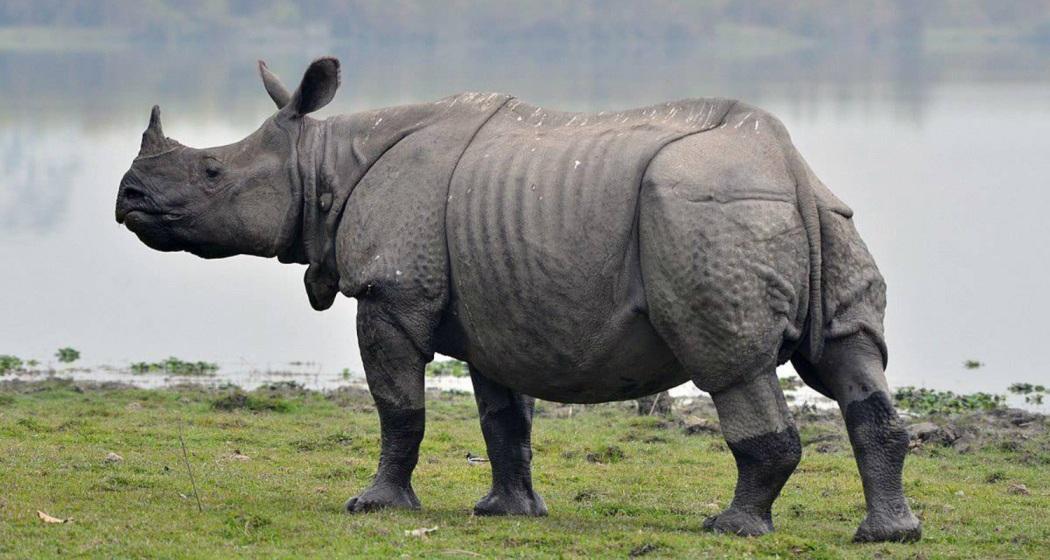
A new scientific study has mapped how Assam’s Kaziranga National Park evolved into the world’s most significant refuge for the Indian one-horned rhinoceros, linking the species’ survival to long-term climate stability and ecological change in northeastern India.
The research, conducted by scientists from the Birbal Sahni Institute of Palaeosciences (BSIP), an autonomous institute under the Department of Science and Technology, reconstructs Kaziranga’s ecological history over the past several millennia using palaeoecological evidence from wetland sediments inside the park.
The team extracted a sediment core measuring just over a metre in length from the Sohola swamp in Kaziranga. The layered mud preserved microscopic pollen grains from plants and fungal spores associated with animal dung, allowing researchers to trace past vegetation patterns and the presence of large herbivores, including rhinoceroses.
Published in the journal Catena (Elsevier), the study shows that Kaziranga’s present grassland-dominated landscape is markedly different from its earlier ecological phases. The findings indicate that megaherbivores, including the Indian rhinoceros, gradually disappeared from northwestern India during the late Holocene period, particularly during the Little Ice Age, due to climatic deterioration and rising human activity.
Also read: Kaziranga fast becoming haven for Royal Bengal tigers
In contrast, northeastern India remained relatively climatically stable over the last nearly 3,300 years. This stability, combined with lower levels of human pressure, created favourable conditions that enabled rhinoceroses to move eastward and eventually establish stable populations in the Brahmaputra floodplains, including present-day Kaziranga.
Fossil records cited in the study show that the Indian one-horned rhinoceros was once widely distributed across the Indian subcontinent. However, its range contracted sharply after the Holocene, driven by habitat loss, increasing aridity, intensified hunting and expanding human settlements in northwestern regions.
The research explains that as grasslands and wetlands declined elsewhere, Kaziranga’s mosaic of floodplain grasslands, wetlands and forests offered a resilient refuge that supported large herbivores. The sustained presence of megaherbivores, in turn, shaped vegetation structure, reinforcing a landscape suited to rhinoceroses.
By linking climate change, vegetation dynamics and palaeoherbivory, the study provides new insights into how long-term environmental processes influence wildlife survival, migration and extinction. It also underlines why Kaziranga emerged as a global stronghold for the Indian one-horned rhinoceros while populations vanished across much of the subcontinent.
The findings add to scientific understanding of conservation landscapes, highlighting the importance of long-term ecological stability in sustaining endangered species.

 Follow us