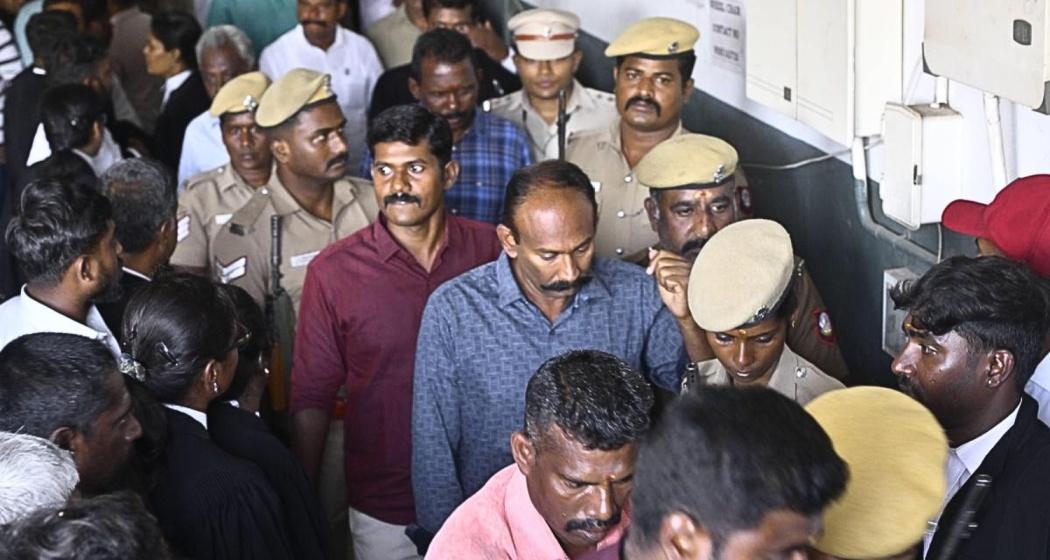
In a landmark verdict, a sessions court in Madurai on Monday sentenced nine policemen to death for the custodial torture and murder of a father-son duo in Tamil Nadu’s Sathankulam in 2020, a case that had sparked nationwide outrage.
The First Additional District and Sessions Court held the nine accused guilty of the murders of P. Jeyaraj and his son J. Beniks, describing the crime as grave and brutal. The court awarded the death penalty to all convicts, marking one of the rare instances in India where multiple police personnel have been handed capital punishment in a custodial death case.
The case dates back to June 2020, when Jeyaraj and Beniks, both traders, were arrested by police in Thoothukudi district for allegedly violating COVID-19 lockdown restrictions by keeping their shop open beyond permitted hours.
They were subsequently subjected to severe custodial torture, leading to Beniks’ death on June 22, followed by Jeyaraj’s death the next day. The incident triggered widespread protests across Tamil Nadu and the country, drawing attention to issues of police brutality and custodial violence.
Also read: Bihar: 3 docs suspended for falsify custodial death post-mortem
Following public outrage, the case was transferred to the Central Bureau of Investigation (CBI), which filed charges against multiple police personnel, including an inspector, sub-inspectors, head constables, and constables.
On March 23 this year, the Madurai court convicted all nine accused of murder after nearly six years of trial proceedings. The prosecution had argued that the case fell under the “rarest of rare” category, warranting the maximum punishment, citing the extent of torture inflicted on the victims.
The defence, however, sought leniency, arguing for the possibility of reformation. The court, after considering submissions from both sides and reports on aggravating and mitigating circumstances, pronounced the death sentence on Monday.
The verdict is being seen as a significant moment in the fight against custodial violence in India, reinforcing accountability within law enforcement agencies. The case had come to symbolise systemic concerns over abuse of power and lack of safeguards in police custody.

 Follow us