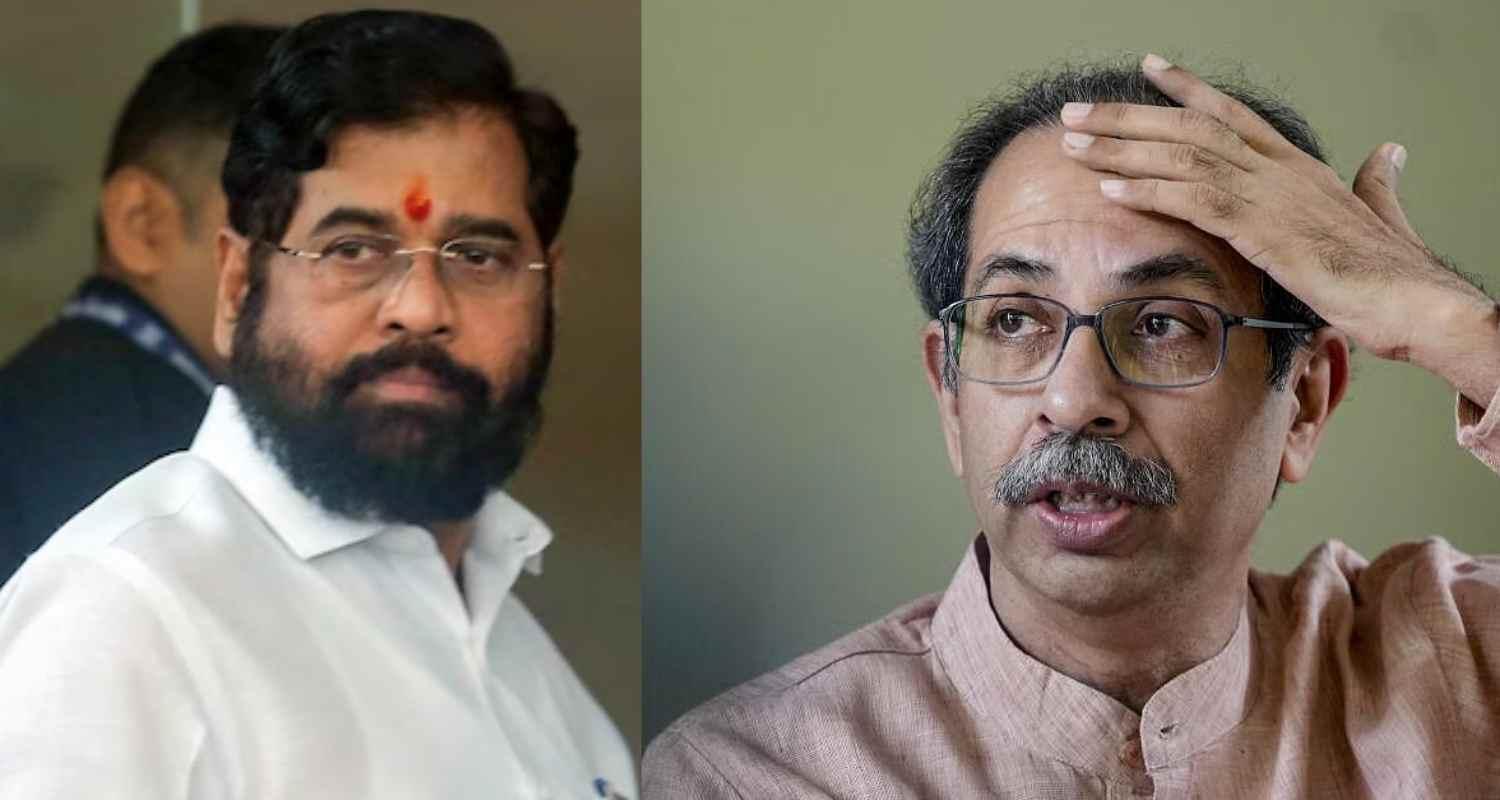
The Supreme Court on Tuesday heard the petitions challenging the Maharashtra Assembly Speaker's refusal to disqualify MLAs of the Eknath Shinde-led faction of the Shiv Sena under the Tenth Schedule of the Constitution, with the Uddhav Thackeray faction arguing that a split in the legislative wing cannot, by itself, be treated as a split in the political party. Senior advocate Kapil Sibal, appearing for Shiv Sena (UBT), submitted that the Election Commission of India (ECI) could exercise jurisdiction under Paragraph 15 of the Election Symbols (Reservation and Allotment) Order only if there was a split in the political party resulting in two rival groups.
Paragraph 15 of the Election Symbols (Reservation and Allotment) Order, 1968 empowers the ECI to decide disputes when rival groups or factions of a recognised political party claim the party's name and election symbol. The decision of the Commission is binding on all rival sections. A separate meeting of the legislative party, he argued, could not constitute such a split.
"The Election Commission says that the indicator of the emergence of a split in Shiv Sena was the holding of a separate meeting of the legislative party. Holding of a separate meeting of the legislative party can never amount to a split in the party," Sibal submitted.
A bench of Chief Justice of India Surya Kant and Justices Joymalya Bagchi and V Mohana was also hearing a separate petition challenging the Election Commission of India's decision recognising the Shinde faction as the official Shiv Sena. Appearing for the Uddhav Thackeray faction, Sibal argued that the statutory scheme distinguished between a political party and its legislative wing.
Referring to Section 29A of the Representation of the People Act and the Election Symbols Order, Sibal submitted that the requirement of a split had to be satisfied at the level of the original political party. Sibal also attacked the ECI's reliance on the Shiv Sena's 2018 constitution while simultaneously accepting the Shinde faction's contention that the constitution was undemocratic. He submitted that this was an opportunistic position because the Shinde faction had itself obtained benefits under the 2018 Constitution before challenging its validity.
"This was the first time they (Shinde group) took the position that the 2018 Constitution was undemocratic. If that Constitution was undemocratic, then every benefit they received under it was equally undemocratic. Their election to the legislature was undemocratic. Their appointment as Ministers was undemocratic. It was opportunistic to do so," Sibal said.
The ECI, according to Sibal, could not use the proceedings under Paragraph 15 to determine whether the party constitution itself was democratic.
"ECI is only a tribunal. It can't decide the democratic or undemocratic nature of the constitution," he said.
Sibal submitted that even if the party constitution was considered undemocratic, the consequence could only be action concerning the party's registration and not transfer of its electoral symbol to a faction that was itself a creature of the same organisational structure.
"If I assume my party constitution was undemocratic, what is the consequence? It is de-registration. There is no other power. The other faction is a creature of the same constitution. How does the symbol go to him?" he asked. Sibal further argued that the ECI guidelines concerning organisational democracy, relied upon against the Thackeray faction, were framed for registration of political parties and were not retrospectively applicable to parties already registered before the guidelines came into force.
He submitted that the Shiv Sena had never been issued a notice seeking its de-registration on the ground that its constitution did not comply with the guidelines. Sibal invoked the fundamental right to form associations under Article 19(1)(c) of the Constitution, arguing that a political party, being a voluntary association, is entitled to function in accordance with its own constitution and rules.
He referred to decisions concerning cooperative societies and other associations, submitting that once an association is constituted and adopts its own rules, it is entitled to function in accordance with those rules. A person who does not wish to remain part of the association, he said, is free to leave, while making the submission in the context of the challenge concerning the internal structure and functioning of the Shiv Sena.
"I am only flagging this issue," Sibal said, while cautioning against a situation where an association is declared "autocratic" and, on that basis, its constitution is held impermissible without notice or due process.

 Follow us