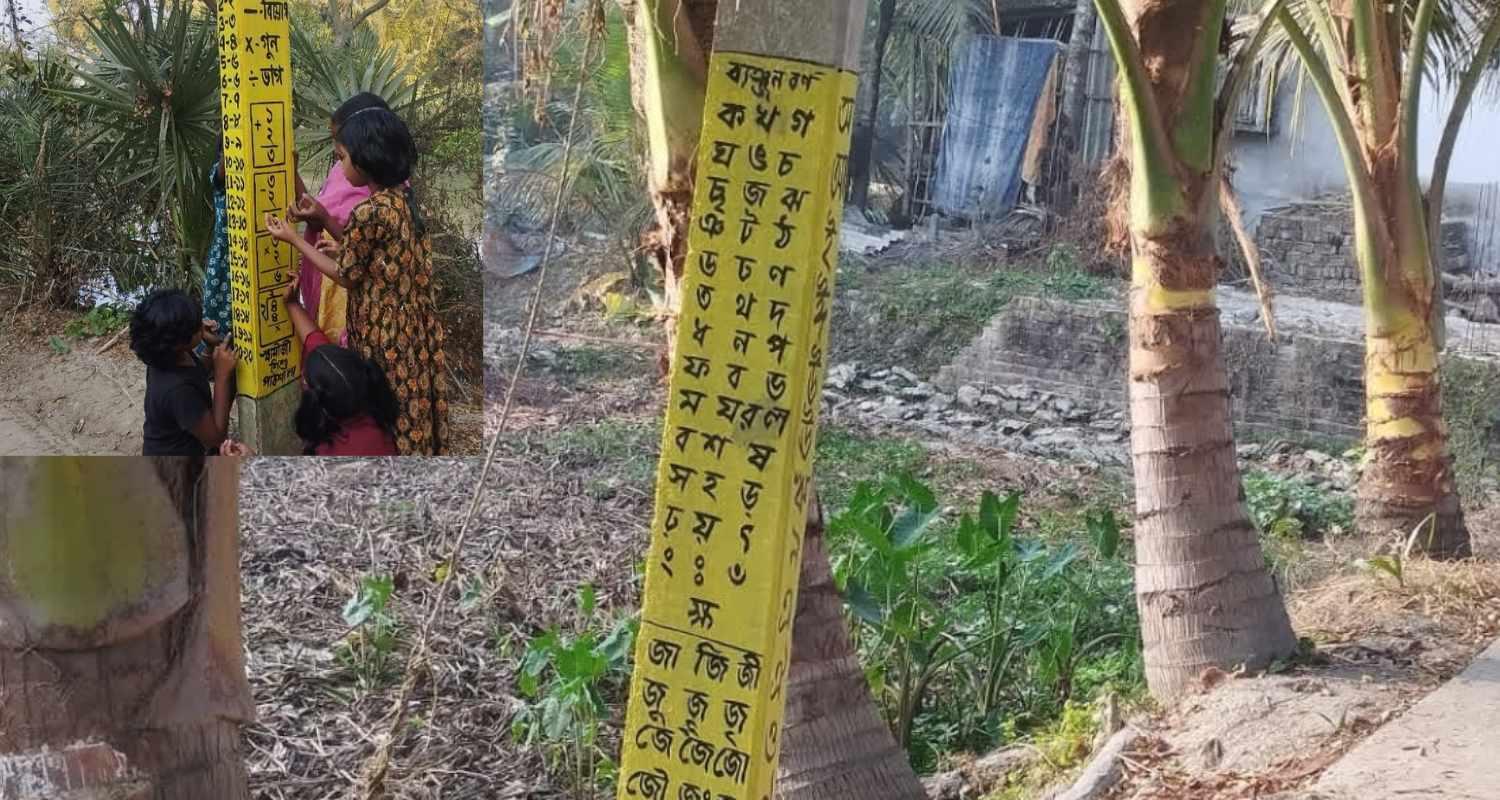
In the fragile, salt-tinged landscape on the fringes of the Sundarbans, where survival often overshadows aspiration, a quiet revolution in learning is unfolding. In Deulbari village under Kultali, South 24 Parganas, a stretch of roadside electric poles has been transformed into an open-air classroom, carrying the timeless imprint of Ishwar Chandra Vidyasagar’s educational philosophy.
Nearly 40 to 45 electric poles lining the village road now stand adorned with vibrant inscriptions from Barna Parichoy, the foundational Bengali primer authored by Vidyasagar. Bengali alphabets bloom in bright colours, accompanied by English numerals and elementary mathematical symbols—addition, subtraction, multiplication, and division. What was once a neglected roadside has become a living corridor of knowledge, where every step doubles as a lesson.
At the heart of this transformation is Pulak Mandal, a resident whose vision has redrawn the village’s educational landscape. For years, the poles stood as silent witnesses to neglect, overrun by weeds, defaced by torn posters, and surrounded by debris. Mandal chose to reclaim them—not with protest, but with a paintbrush.
”With the support of fellow villagers, the posts were first cleaned and restored. Then came the colours. Letters, numbers, and symbols emerged one by one, turning dull concrete into vibrant vessels of learning,” said Mandal.
For parents like Minti Bhuiyan, the change has been profound. “Earlier, these poles meant nothing to us. Now, as we walk our children to school, they stop to read letters and count numbers. The road itself has become a teacher,” she said. What was once an ordinary walk has evolved into an interactive ritual of discovery.
The initiative, aptly named ‘One Taka Pathshala’, draws inspiration from a powerful anecdote in Vidyasagar’s childhood—his habit of learning English numerals by reading milestones along the roadside. That legacy now lives on in Deulbari, where forgotten infrastructure has been reimagined as an educational lifeline.
For the village’s youngest learners, the impact is immediate and visible. Curiosity has replaced indifference. Letters once confined to textbooks now greet them under the open sky. Education has stepped beyond the classroom, embedding itself into the rhythm of daily life.
Villagers, too, have embraced the initiative with pride. Many believe it has created a culture where learning feels accessible, natural, and constant. In a region where resources are scarce but resilience runs deep, this effort stands as a testament to the transformative power of collective will.
Deulbari’s painted poles carry a message far greater than alphabets and numbers. They affirm that education does not depend on walls, wealth, or formal spaces. Sometimes, all it takes is vision, determination, and the courage to turn an ordinary road into a pathway of enlightenment.
By Pranab Mondal

 Follow us