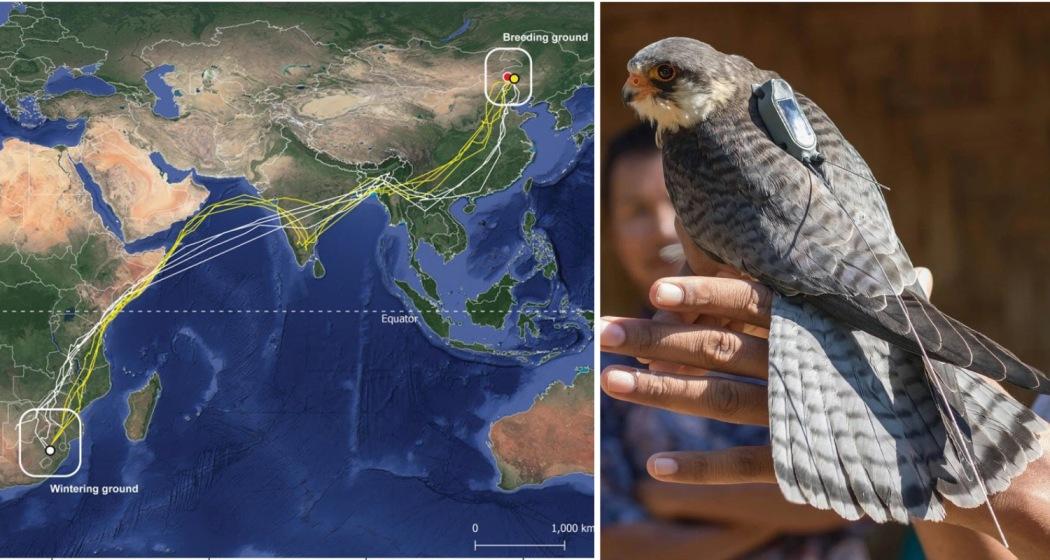
Three Amur falcons tagged with satellite transmitters in Manipur in November 2025 have successfully completed their transcontinental migration to Africa within nine to ten days and are reported to be healthy and active, scientists confirmed on Thursday.
The tagging was conducted on November 8, 2025, under Phase II of the Manipur Amur Falcon Tracking Project by the Manipur Forest Department in collaboration with the Wildlife Institute of India. The three falcons, Ahu, Alang and Apapang, were released from the Chiuluan roosting site in Tamenglong district by a joint team of scientists, officials of the Tamenglong Forest Division and volunteers from Chiuluan village.
Dr R. Suresh Kumar of the Wildlife Institute of India, Dehradun, said in the latest update that all three birds are active and doing well at their respective wintering grounds in Africa.
According to the latest satellite data, Ahu is currently in Somalia, Apapang in Zimbabwe and Alang in Botswana. Earlier concerns had been raised regarding Ahu’s movement, but subsequent tracking inputs confirmed that the bird is making localised movements within Somalia and remains safe.
Also read: Manipur steps up to protect falcons flying 22,000 km from Siberia
Officials said the falcons reached Africa in a record span of nine to ten days after leaving Manipur, underscoring the extraordinary endurance of the species. The ongoing tracking initiative aims to generate scientific data on migratory routes, stopover sites and behavioural patterns to strengthen conservation strategies for the Amur falcon.
The Manipur initiative builds on earlier tagging efforts. During the previous wintering cycle, a tagged falcon from Chiuluan began its northward migration to its breeding grounds on April 14, 2025, providing valuable insights into return routes and seasonal timing. Phase I of the tracking programme had similarly documented the birds’ passage across the Indian subcontinent, the Arabian Sea and parts of eastern and southern Africa.
The Amur falcon’s migration, one of the longest undertaken by any raptor, spans thousands of kilometres from breeding grounds in eastern Asia to wintering sites in southern Africa. Manipur, particularly Tamenglong district, has emerged as a key stopover site during the birds’ southbound journey.

Conservation efforts in the region have gained momentum over the past decade, transforming former hunting hotspots into community-led protection zones. Scientists believe sustained tracking and community participation will be critical in ensuring the long-term survival of the species.

 Follow us