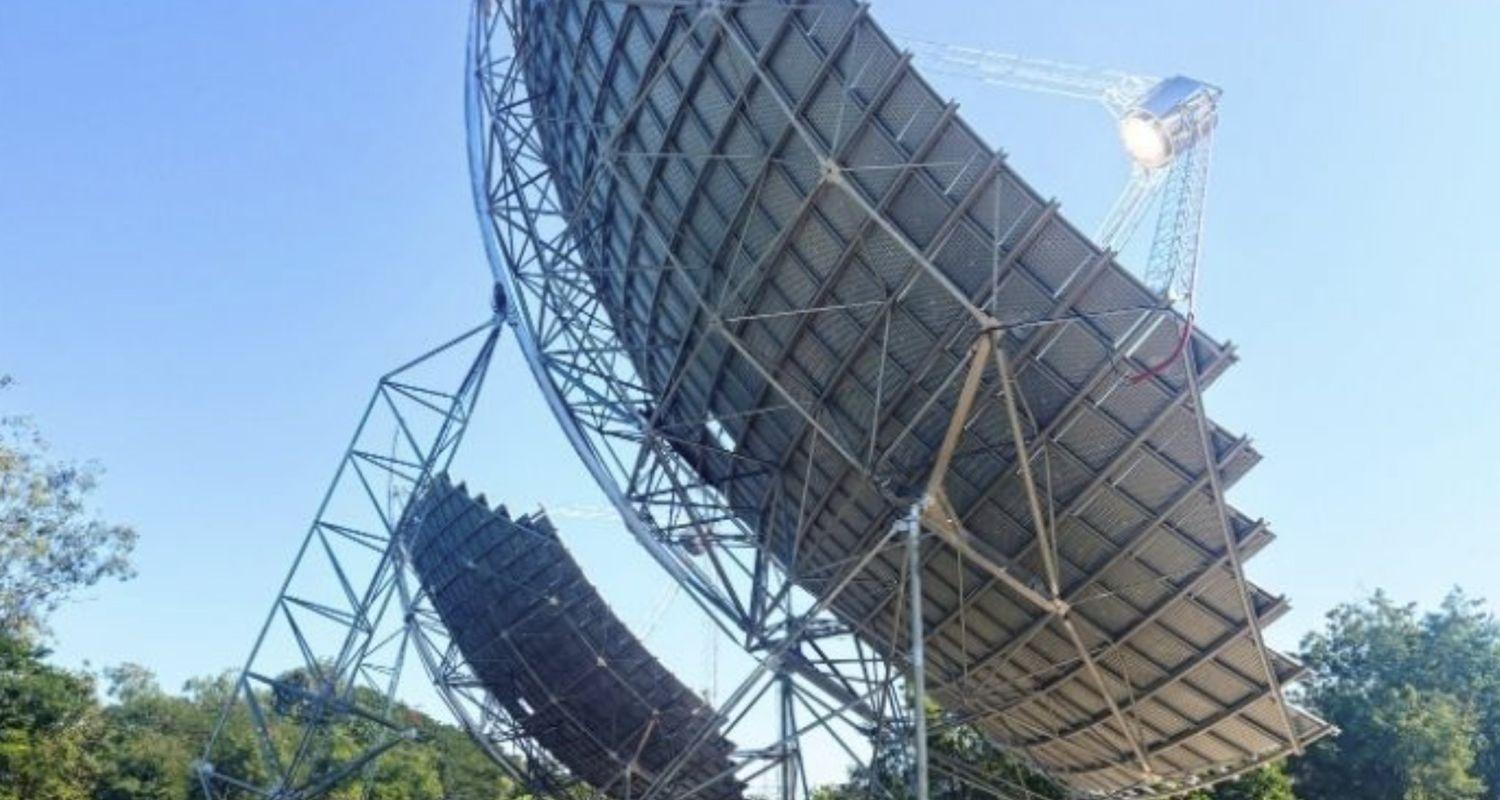
In a significant boost to India’s clean energy ambitions, the world’s largest solar dish — based on advanced solar concentrator technology — has been installed at Muni Seva Ashram in Goraj near Gujarat’s Vadodara. The state-of-the-art installation is capable of cooking food for nearly 2,000 people every day and running a 100-ton air-conditioning plant, while virtually eliminating the use of conventional gas and electricity.
Spanning an area of 500 square metres and standing as tall as a seven-storey building, the massive solar dish uses around 300 precisely aligned mirrors to concentrate sunlight onto a single focal point. This generates temperatures as high as 1,700 degrees Celsius, producing high-pressure steam that can be used for cooking, air conditioning, laundry, sterilisation and hot water requirements— particularly beneficial for large institutions such as hospitals and ashrams.
The introduction of this environment-friendly technology marks a major shift for Muni Seva Ashram, which earlier consumed nearly 1,000 kilograms of firewood every day. The transition to solar steam is expected to completely eliminate the use of wood, sharply reducing carbon emissions and operational costs while creating a safer and more sustainable environment.
Explaining the impact of the project, Dr Vikrambhai of Muni Seva Ashram said the compact land requirement of the solar dish makes it ideal for hospitals and similar facilities. “Earlier, our air-conditioning systems depended on electricity and gas. Now, the entire system runs on steam generated by solar energy. No gas will be used and no air will be polluted,” he said. One solar dish alone can operate a 100-ton AC plant, significantly cutting energy expenses.
Currently, two such solar dishes are operational at the ashram, together providing an air-conditioning capacity of 200 tons. Over the long term, the technology is expected to bring substantial economic savings, allowing the institution to expand and improve its facilities.
Deepak Gadhia, who spearheaded the introduction of this cutting-edge system, said the technology was originally sourced from Australia but has now been fully developed and manufactured in India. “This is the world’s largest solar dish and the first of its kind to be built in India,” he said, adding that the innovation positions the country as a global leader in solar concentrator applications.
The dish is designed to track the sun throughout the day, rotating in both directions much like a sunflower. Its fully automated system uses software that factors in the site’s latitude and available space to optimise alignment with the sun. Safety features are also built in—the system automatically shuts down during strong winds to prevent damage. The installation is IBR-approved, requiring only routine monitoring by an operator.
The project has received financial support of ₹1.6 crore from the Rotary Club of Bombay Pier, underlining the role of civic institutions in promoting sustainable innovation. Experts believe the success of the Vadodara installation could serve as a replicable model for hospitals, religious institutions, community kitchens and industrial units across the country.
More than just an ashram-level initiative, the solar dish project demonstrates how indigenous clean technology can dramatically cut energy costs, reduce carbon emissions and contribute to India’s broader goals of sustainability and energy self-reliance.
Also read: Gujarat hosts world’s biggest water conservation meet

 Follow us