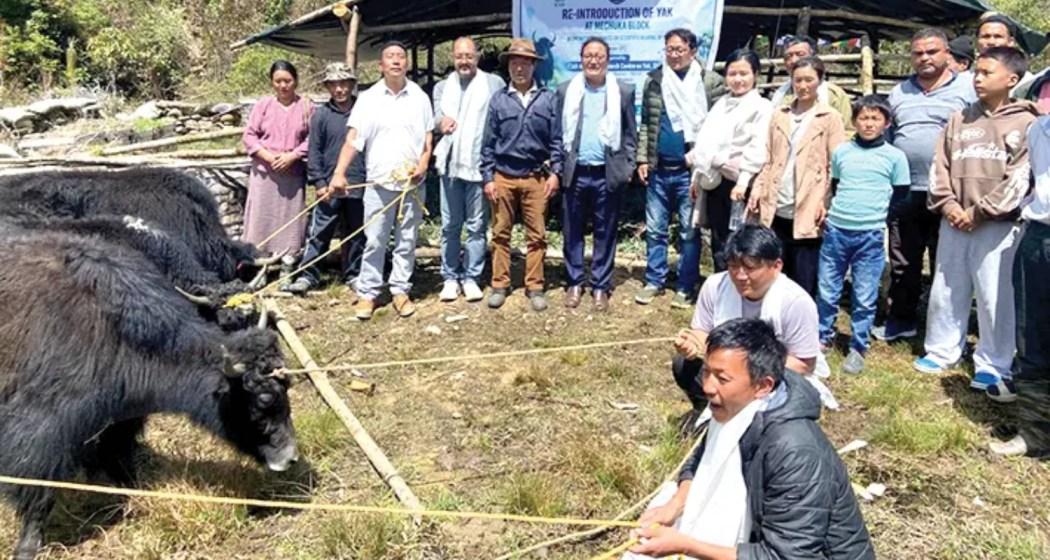
The Arunachal Pradesh government has initiated a yak reintroduction drive in the remote Mechuka region, seeking to revive traditional livestock practices and generate sustainable livelihood opportunities for tribal communities in the high-altitude belt of Shi-Yomi district.
As part of the programme, six yaks, four females and two males, were distributed among selected farmers on Friday. The move is aimed at restoring yak-based income systems in an area where the population of the animal has declined steadily over the years, affecting traditional pastoral livelihoods.
The initiative also covered 45 farmers through awareness sessions on scientific yak rearing. These sessions focused on improving breeding practices, disease management, nutrition, and shelter, ensuring that the reintroduction effort is not merely symbolic but economically viable in the long run. Input support has been extended under the Scheduled Tribe Component (STC) to enhance productivity and strengthen the sustainability of yak farming.
The drive is being implemented by the ICAR-National Research Centre on Yak (NRCY), Dirang, under the leadership of director Mihir Sarkar, in collaboration with the Jomlo Mongku Mithun Farmers Federation (JMMFF) and the state Animal Husbandry Department.
Also read: First Assam-Arunachal border pillar erected
Yak rearing has historically been central to the subsistence economy of high-altitude tribal communities in Arunachal Pradesh. The animals are uniquely adapted to harsh mountainous terrain and cold climates, making them an ideal livestock choice for regions like Mechuka. They provide multiple sources of income and sustenance, including milk, meat, wool, and transport.
Yak milk is used to produce butter, cheese, and other value-added products that fetch premium prices in niche markets. Yak wool is utilised for making traditional clothing and handicrafts, while their dung serves as an important source of fuel and manure. In addition, yaks are used as pack animals in difficult terrains, supporting both agriculture and local trade.
Officials noted that reviving yak rearing could help reduce migration by creating stable, location-specific livelihoods. By combining traditional knowledge with scientific practices, the programme aims to make yak farming a reliable and profitable occupation for tribal households.
The initiative is expected to strengthen rural incomes while preserving indigenous practices, offering a model for sustainable development in ecologically fragile, high-altitude regions.

 Follow us