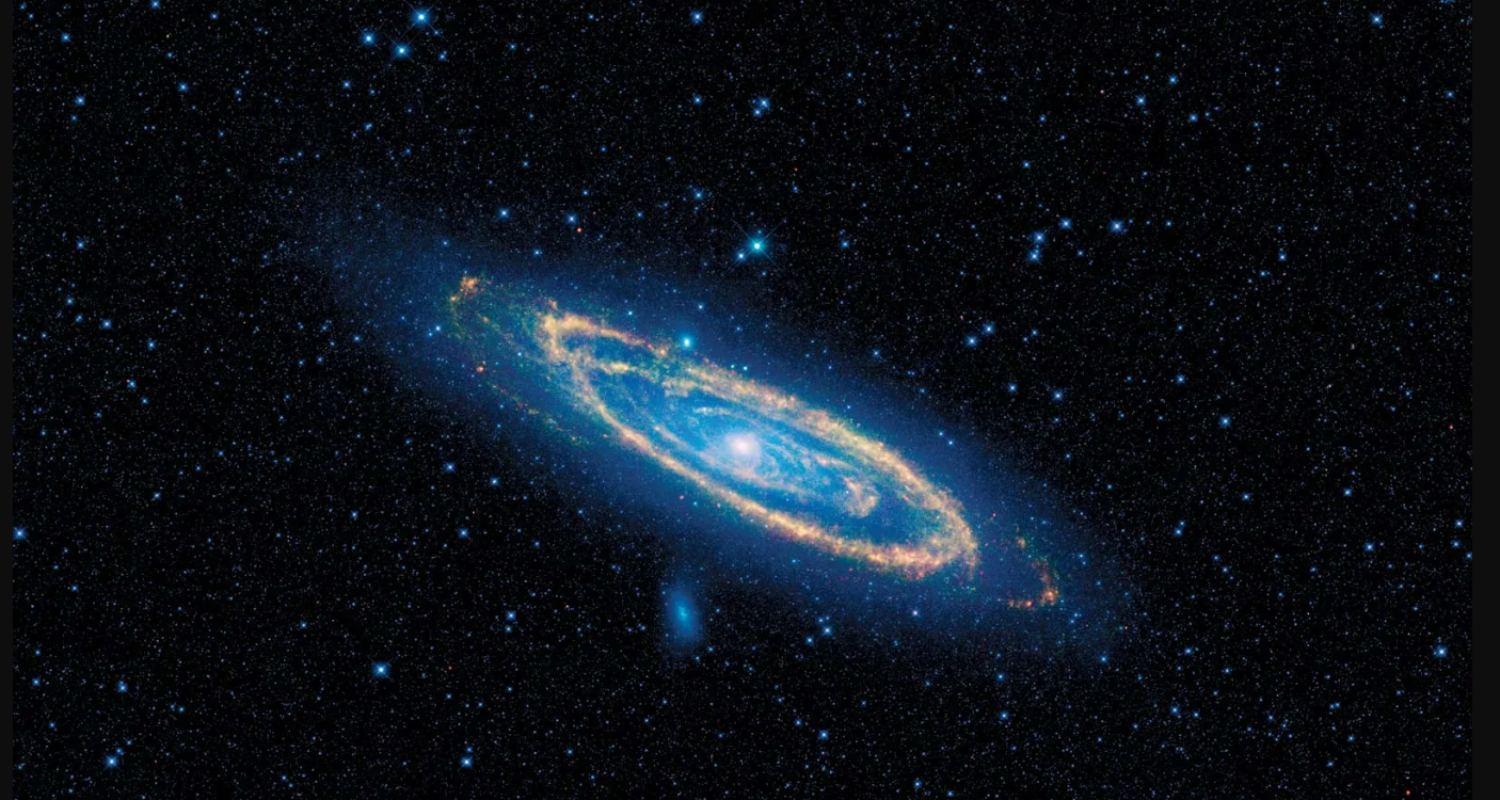
For the first time, astronomers have observed far-ultraviolet emissions from novae—sudden, bright explosions on stars—during their outbursts in the Andromeda galaxy, which is our nearest large galactic neighbour.
These discoveries, spearheaded by a team from the Indian Institute of Astrophysics (IIA) in Bengaluru, provide new insights into these stellar events.
Novae take place in binary star systems where a dense, Earth-sized white dwarf star orbits closely around a Sun-like companion.
The strong gravitational force of the white dwarf pulls matter from its companion, leading to a significant accumulation of material on its surface. This build-up initiates powerful thermonuclear reactions, resulting in a sudden bright flash that we observe as a nova.
By using data from the Ultraviolet Imaging Telescope (UVIT) on ISRO’s AstroSat satellite, the researchers detected ultraviolet emissions from 42 novae, including four that were observed in the process of erupting. The study, published in the Astrophysical Journal, emphasises how these explosions play a role in enriching galaxies with new elements.
“UVIT’s distinctive capability to observe both far and near ultraviolet wavelengths with high resolution allowed us to monitor the accretion disks surrounding white dwarfs,” said Judhajeet Basu, the principal investigator and a PhD candidate at IIA. “These disks, created from material stripped from the companion star, offer valuable insights into the processes leading up to a nova eruption.”
The team also detected periods of dimming, referred to as a “calm before the storm,” during which the collected material behaves like a shell that obstructs radiation.
When conditions reach a critical point, a significant thermonuclear explosion takes place, expelling material into space and causing a dramatic surge in the system’s brightness.
Identifying these novae in the bright central region of Andromeda necessitated sophisticated image processing methods, which ensured their validity. “This finding was only achievable because of the Andromeda survey proposals utilising UVIT,” Basu remarked.
The results highlight the necessity of upcoming ultraviolet and X-ray missions to unveil the secrets of novae, enhancing our comprehension of stellar evolution and galactic chemistry.

 Follow us