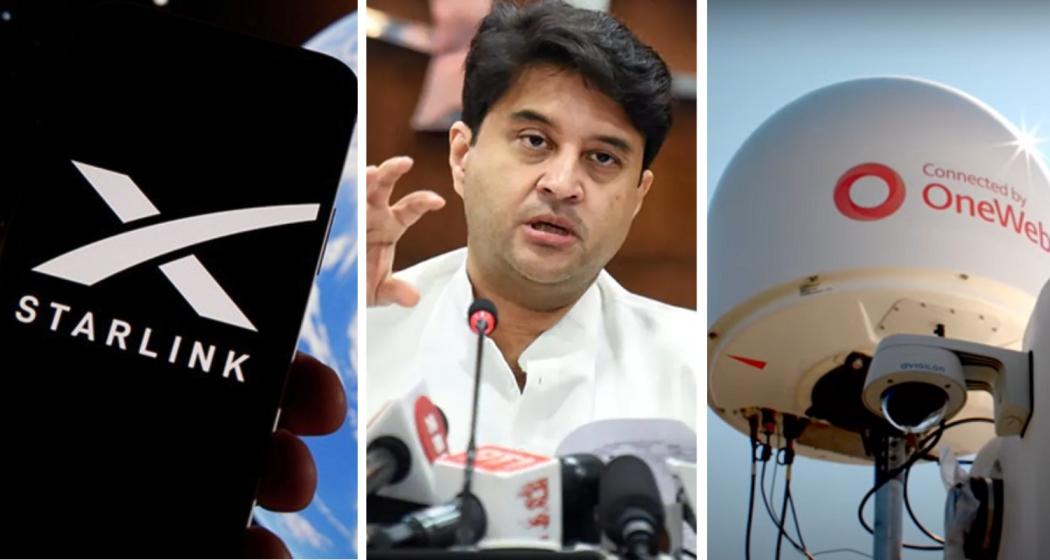
Satellite communication services in India will be rolled out only after companies in the sector secure mandatory security clearances and spectrum allocation, Union Telecom Minister Jyotiraditya Scindia said, signalling that regulatory approvals remain the final hurdle before commercial launch.
Scindia said the government would soon be in a position to allocate spectrum to satcom players such as Elon Musk-owned Starlink, Eutelsat One and Jio Satellite Global Services once the Department of Telecommunications (DoT) finalises spectrum pricing.
“There are two issues that need to be addressed. One by the licence holders OneWeb, Reliance Jio, and Starlink, which is to comply with security clearances regarding international gateways, ensuring data remains in India, and so on,” Scindia said.
The minister added that provisional spectrum has already been allocated to satcom companies to allow them to demonstrate compliance with security requirements.
“They are in the process of doing that, so they need to comply,” he said.
Scindia noted that spectrum pricing remains under consideration by the DoT and the Telecom Regulatory Authority of India (Trai), which have differed on several aspects of satcom spectrum allocation.
“Hopefully that should be resolved soon,” he said.
Earlier this month, Trai rejected multiple proposals put forward by the DoT, including suggestions to levy a 5 per cent annual spectrum fee on satcom players instead of 4 per cent, and to remove a Rs 500 per-connection charge in urban areas.
Also read: India’s telecom sector records historic growth in 2025
The DoT is expected to make its presentation before the Digital Communication Commission (DCC), the apex decision-making body in the telecom sector, which will determine the future course of action on spectrum pricing. The matter could subsequently be placed before the Cabinet for approval.
On the issue of relief sought by Vodafone Idea Ltd (VIL), Scindia said discussions within the government were still ongoing.
“We are today applying our minds on that. It is work in progress within the Department of Telecommunications,” he said.
VIL has informed the DoT that its liabilities to the government stand at around Rs 2 lakh crore, including Rs 1.19 lakh crore in spectrum dues. The company has warned that without support, the Centre could face significant losses, including unrecovered dues and erosion of equity value.
The Supreme Court has allowed the government to resolve the matter within the framework of its policy-making powers.
Responding to concerns about repeated relief to VIL, Scindia said no fresh relief had been extended so far.
“We have not given any relief as such. We have converted our dues into equity. Therefore, we hold a 49 per cent equity stake in Vodafone against dues of close to, if I recall correctly, Rs 37,000 crore. That is now the Government of India's equity stake in that company,” he said.
Scindia underlined that the government remains committed to preserving competition in the telecom sector.
“If you look at countries across the world, very few can boast of four providers of telecom services. India today has four very robust telcos,” he said, adding that Vodafone Idea and BSNL together continue to serve over 300 million subscribers.

 Follow us