
Trending:
Last of its kind: Kolkata trams that carry a Bengali legacy
Kolkata’s tramways, introduced in 1873 and electrified in 1902, remain India’s only surviving tram network. Once the backbone of urban mobility, they shaped the city’s growth, culture and daily rhythms, even as modernisation steadily reduced their footprint and relevance. Follow us
- Kolkata - UPDATED: March 27, 2026, 04:52 PM - 2 min read
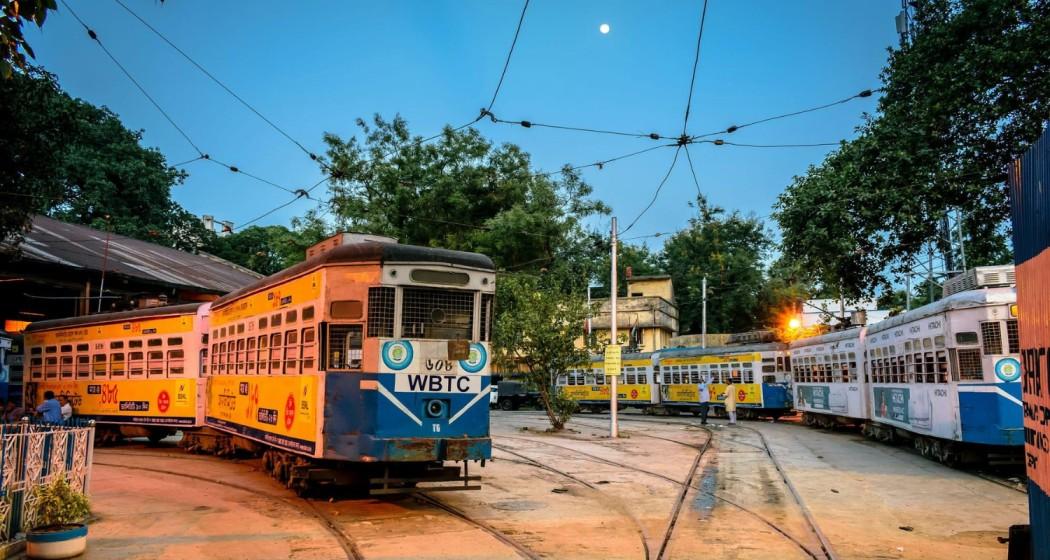
As dusk settles over the tram depot, Kolkata’s iconic trams stand shoulder to shoulder, bathed in the last light of the day. These old companions have carried generations through the streets of Kolkata.
There are cities that rush. And then there is Kolkata, a city that, for over a century, has known the luxury of slowing down.
To step into a tram here is to enter a different rhythm of time. The metallic clang of the bell, the soft hum of overhead wires, and the gentle sway along tree-lined avenues feel less like transport and more like memory in motion. As Bengali writer Sunil Gangopadhyay once evoked in his writings on the city, Kolkata is “a place where time lingers rather than passes.”
The tram, perhaps more than anything else, embodies that lingering. It is not merely a vehicle. It is adda on wheels. It is the city thinking aloud.
How the tracks first came to India
The story of trams in India begins, as many colonial stories do, with the British. The first horse-drawn tram in the country ran in 1873 between Sealdah and Armenian Ghat, a short-lived experiment that nevertheless planted the seed. By 1880, the Calcutta Tramways Company had formalised the system, laying down tracks that stitched together markets, courts, ghats and neighbourhoods. Viceroy Lord Ripon himself inaugurated the permanent metre-gauge service on November 1, that year, tracks snaking from Sealdah through Bowbazar, Dalhousie Square and Strand Road.
In 1902, Kolkata achieved another first, the introduction of electric trams, the earliest in Asia, running from Esplanade to Kidderpore. On 27 March, the first electric tram in Asia glided from Esplanade to Kidderpore. Calcutta, as it was then known, became the continent’s pioneer. By the early 20th century, the network sprawled across 67 kilometres at its peak, ferrying clerks to Dalhousie, pilgrims to Kalighat, and students to College Street.
Unlike horse trams elsewhere in India, Madras tried in 1874, others followed. Mumbai, Delhi, Chennai and Kanpur all dismantled theirs by the 1960s, seduced by buses and cars. Today, Kolkata remains the only Indian city where trams still run. And that survival is not accidental. It is emotional.
As Rabindranath Tagore wrote, “The butterfly counts not months but moments.” The tram, in its unhurried passage, seems to live by that very principle, counting not distance, but experience. The tram, perhaps more than anything else, embodies that lingering.
Weaving through Bengali lives: A moving ‘adda’
Step inside any old-timer’s memory and the tram is no mere means of transport, it is a mobile drawing room. Before buses clogged the streets and the Metro burrowed underground, trams were the arteries of middle-class Calcutta. Office-goers read Anandabazar Patrika while the carriage swayed, housewives shopped at New Market and returned laden with baggages, students debated politics en route to Presidency College. The slow pace, never more than 20 kilometres an hour, invited ‘adda’, the quintessential Bengali art of unhurried banter.
A conductor in his crisp uniform, leather bag slung across his chest, rang the bell with theatrical flair, stacking notes between his fingers like a street magician. “Tram workers were like a family,” recalled retired tram driver Gopal Ram. “It didn’t matter if you were Hindu or Muslim.”
The trams altered the Bengali way of living in subtler ways too. They knit the city together, north to south, river to maidan allowing women like ‘Arati Mazumdar’ the protagonist in Satyajit Ray’s Mahanagar (1963) to step out for office jobs without the tyranny of distance, allowing Bengali women to assert their presence beyond the confines of their homes.
In the film’s opening sequence, a two-minute tram ride captures the daily grind of the city. Sparks flying, passengers jostling, the city’s dreams and drudgery flashing by. Ray used it not as backdrop but as metaphor, the carriage embodying a society in constant transition.
Post-Partition refugees flooded in and trams carried them to new lives. Hospitals, schools, cinemas, routes were designed around them, as activist Debashis Bhattacharya, President of the Calcutta Tram Users Association, notes: “Trams survived in Kolkata all these years because they connected the city’s schools, hospitals and cinemas.”
Economically humble and environmentally kind, no diesel fumes, just the quiet electric hum, they fostered a gentler urbanism. In an era when the “effeminate Bengali babu” stereotype lingered, trams offered dignity, that was reliable and affordable as historian Sabyasachi Chatterjee calls the tram “a link between life and literature.”
Canvas of creativity: Trams in film, verse and collective memory
No other Indian city’s transport has inspired such artistic devotion. Filmmakers from Satyajit Ray to Ritwik Ghatak, Mrinal Sen and Buddhadeb Dasgupta returned again and again to the tram’s rhythmic clatter. “A Kolkata film means they have to show a tram,” quips filmmaker Anjan Dutt, who has featured them himself. Mrinal Sen wielded the tram as a symbol of suffocating monotony and class tension in the 1970s; Ray let it stand for quiet resilience.
Literature has always held the Kolkata tram close to its heart. The great Bengali poet Jibanananda Das, known for his quiet, melancholic verses about the city’s streets and shadows, met a tragic end in 1954. While out on his evening walk near Deshapriya Park, he was struck by a tram on Rashbehari Avenue. He passed away eight days later.
Then there is Tramjatra, the annual cultural festival launched in 1996 by filmmaker Mahadeb Shi and Australian conductor Roberto D’Andrea. Trams become moving canvases, painted by art students, filled with bands and poetry recitals themed around Tagore’s Gitanjali or Durga Puja. Young Calcuttans who never rode the daily grind discover their heritage aboard these rattling stages. As Shi says, it “helped expose younger people to trams too.”
Battling resilience, decline and the fight for survival
From 52 routes in the 1970s to just two or three today, the network has shrunk dramatically. Tracks have been uprooted for flyovers and Metro pillars, depots sold for real estate. The West Bengal government has floated plans for a final farewell, retaining only a short heritage loop. Traffic congestion is the official reason, roads occupy a mere 6 per cent of the city, far less than Mumbai or Delhi.
Retired transport worker Subir Bose sums it up, “Three things made Kolkata Kolkata, the Howrah Bridge, the Victoria Memorial and the trams. It’s heart-breaking to think we could be losing one of them.”
The quiet rebels, reminders that progress need not erase character. They changed Bengali life not by speed but by steadiness, fostering community, inspiring art, carrying the weight of ordinary dreams without complaint.
As the bell clangs once more and the carriage glides forward, one feels the city’s pulse in its rhythm. Kolkata’s trams have rattled through empire, independence, turmoil and boom. Whatever tomorrow brings, their clang will echo in stories, films and the quiet pride of those who still call this home. They are more than transport. They are Calcutta itself, stubborn, soulful, and forever rolling on.
By Deepan Chattopadhyay
