
Trending:
Spectacle on a scarred road: At the Wagah Border
Beyond the choreographed spectacle at the Wagah Border lies a deeper history, of Partition, migration, and a road that once connected people freely, before becoming one of the most heavily symbolic borders in South Asia. Follow us
News Arena Network - Chandigarh - UPDATED: April 17, 2026, 02:07 PM - 2 min read
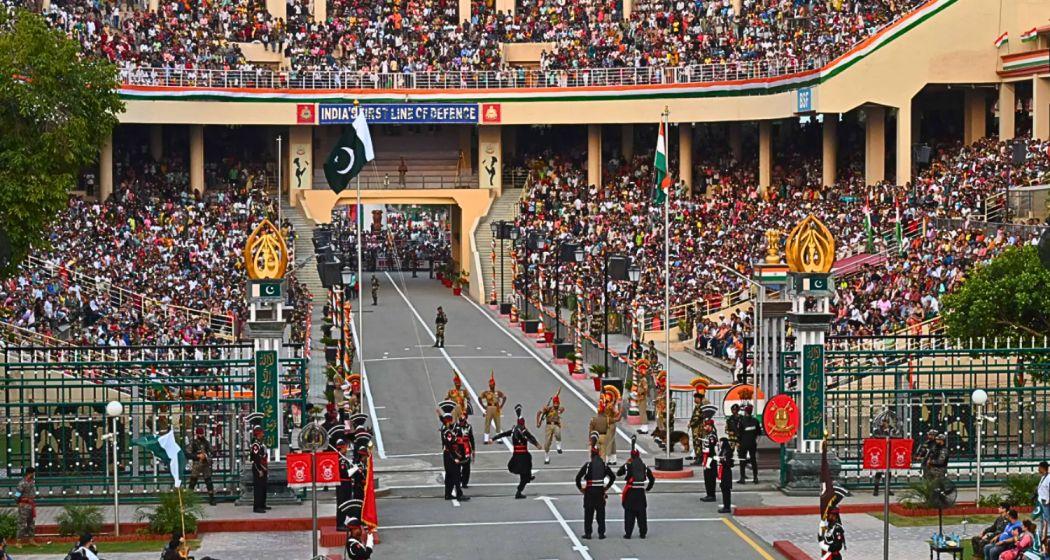
Indian BSF personnel and Pakistan Rangers take part in the Beating Retreat ceremony at the Wagah Border.
The spectacle at the Wagah Border is designed to overwhelm. Music surges through loudspeakers, the crowd rises in waves, and slogans echo across the stands. By the time the evening retreat ceremony begins, the border resembles a theatre and a stadium, at the same time, more than a frontier. It is loud, deliberate, and intensely choreographed.
But what it does not immediately reveal is what this place once was.
Before 1947, this was simply a road, a stretch of the historic Grand Trunk Road, linking Amritsar to Lahore. People crossed it without a pause, moving for trade, family gatherings, or routine journeys, that did not require their identity to be asserted at every step.
There was no performance here. There was no gates or the line. That changed with the Partition of India.
When the Radcliffe Line was hastily drawn across Punjab, this road became one of the principal corridors of migration. Nearly 15 million people were uprooted in one of the largest human displacements in history. Many travelled along this very route - on foot, in long caravans, or in overcrowded trains that often arrived filled with corpses.
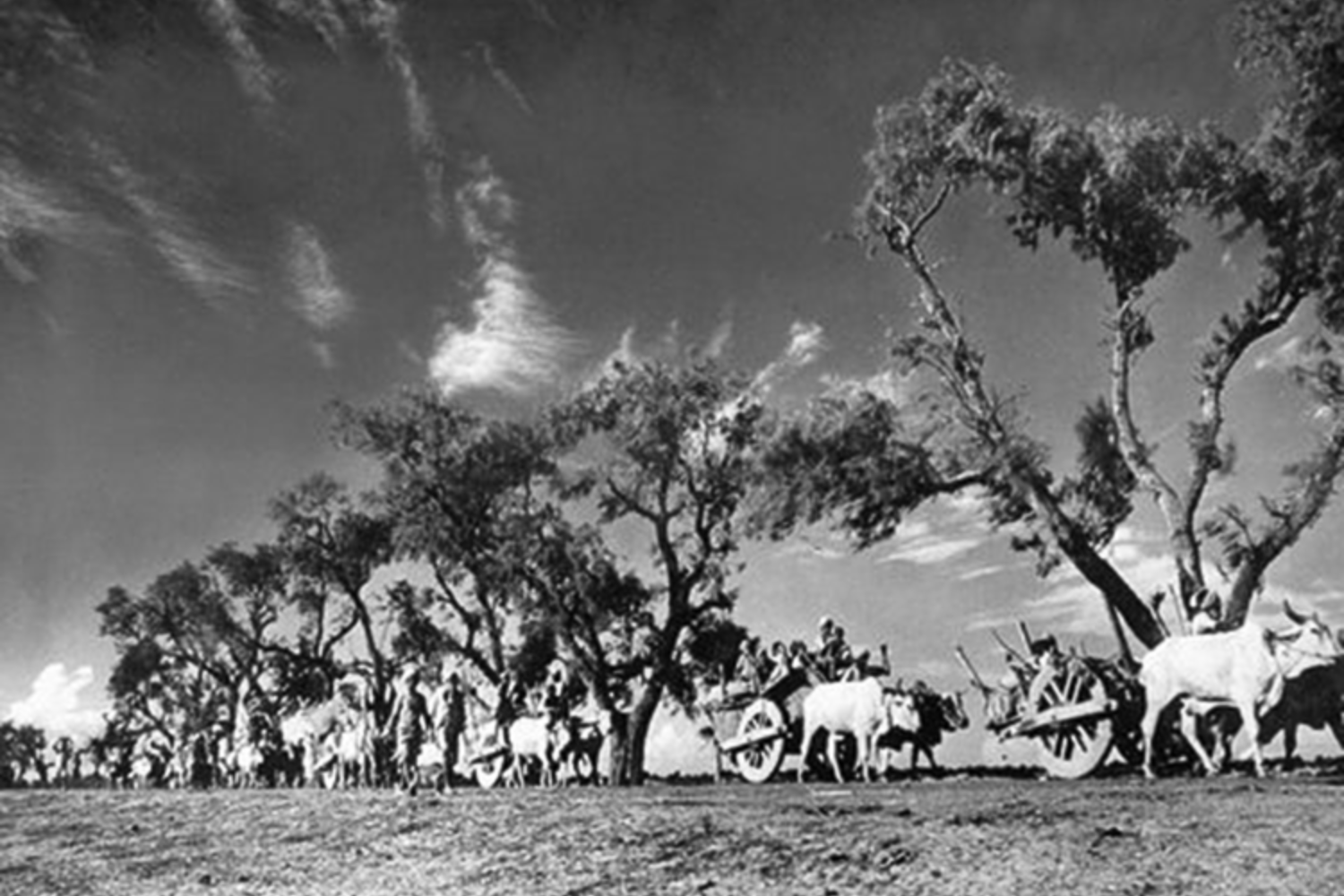
The violence was not incidental; it was overwhelming. Estimates suggest that up to two million people were killed in the months that followed, with Punjab bearing the deepest scars. At the same time, around 10 million Punjabis, nearly a third of the province’s population, were displaced, forced to leave behind homes, land, and memory. The road did not just witness history. It carried it.
In October 1947, as the chaos of migration unfolded, a formal checkpoint was established here by Indian Army officer Brigadier Mohindar Singh Chopra, in coordination with his Pakistani counterpart. Until then, there was not even a clearly marked point where one country ended and the other began. A line had to be fixed on a road that had never known one. Today, that line is guarded, regulated, and performed each evening through a carefully choreographed ceremony.
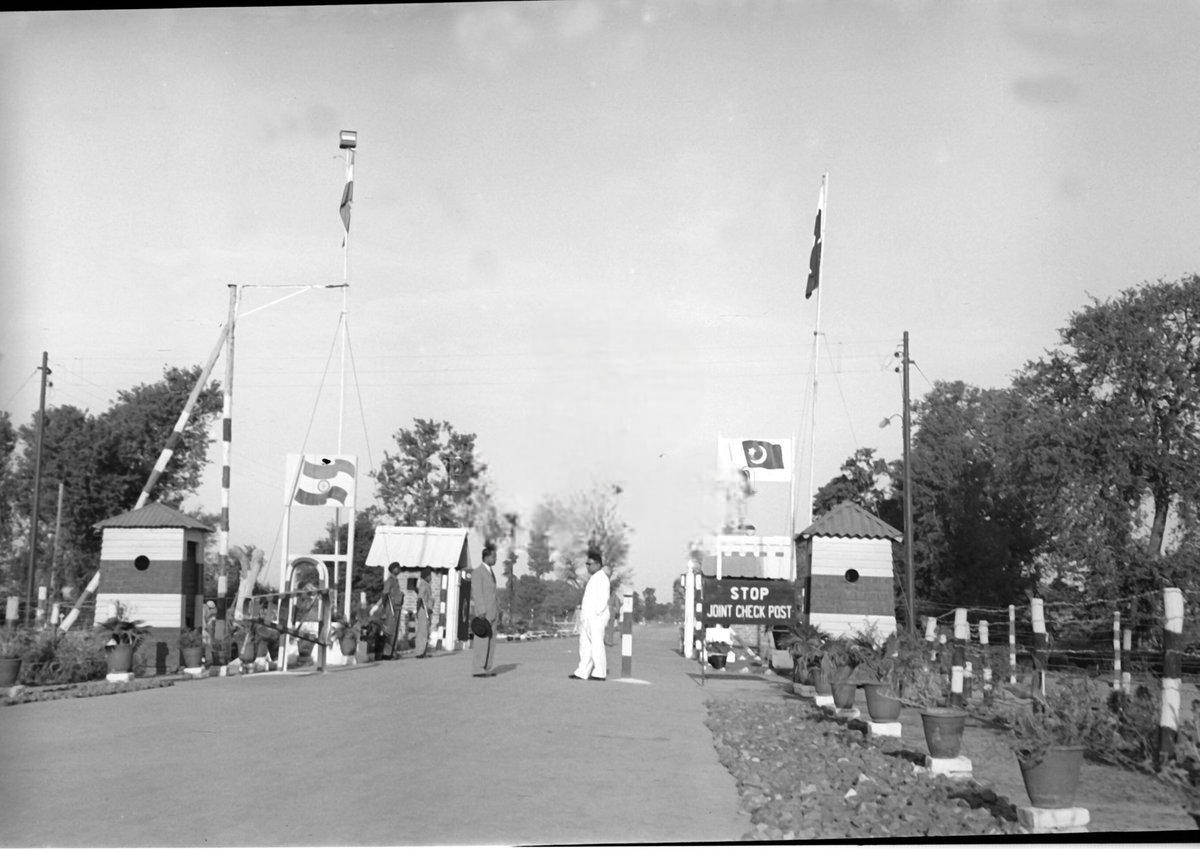
The Wagah Border in 1950.
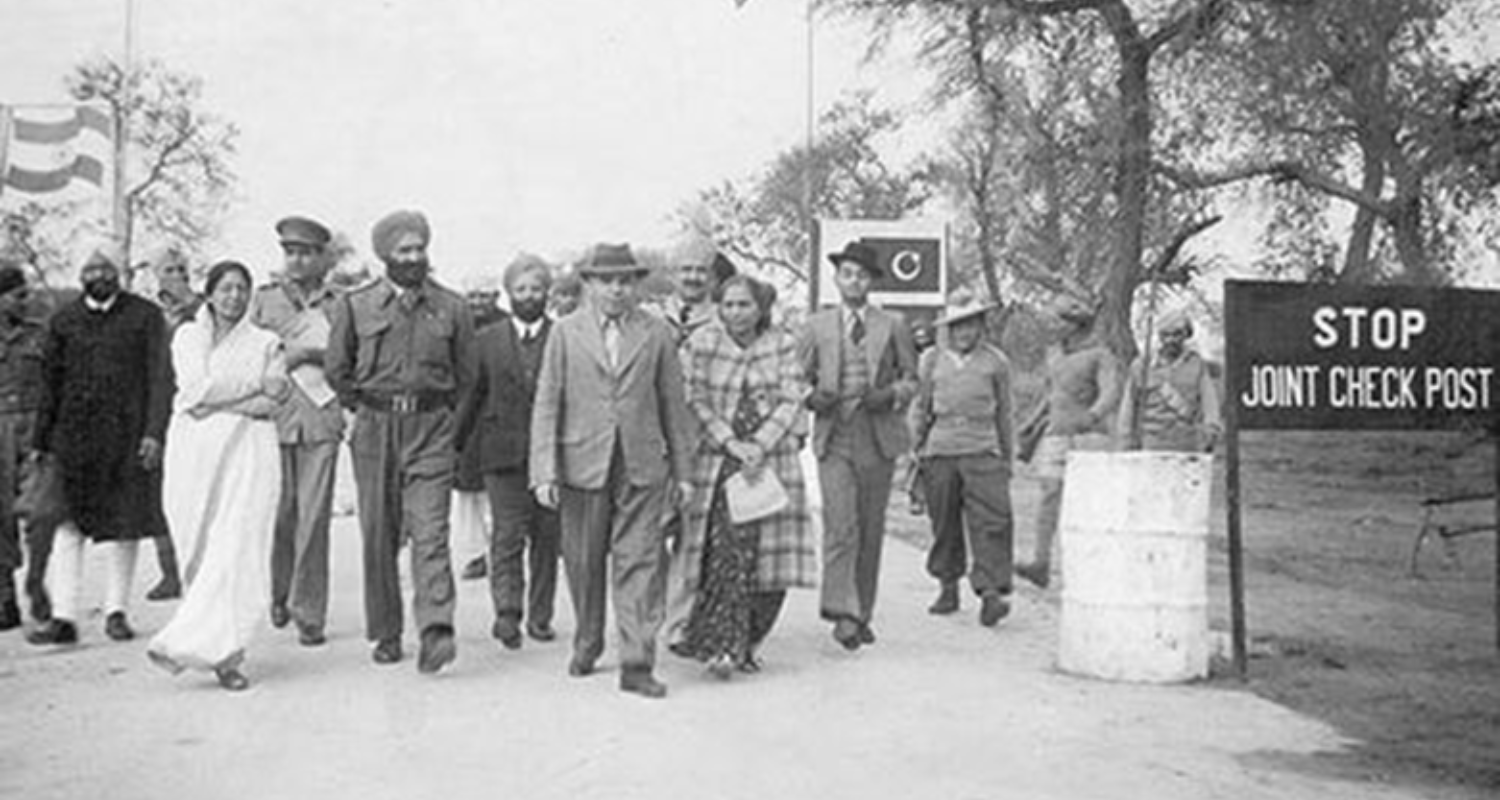
The then Governor of Punjab, Sir Chandulal Madhavlal Trivedi, accompanied by Brigadier Mohinder Singh Chopra, during a visit to the Joint Check Post at Wagah-Attari on the GT Road between Amritsar and Lahore.
The daily retreat ceremony, formally instituted in 1959, has evolved into a carefully choreographed display of rivalry and restraint. Soldiers of the Border Security Force and the Pakistan Rangers march in synchronised aggression - high kicks, sharp turns, emphatic gestures, each movement calibrated, each expression rehearsed. The aggression is visible. The coordination is less obvious, but no less real.
Even at its most dramatic, the ceremony depends on balance. Neither side escalates beyond a point. Each mirrors the other, maintaining an unspoken equilibrium that allows the performance to continue without tipping into confrontation.
BSF, sub-inspector Vikram Singh, observed during ceremony duty, “We do this drill every single day, rain or shine. Keeps the boys sharp. People like the show, makes them feel the border is looked after.”
I visited this border in 2024, expecting precisely this spectacle. And it delivered, the energy, the crowd, the theatre of nationalism, all unfolding with clockwork precision.
As the gates open briefly and then close again, you start thinking about what this line replaced. About the people who once crossed without stopping. About those who crossed in fear, leaving everything behind, and those who crossed in tears, parting from people they would never meet again. And then, almost without trying, your mind goes to the images you’ve grown up with, a flashback of countrywide protests, freedom fighters sacrificing their lives, processions, slogans of independence, all building towards the idea of a nation that was meant to be free.
The idea of a country being born. But here, that idea feels complicated. Because the same moment of freedom also meant division. The same line that marked independence also triggered violence that could not be controlled. Many who believed in that freedom never lived to see what followed.
You don’t think all of this at once. It comes in parts. In flashes.
Around you, people are still cheering. Phones are still up. The ceremony ends the way it always does, with applause, with energy, with a sense of closure.
For many in the crowd, the ceremony ends with applause and photographs. For some, it lingers differently - as a reminder that the idea of independence, so fiercely fought for, arrived entangled with loss, displacement, and unfinished histories.
Arghwani Begum was 25 when her train from Delhi reached the Wagah Border on August 20, 1947. “It was so sudden,” she later recalls. “We sealed the windows with whatever we could… My baby almost fainted from lack of air. When the attackers left, I saw the bloodied bodies of children in the other berths.”
Ten-year-old Kidar Nath Jain came the other way, on a bus from Jhelum. “There was no police or army guard,” he says. “But we reached safely.”
Others were not as fortunate. Major General Ravindar Chopra, then a child, remembered hiding in a train where “we were the sole survivors… all the others had been massacred.”
Nirmal Kohli, then a young girl, says, “A train full of dead bodies arrived from Wazirabad while we were at Sialkot station. The few survivors were brought onto our train. Just half an hour after leaving, it derailed, the tracks had been sabotaged.” Her family eventually continued on foot, crossing the Ravi bridge near Dera Baba Nanak before boarding another train towards Amritsar, along a route that passed close to the newly forming Attari crossing on the Grand Trunk Road.
These were not isolated journeys. They were fragments of a movement where survival itself was uncertain, across roads that had once connected, and were now beginning to divide.
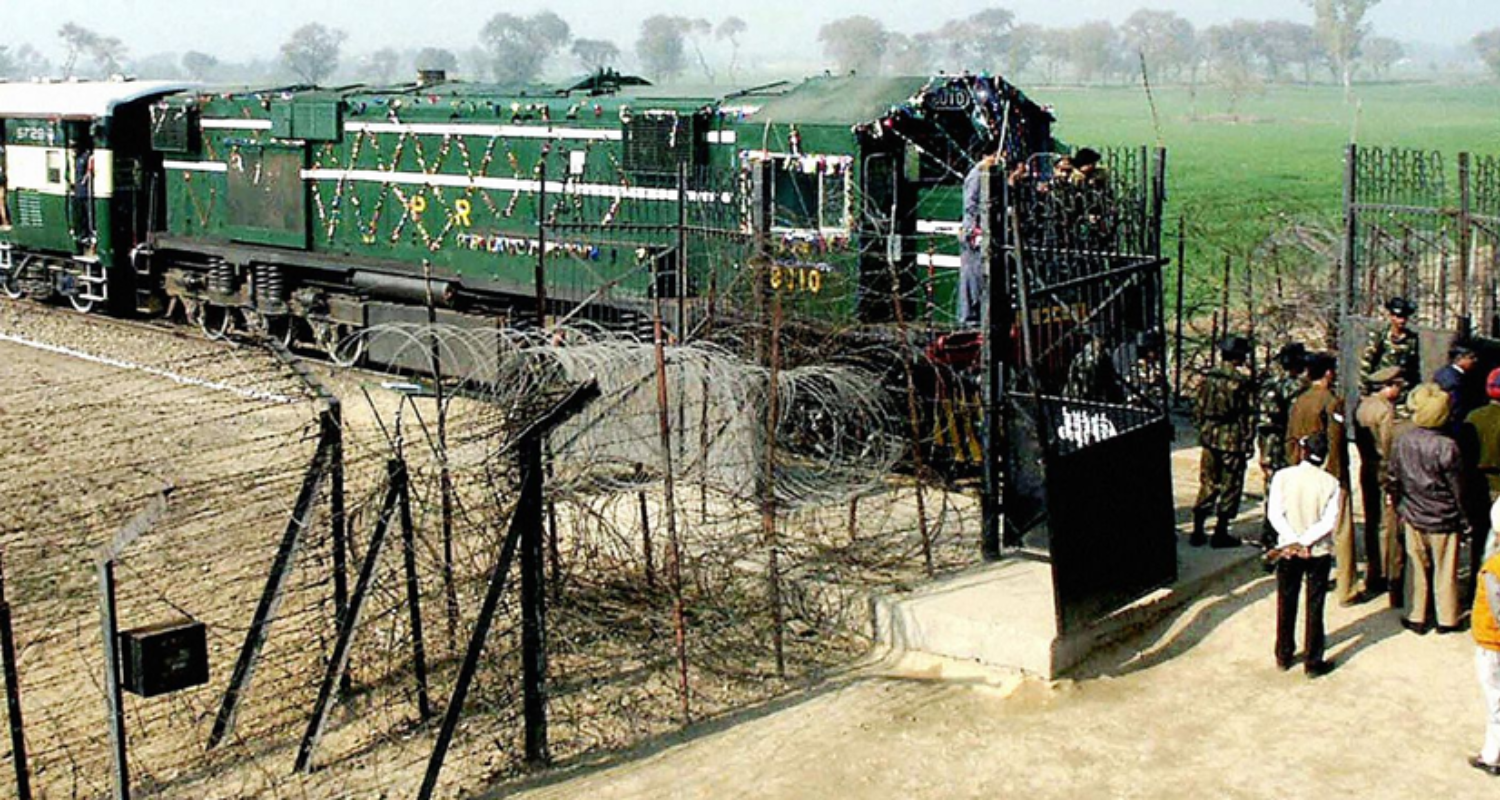
Indian BSF personnel watching the Samjhauta Express, a formerly twice-weekly train traveling between the two countries, arrive at Attari from Lahore..
But even today, the geography carries its quiet ironies. What is popularly called Wagah on the Indian side is actually Attari, while Wagah lies across the border in Pakistan. The shared name survives, even when the shared past feels distant.
Beyond the spectacle, the crossing continues to function as the only legal land transit point between the two countries, a tightly controlled corridor for limited trade and movement. Its activity expands or contracts with the rhythm of India-Pakistan relations, turning the border into a barometer of political mood.
At times of tension, the flow slows, ceremonies are subdued, and gates close more firmly. During brief moments of thaw, the same space hosts gestures of cautious goodwill.
Step away from the stands, and the noise fades quickly. The stadium gives way to stillness, stretches of farmland, layered security, and a border that is less about display and more about control. Here, the contradiction sharpens. The ceremony amplifies difference, but its structure depends on coordination. It dramatises separation, yet reveals a shared script. The border, in this sense, is not only enforced, it is performed, repeatedly, to remain visible. As the flags are lowered and the gates briefly meet before shutting for the night, the day’s performance draws to a close. The crowd disperses. The slogans dissolve into memory.
What remains is a line that was once a road. A road that carried millions seeking safety. A road that witnessed violence on a scale difficult to comprehend. A road that now stages a daily ritual of nationhood, even as it quietly holds the memory of what was lost when that nation was born. At Wagah, the present is loud, precise, and deliberate. The past, however, is quieter, and far more difficult to contain.
Historical context and testimonies have been drawn from the 1947 Partition Archive (Stanford University) and standard scholarship, including Encyclopaedia Britannica and journals such as Economic and Political Weekly and the Journal of Punjab Studies. Observations are supported by the author’s on-ground reporting at the Attari–Wagah border in May, 2024.
By Deepan Chattopadhyay
