
Trending:
The Silk Route through the Himalayan passes
Across windswept Himalayan passes, caravans once carried silk, spices and stories, linking India to the vast trade network known as the Silk Route. Follow us
News Arena Network - Chandigarh - UPDATED: March 6, 2026, 04:09 PM - 2 min read
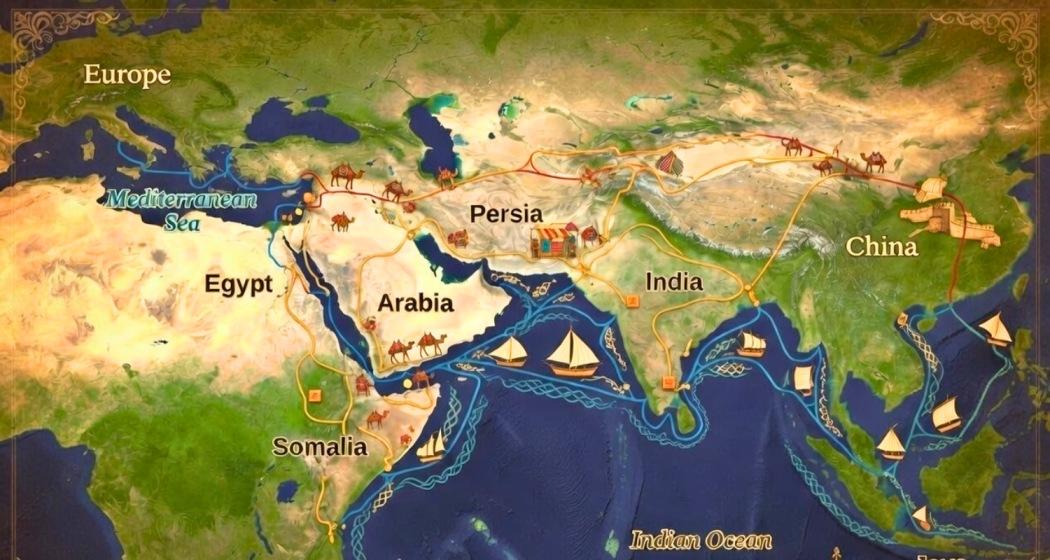
A map illustrating the vast network of trade routes known as the Silk Route, which connected China, Central Asia, India and the Mediterranean through land and sea corridors.
Picture this: a weary trader, bundled in yak wool against the biting Himalayan wind, pauses at the crest of Nathu La Pass. It is dawn, and the first rays of sun glint off snow-capped peaks that stretch like jagged teeth into the clouds. Below, the Chumbi Valley in Tibet unfurls like a rumpled green carpet, while the forested slopes of Sikkim promise warmer lands.
In his saddlebag are not just bolts of shimmering silk from distant Xi’an, but stories, tales of clever hares outwitting lions, of golden geese slain in greed, and of monks carrying scrolls that would reshape empires. This was the Silk Route, not a single imperial highway but a tangled web of paths where goods, gods and gossip travelled together. Along India’s Himalayan frontier, it found some of its most vital arteries.
Most of us learned about the Silk Route in schoolbooks as China’s great trade road linking East and West. In reality, it was far more complex. The network thrived for nearly two millennia, from around the second century BC until the 15th century, stretching from the markets of Chang’an across deserts, mountains and seas to the Mediterranean world.
India was never merely a stop along this system. The subcontinent was one of its great crossroads. Traders exchanged spices, cotton textiles and precious stones for horses, silk and ideas that travelled just as widely.
The southern flow: From China to India’s eastern hills
Imagine a line of shaggy yaks, their bells tinkling like distant temple chimes, picking their way along a ridge at nearly 5,000 metres. The air is thin, and the wind carries voices from many lands, Persian merchants, Tibetan monks, Kashmiri pony-men, all bound for markets beyond the mountains.
One major route began in the bazaars of Chang’an. From there it ran northwest through the Taklamakan Desert, crossed the Pamirs and entered Central Asia. Beyond that, the network splintered like a river delta, with southern branches dipping into the Indian subcontinent through Himalayan passes.
The journey’s end was not only the markets of Constantinople but also Indian ports such as Bharukaccha (modern Bharuch) in Gujarat and Tamralipti in Bengal, where ships carried goods across the Indian Ocean toward the Mediterranean.
Spices from Kerala, cotton from the Deccan and gemstones from Golconda moved eastward, while silk, porcelain and horses travelled west. Historian William Dalrymple has noted that the Silk Road was as much an Indian Ocean system as a land route, with India absorbing enormous amounts of Roman gold through trade.
One of the most important Himalayan gateways in this eastern network was Nathu La, rising to about 4,310 metres. Its Tibetan name means “listening ear”, as if the mountain itself overheard the conversations of passing traders.
Caravans climbed slowly from Gangtok below. Tibetan salt, borax and wool were traded for Sikkimese cardamom, rice and Indian dyes used to colour silk.
Nearby Jelep La, the “lovely pass”, offered another route into the Chumbi Valley before descending toward Bengal and the ancient port of Tamralipta.
Further east, Bum La Pass near Tawang in Arunachal Pradesh linked Tibet with the eastern Himalayas and was used by traders and Buddhist pilgrims alike.
The western ladder: Passes of the northwest
Further west the terrain grew harsher, where the Karakoram mountains rise like stone walls. The Karakoram Pass, about 5,540 metres high between Ladakh and Xinjiang, was among the most formidable crossings on the Silk Route. Caravans arriving from Kashgar funnelled through this bleak terrain toward the Nubra Valley.
Glaciers, avalanches and altitude sickness constantly threatened traders who travelled these routes. Nearby Sasser Pass formed another high-altitude corridor leading across the Depsang Plains toward Leh. Over time Leh emerged as a major trading town of the Himalayan Silk Route, where Ladakhi merchants exchanged prized pashmina wool for Chinese tea bricks.
Archaeologist Monica L. Hamilton notes that these routes functioned as more than trade corridors. They served as channels through which ideas, beliefs and artistic traditions travelled across Asia. Further south, Shipki La in Himachal Pradesh linked the Sutlej Valley with Tibet’s Ngari region. Caravans carried wool, borax and hardy Tibetan ponies along this route.
The valley routes below connected monasteries such as Tabo to wider trade networks, turning them into lively centres of commerce.
Local folklore still surrounds these mountains. Elders in Kaza tell of Shipki’s guardian spirit, a one-eyed yak herder who tested traders by hiding a single grain of barley within their cargo. Those who found it were granted safe passage; those who missed it were turned back by sudden storms.
In Uttarakhand, the routes took on an even more mystical character.
Mana Pass near the temple of Badrinath was often called the “gateway to heaven”. Pilgrims crossed the Garhwal Himalayas toward Tibet’s Tsangpo Valley, bartering rudraksha beads and other goods along the way.
Close by, Niti Pass wound through narrow valleys and icy streams. The route later gained a reputation for smugglers as well as traders moving quietly across the mountains. Another dramatic crossing was Zoji La in Jammu and Kashmir, linking Srinagar with Leh. Caravans navigating this route faced treacherous cliffs and landslides as they moved toward the Suru Valley.
Across these passes traders carried remarkable loads. Yaks could haul around 100 kilograms, while ponies managed roughly sixty. Nights were often spent in caves or crude shelters, with travellers drinking warm barley chang to fight the cold.
Tales that travelled the passes
Trade was not the only thing moving across these mountains. Stories travelled just as far. In Sikkimese folklore, Nathu La is guarded by spirits who open the pass only to travellers with pure intentions. One tale tells of a yak herder who tricked a greedy merchant seeking hidden gold, leading him into a blizzard where he vanished in the snow.
Such stories echoed the older Buddhist Jataka tales that spread across Asia along the same routes. One well-known fable tells of a lion that terrorised a forest until a clever hare tricked him into leaping into a well after mistaking his own reflection for a rival. Versions of the story later appeared in Persian, Arabic and Hebrew traditions.
Buddhism itself travelled through these passes from the Gangetic plains into Tibet and Central Asia. Monks from institutions such as Nalanda carried scriptures northward, while Tantric traditions later returned south, blending with Himalayan practices and shaping Vajrayana Buddhism.
Artistic influences moved along the same routes. The murals of Dunhuang in western China show echoes of India’s Ajanta caves, while the Tibetan script drew inspiration from earlier Indian writing systems derived from Gupta-era Brahmi. UNESCO’s Silk Roads Programme describes these routes as “veins of shared heritage”, carrying ideas as much as goods.
Traders and legacies
India’s role in this network was economically powerful. The subcontinent exported cotton textiles, ivory, spices and gemstones in enormous quantities. Roman writers often complained about the steady flow of gold leaving their empire to pay for Indian luxuries. Ports such as Muziris in Kerala buzzed with Mediterranean traders exchanging wine and silver for pepper.
Far to the north, the Ladakhi town of Kargil became an important stop for caravans crossing the Himalayas. One of its most prominent traders was Munshi Aziz Bhat, born in Leh in 1866. Beginning as a clerk, he eventually built a major trading business and partnered with a Punjabi Sikh merchant by the early 20th century.
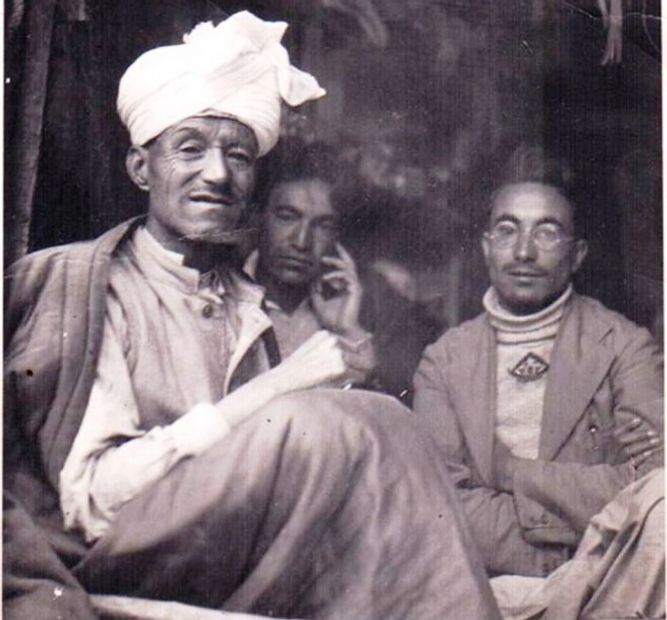
Munshi Aziz Bhat, a prominent Ladakhi trader whose caravan networks once linked Himalayan markets along the Silk Route.
His three-storey caravanserai in Kargil housed animals on the ground floor, trade goods on the second and travellers above. Locals joked that almost anything could be found in his stores, Afghan silver, foreign medicines and Tibetan turquoise.
Kargil’s name itself comes from the Balti word “Garkill”, meaning “the place where paths meet”. Caravans from Kashgar travelled through Nubra Valley to Leh, then descended along the Suru River toward Srinagar before goods continued to Amritsar and Bombay.
But the world was changing. Partition in 1947 disrupted many of these routes, and the rise of Communist China soon closed the Himalayan frontiers. Aziz Bhat retired soon afterward, his once-busy caravanserai gradually falling silent.
Years later his descendants opened some of his old crates. Inside were relics of a vanished trading world, saddles from Mongolia, turquoise from Tibet and Ladakhi bows.
Today they form the Munshi Aziz Bhat Museum in Kargil.
Whispers that linger
Fragments of these ancient routes are stirring again. Trade through Nathu La resumed in 2006, and several Himalayan passes are now being explored for tourism and cultural heritage projects.
Stand on one of these windswept ridges and listen closely. Beneath the whistle of the wind you might still imagine caravan bells, traders bargaining in unfamiliar languages and pilgrims quietly carrying ideas across mountains.
The gateways that once connected worlds still whisper their stories.
By Deepan Chattopadhyay
