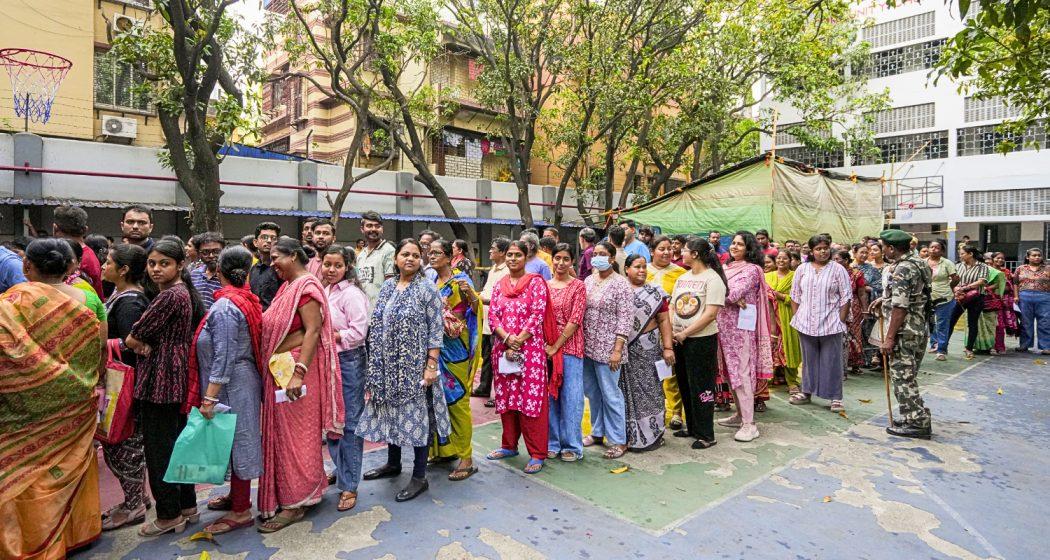
West Bengal’s high-stakes Assembly elections concluded on Wednesday with a record voter turnout exceeding 92 per cent across two phases, capping an intense political contest between the ruling Trinamool Congress and the Bharatiya Janata Party.
According to the Election Commission, the second and final phase covering 142 constituencies recorded a turnout of 91.66 per cent till late evening, with many voters still in queues. Combined with the first phase turnout of 93.19 per cent on April 23, overall participation stood at 92.47 per cent, the highest recorded in the state since Independence.
The scale of voter participation signalled the significance of the electoral battle, widely seen as a referendum on Chief Minister Mamata Banerjee’s bid for a fourth consecutive term and the BJP’s push to break the TMC’s long-standing dominance.
South Bengal, which voted in the second phase, emerged as the decisive battleground. The region includes politically crucial districts such as Kolkata, Howrah, Hooghly, Nadia and North and South 24 Parganas, which together account for nearly one-third of the Assembly’s 294 seats.
At the heart of the contest was Bhabanipur, Banerjee’s constituency and a symbolic arena for the TMC-BJP rivalry. The Chief Minister, 71, faced Leader of Opposition Suvendu Adhikari in what was widely viewed as a high-profile rematch after their contest in Nandigram in 2021.
Bhabanipur witnessed a sharp surge in turnout, touching nearly 87 per cent, significantly higher than previous elections. Banerjee, breaking from her usual routine, visited polling areas early in the day following complaints of alleged intimidation.
Also read: Bengal breaks 2021 record, hits 89.99 pc voter turnout till 5PM
Tensions flared at several locations during the day. In Kolkata’s Kalighat area, clashes broke out when Adhikari visited a polling station, prompting police to resort to a lathi-charge to disperse crowds. Sporadic incidents of unrest were reported from other constituencies as well.
Both parties traded allegations throughout the day. Banerjee accused central forces of intimidation and claimed attempts to “rig” the polls, while the BJP dismissed the charges as “frustration” and alleged obstruction by ruling party workers.
The BJP also raised concerns over alleged tampering of Electronic Voting Machines (EVMs), claiming party symbols were covered with tape in some booths. Chief Electoral Officer Manoj Agarwal said repolling would be ordered if such allegations are verified after due inquiry.
Beyond the headline turnout, the election was shaped by the Special Intensive Revision (SIR) of electoral rolls, which saw over 90 lakh names deleted — nearly 12 per cent of the electorate. The exercise reduced the voter base from 7.66 crore to 6.77 crore, adding a statistical and political dimension to turnout figures.
Polling largely followed Bengal’s familiar pattern of long queues, localised clashes and sharp political rhetoric. However, compared to past elections marked by widespread violence, this cycle remained relatively peaceful, aided by the deployment of nearly 2,450 companies of central forces.
With polling complete, all eyes are now on the counting of votes scheduled for May 4, which will determine the political future of one of India’s most politically significant states.

 Follow us