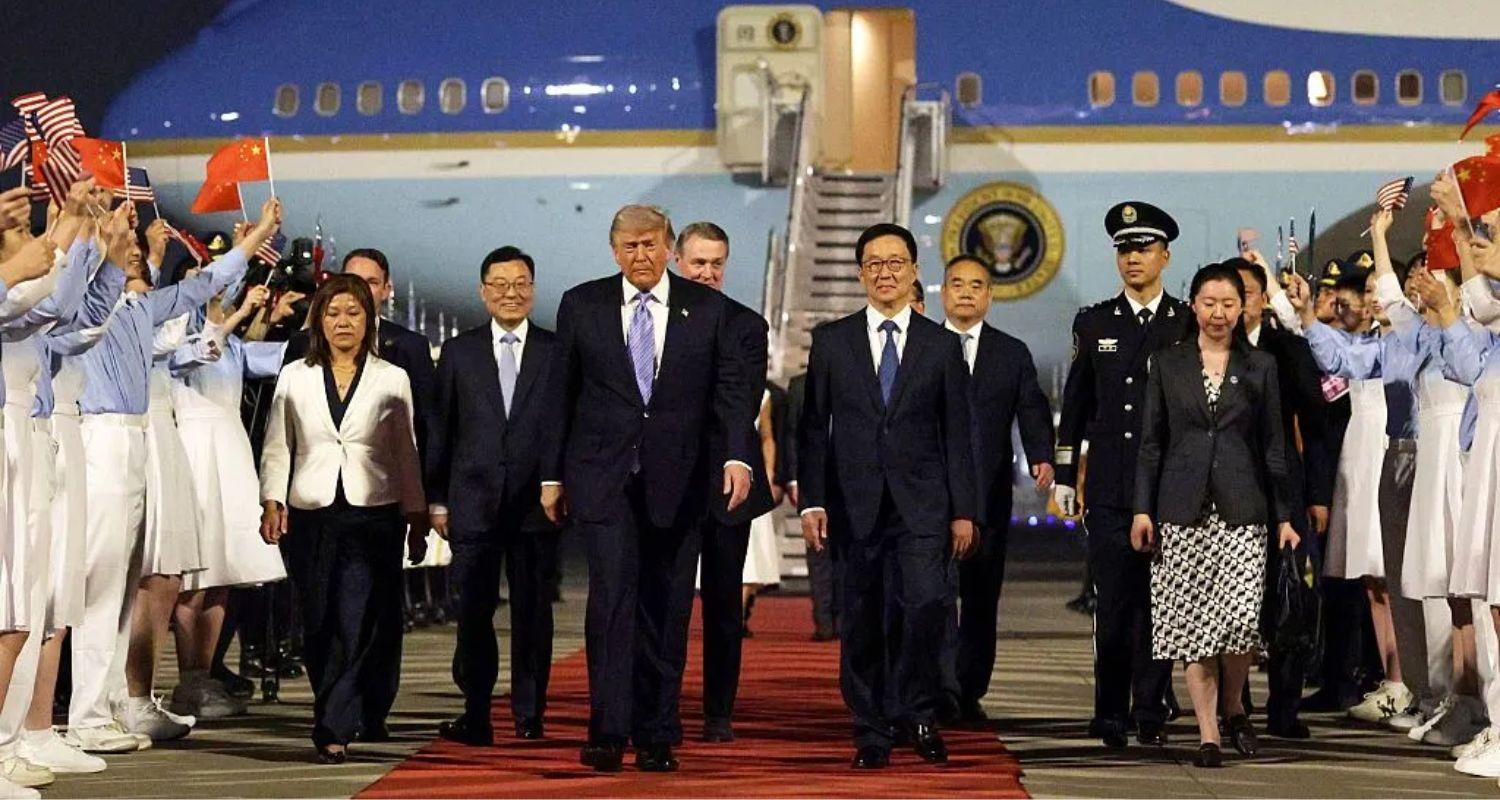
Donald Trump has landed in Beijing, the first visit to China by a US president in nearly a decade, as he seeks to mend power and prestige weakened by the war in Iran. Trump pumped his fist, descended the stairs of Air Force One and walked a red carpet flanked by 300 young Chinese people wearing light blue and white, waving red flags and chanting welcome.
He was greeted late on Wednesday by China’s vice-president, Han Zheng, the vice-minister of foreign affairs, Ma Zhaoxu, and a military band and honour guard. Trump was accompanied by his son Eric and daughter-in-law Lara as well as tech leaders, including Elon Musk of Tesla and Jensen Huang of the chip-maker Nvidia. The US president has plans for headline-grabbing deals and previously predicted that China’s leader, Xi Jinping, would “give me a big, fat hug when I get there”.
But the Middle East conflict that Trump started, and seems unable to finish, will cast a long shadow over two days of talks amid fears that he might be tempted to weaken US support for Taiwan, the self-governing democracy claimed by China, in return for Xi’s assistance. “I don’t think we need any help with Iran,” Trump said to reporters before departing the White House on Tuesday. “We’ll win it one way or the other, peacefully or otherwise.”
He also sought to play down divisions with Beijing, saying Xi had been “relatively good” during the crisis and insisting that Washington had “Iran very much under control”. Behind the scenes, US officials have spent weeks urging China, Iran’s biggest oil customer and one of the few powers with leverage in Tehran, to pressure the Islamic Republic into reopening the Strait of Hormuz, through which roughly a fifth of the world’s oil supply passes, while accepting US terms for peace.
A sale of 500 Boeing 737 Max jets, one of the biggest orders in the aeroplane-maker’s history, will be announced during the trip, the Bloomberg news agency reported. Trump and Xi will also discuss creating a new board of trade to manage what China should buy from the US and vice-versa.
Beijing, too, has reasons to avoid escalation. China’s economy remains burdened by sluggish domestic demand and a prolonged property crisis, while the closure of the Strait of Hormuz has exposed its heavy dependence on Middle Eastern energy supplies.
Trump’s trip will be closely scrutinised in Taiwan for any sign of weakening US support. On Monday, he said he would speak to Xi about US arms sales to Taiwan, a departure from historic US insistence that it would not consult Beijing on its support to the island. He also insisted that his personal relationship with Xi would prevent a Chinese invasion of the island. “I think we’ll be fine,” he said. “I have a very good relationship with President Xi. He knows I don’t want that to happen.”
Another potential focus will be AI with both countries facing calls to cooperate on global standards and safeguards. Bernie Sanders, an independent US senator, urged Trump and Xi to agree on allowing top scientists to share technical information and develop “AI redlines” about dangerous behaviour.
Also read: Trump’s upcoming China visit: What to expect

 Follow us