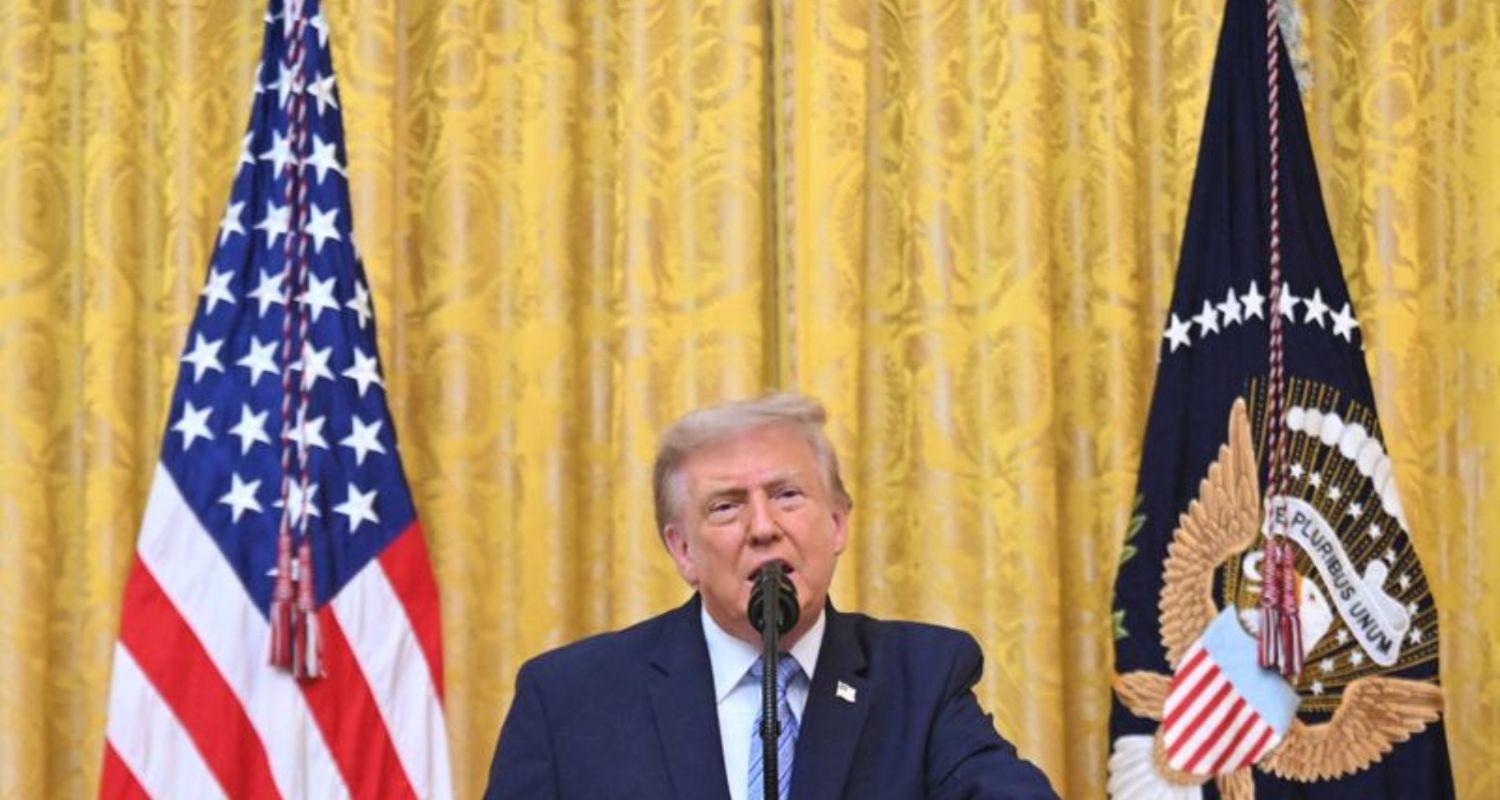
US President Donald Trump on Thursday released declassified intelligence documents that he said proved Chinese interference in the 2020 US presidential election, renewing his long-standing claims about election security despite previous US intelligence assessments finding no evidence that Beijing altered or influenced the outcome of the vote.
In a 25-minute prime-time address, Trump sought to make election security a major political issue ahead of the November midterm elections, where Republicans will defend their narrow majorities in Congress. He also urged lawmakers to pass legislation introducing stricter voter identification and citizenship verification requirements, a proposal that has faced strong opposition from Democrats and remains stalled in the Senate.
Trump claimed the declassified documents revealed "shocking vulnerabilities in our election infrastructure" and alleged that China had illegally obtained information from around 220 million US voter files, including names, addresses and other registration-related data. He further accused members of the US intelligence community of withholding information about China's activities.
However, Trump's claims contradict a 2021 unclassified assessment by the US intelligence community, which concluded that no foreign actor had attempted to alter or successfully changed any technical aspect of the 2020 election, including voter registrations, ballots, vote counting systems or final results.
That assessment was conducted during Trump's own administration under then-Director of National Intelligence John Ratcliffe, who is now serving as CIA director.
The intelligence report did acknowledge that China had conducted a long-running effort, dating back to at least 2008, to collect information on US voters, political parties, candidates and government officials. Officials said the data collection was likely aimed at understanding political trends rather than directly manipulating election results.
Two people familiar with the matter said the voter information obtained by China was not classified, as voter registration data is often available for purchase by political consultants and cannot be used to change votes.
Ahead of Trump's speech, some White House officials reportedly expressed concerns that releasing the information could create a misleading impression about China's role in the election.
China rejected the allegations. Liu Chang, a spokesperson for the Chinese embassy, said, "China has never and will never interfere in the presidential elections of the US."
Trump has repeatedly questioned election results since losing the 2020 presidential race to Democrat Joe Biden, making claims of widespread fraud that have been rejected by courts, recounts and election officials. Investigations found no evidence of large-scale fraud or vote manipulation.
Several documents cited by Trump also appeared to provide limited support for his claims. One CIA document discussed Venezuela's election rather than US elections, while another stated that US vote tabulation systems would be difficult to manipulate on a scale large enough to affect election results.
A third document noted that Chinese intelligence had targeted Biden's campaign but said Beijing did not currently intend to secretly interfere to influence the outcome of the election.
Also read: Andy Burnham set to become Britain's new Prime Minister
Democratic Senator Mark Warner, vice chair of the Senate Intelligence Committee, criticised Trump's claims, saying intelligence agencies had consistently concluded that China did not attempt to change votes in the 2020 election.
The speech came at a difficult political moment for Trump and Republicans, with public concerns over the economy, high energy prices and the Iran war affecting his approval ratings. Trump briefly addressed the conflict before focusing on domestic issues, including tax cuts, immigration policies and election security.
Since returning to office in January 2025, Trump has pushed for greater federal involvement in election administration, despite elections traditionally being managed by individual states. He renewed calls for the SAVE America Act, which would require voter identification and proof of citizenship for registration.
Republicans have passed the legislation in the House several times, but it lacks the votes needed to overcome a Senate filibuster. Democrats and voting-rights groups argue the measure could restrict legitimate voting access.
With midterm elections approaching, Republicans are facing pressure to focus on economic concerns, while Democrats need only a small number of victories to regain control of the House. Polls show many voters remain dissatisfied with the economy and opposed to the Iran war.

 Follow us