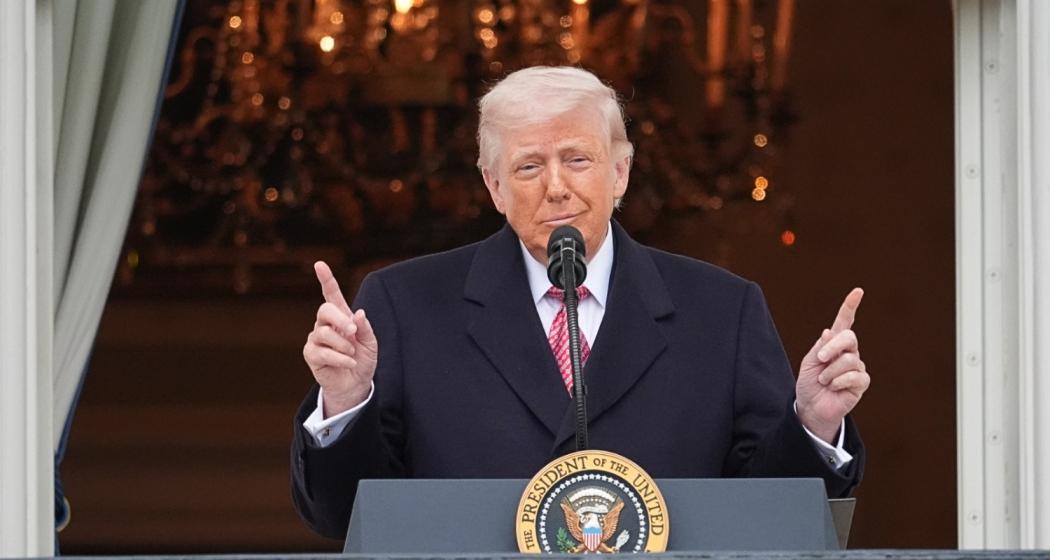
US President Donald Trump has warned that the United States would “completely” obliterate Iran’s electric generating plants, oil wells and Kharg Island if the strategically vital Strait of Hormuz is not reopened immediately and a peace deal is not reached soon, sharply escalating rhetoric as the West Asia conflict deepens. He said that the United States has engaged in serious talks with what he described as a “new and more reasonable regime” in Iran to end its military operations.
Taking to his social media handle, US President Donald Trump said, “The United States of America is in serious discussions with A NEW, AND MORE REASONABLE, REGIME to end our Military Operations in Iran,” in a post on Truth Social. “Great progress has been made but, if for any reason a deal is not shortly reached, which it probably will be, and if the Strait of Hormuz is not immediately ‘Open for Business,’ we will conclude our lovely ‘stay’ in Iran by blowing up and completely obliterating all of their Electric Generating Plants, Oil Wells and Kharg Island (and possibly all desalinization plants!), which we have purposefully not yet ‘touched.’”
His comments come as the Iran war enters its fifth week and as the Trump administration weighs sending in ground forces to seize Kharg Island, a major fuel hub which serves as the centrepiece of Iran’s oil industry.
In remarks on Monday, Trump said, “Maybe we take Kharg Island, maybe we don't. We have a lot of options,” indicating that such a move could require a prolonged American presence in the region. The proposal comes amid continued US and Israeli strikes on Iran and its allies, raising fears of further escalation.
Kharg Island and oil supply risks
Kharg Island, located in the Persian Gulf, handles a significant portion of Iran’s crude exports, making it a strategic target. Any attempt to seize or disrupt operations there could have far-reaching consequences for global energy markets already rattled by the conflict.
Iran has warned it could mine the Strait of Hormuz if its territory is invaded. The waterway is a critical artery for global oil shipments, and disruptions have already driven volatility in prices and supply chains.
Trump claimed that Iran had agreed to allow 20 oil tankers to transit through the strait “out of a sign of respect”, though he cautioned that negotiations with Tehran remained unpredictable. “I would only say that we're doing extremely well in that negotiation but you never know with Iran because we negotiate with them and then we always have to blow them up,” he said.
Regional tensions escalate
The conflict has widened beyond Iran’s borders, with Tehran launching strikes on infrastructure in Gulf countries. A recent attack on a water and electricity plant in Kuwait underscored the regional spillover.
Iran defended its actions, with Foreign Ministry spokesman Esmail Baghaei asserting that neighbouring countries were being used by the US for military operations. “Therefore, what Iran is doing is defending itself and it's not considered attacking regional countries,” he said.
Meanwhile, violence has spread across multiple fronts. In Iraq, a rocket strike on an air base west of Baghdad destroyed a military aircraft, while Israeli operations in Lebanon have continued, with casualties reported on both sides.
Also read: Pentagon readies weeks-long US ground ops in Iran
Ceasefire efforts and global reactions
Amid the escalating conflict, there have been renewed calls for de-escalation. Egyptian President Abdel Fattah el-Sisi appealed directly to Trump to help end the war. “I say to President Trump: no one can end the war in our region… except you,” he said, warning of “dangerous consequences” if hostilities continue.
Iran, however, has rejected a proposed 15-point US ceasefire plan as “excessive” and “unrealistic”, indicating that negotiations remain fragile.
European opposition to the war has also sharpened. Spain has barred US military aircraft linked to the conflict from using its airspace, with Defence Minister Margarita Robles calling the war “profoundly illegal and profoundly unjust”.
Indian killed in Iranian strikes
An Indian national has been killed in Kuwait in Iranian strikes on a power and water desalination plant, taking the total number of Indian fatalities from the ongoing conflict in West Asia to eight since it began a month back.
Kuwait's Ministry of Electricity, Water and Renewable Energy said a service building at the facility was damaged in Sunday's attack, Kuwait's state-run KUNA news agency reported.
It was the fifth Indian fatality on land since the Iran-US conflict erupted on February 28.
The embassy of India in Kuwait, confirming the death, expressed its "deepest condolences" at the "tragic demise" of the Indian national.
Wider geopolitical shifts
The crisis has triggered broader geopolitical manoeuvres. Ukrainian President Volodymyr Zelenskyy announced new long-term defence and economic agreements with Middle Eastern partners, including Saudi Arabia, the United Arab Emirates, Qatar and Jordan, aimed at strengthening cooperation in energy, trade and military technology.
The war has already disrupted global supply chains, triggering concerns over oil and gas availability, fertiliser shortages and aviation routes. Analysts warn that any escalation involving key energy infrastructure could deepen the economic fallout.
With multiple theatres of conflict and competing geopolitical interests, the situation remains volatile. Trump’s remarks on Kharg Island highlight the possibility of further escalation even as diplomatic channels remain open.
The coming days are likely to be critical in determining whether negotiations can stabilise the region or whether the conflict will intensify, with significant implications for global security and energy markets.

 Follow us