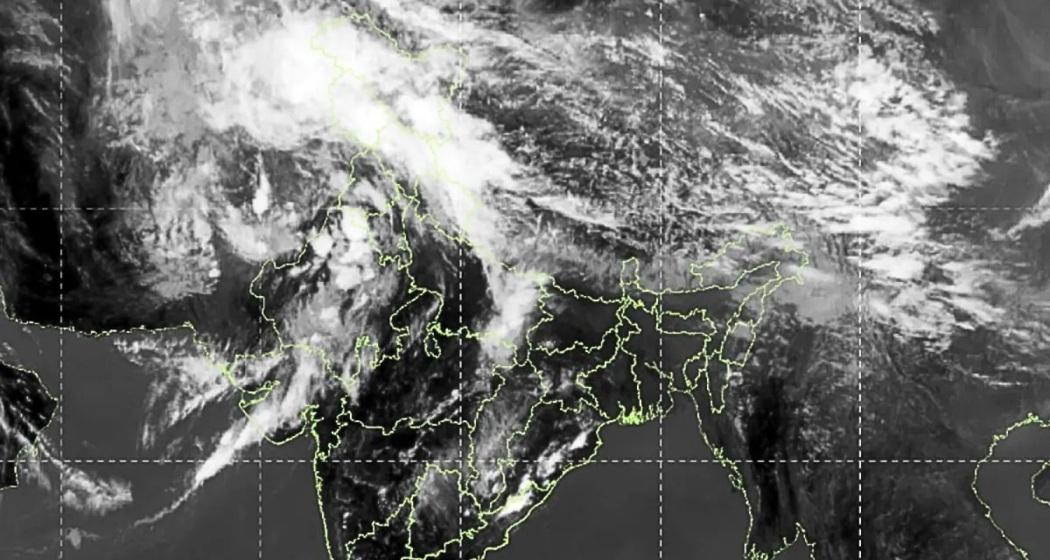
A powerful spell of unseasonal weather swept across North and Central India on Saturday as a massive 1,000-kilometre-long cloud band formed over the region, prompting the India Meteorological Department (IMD) to issue alerts for severe hailstorms, intense rainfall and strong winds.
The development has been attributed to a strong Western Disturbance, which has disrupted typical early April conditions, replacing rising temperatures with volatile atmospheric activity.
According to meteorologists, the system originates from the Mediterranean region and carries moisture towards the Indian subcontinent. As it interacts with warm air rising from the plains, it triggers what is known as pre-monsoon convective activity, leading to the formation of towering storm clouds.
The current system is particularly unusual due to its structure, a long, continuous cloud band stretching nearly 1,000 km, resulting in widespread and synchronised weather disturbances across multiple states.
The IMD has issued a yellow alert for Delhi-NCR, warning of severe rain and thundersqualls, with wind speeds expected to reach up to 60–70 kmph between 2 pm and 11 pm. Such winds are capable of damaging temporary structures and disrupting daily life.
Apart from Delhi-NCR, regions including Haryana, West Uttar Pradesh, east Rajasthan and parts of Madhya Pradesh are expected to face intense weather conditions. The system is also extending its influence into central and eastern Maharashtra.
Hailstorms, typically rare in April, are being triggered by intense activity within cumulonimbus clouds, dense, vertically developed clouds associated with thunderstorms. Inside these formations, strong upward air currents lift water droplets into freezing layers of the atmosphere, where they solidify into ice pellets. These pellets grow in size as they are repeatedly carried up and down by air currents before falling as hail.
While the rainfall has brought a temporary drop in temperatures by around five degrees Celsius, the accompanying hail has raised concerns for agriculture. Standing crops in parts of Rajasthan and Haryana have already suffered damage due to the sudden and intense weather activity.

 Follow us