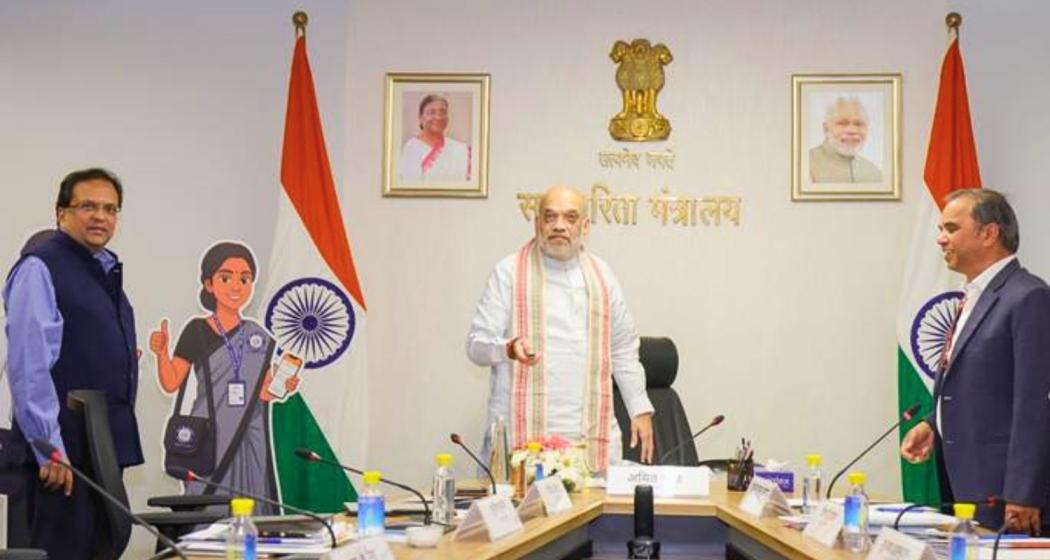
Union Home Minister Amit Shah on Thursday unveiled mascots and soft-launched four digital platforms that will drive India’s first fully digital Census, with the houselisting phase scheduled to begin on 1 April.
The platforms are designed to support enumeration operations across the country and streamline one of the world’s largest administrative exercises.
Shah also introduced the official mascots for Census 2027: ‘Pragati’ (female) and ‘Vikas’ (male).
“These mascots symbolise equal participation of women and men in fulfilling the resolve to make India a developed nation by 2047. Through these mascots, information, objectives and key messages related to Census-2027 will be disseminated in an effective and citizen-friendly manner across diverse sections of society,” a government statement said.
Among the four digital platforms launched is the Houselisting Block Creator (HLBC) web application, which enables officials to digitally create houselisting blocks using satellite imagery, ensuring standardised geographic coverage across the country.
The second tool is the HLO mobile application, a secure offline mobile app that will allow enumerators to collect and upload houselisting data directly from the field using handheld devices. Only enumerators registered on the Census Management and Monitoring System (CMMS) portal will be able to access the application.
“The app enables direct field-to-server data transmission, eliminating traditional paperwork,” the statement said.
The application will operate through registered mobile numbers and will be compatible with both Android and iOS platforms. It can be used in 16 regional languages.
Also read: Census 2027 to be entirely digital
The third platform is the Self-enumeration (SE) portal, which will allow citizens to submit household information online before field operations begin — a first for the decennial exercise.
“The SE portal is a secure web-based facility that allows eligible respondents within a household to submit their household information online before field operations,” the statement said.
Upon submission, users will receive a unique self-enumeration ID that will be shared with the enumerator for verification.
At the core of the digital framework is the Census Management and Monitoring System (CMMS), a centralised web-based platform designed to plan, manage and monitor census activities across administrative levels.
The system will enable officers at sub-district, district and state levels to track enumeration progress and field performance in real time through integrated dashboards.
The digital backbone, developed by the Centre for Development of Advanced Computing (C-DAC), will support around 3.2 million field functionaries, including enumerators and supervisors.
Originally scheduled for 2021, the Census was postponed due to the Covid-19 pandemic. The exercise will now be conducted in two phases — houselisting and housing census from April to September 2026, followed by population enumeration in February 2027.

 Follow us