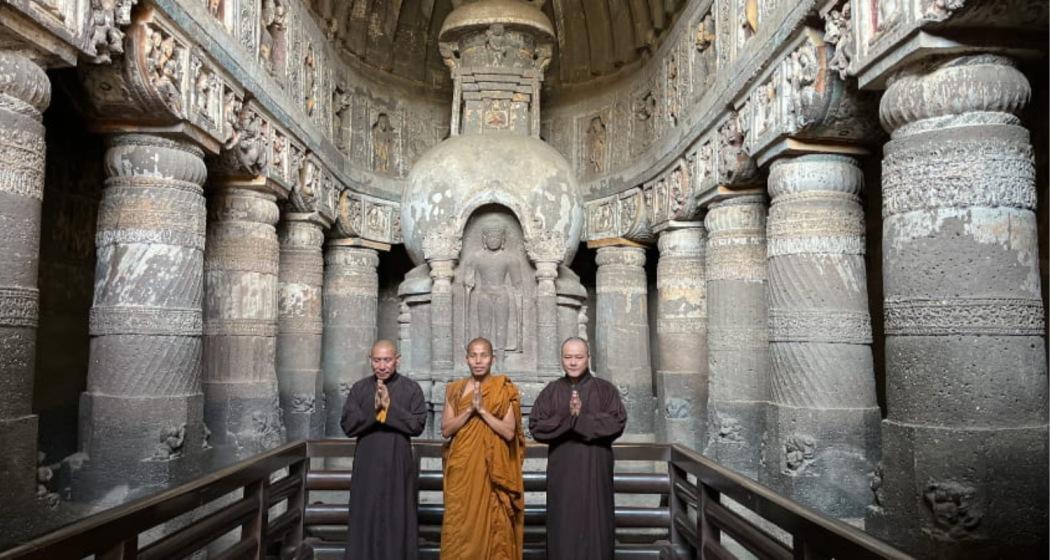
Bhutan’s Home Minister Lyonpo Tshering visited the renowned Ajanta Caves complex in Maharashtra’s Chhatrapati Sambhajinagar district and described the experience as “awesome” in the feedback book, officials said on Sunday.
Tshering, who visited the site on Saturday, also World Heritage Day, spent considerable time admiring the Padmapani Bodhisattva painting, one of the most celebrated masterpieces of ancient Indian art.
“He reached the Ajanta Caves complex at 11 am. He visited caves 1, 2, 5, 9, 10, 12, 17 and 26. The minister spent the longest time looking at the Padmapani painting in cave number 1,” his guide Rahul Nikam said.
An official from the Archaeological Survey of India said Tshering wrote in the visitors’ book: “The visit to the UNESCO heritage site was awesome with co-operative staff who guided us the whole time.”
The visit to Ajanta formed part of Tshering’s ongoing trip to India, during which he has been engaging with Indian counterparts on issues related to internal security, border management and bilateral cooperation. India and Bhutan share close strategic and cultural ties, and such high-level exchanges are seen as reinforcing coordination between the two neighbours.
Also read: The Silk Route through the Himalayan passes
More about the Ajanta Caves
The Ajanta Caves, a UNESCO World Heritage Site since 1983, are widely regarded as among the finest surviving examples of ancient Indian art and architecture. Carved into a horseshoe-shaped escarpment along the Waghora river valley, the caves date from the 2nd century BCE to around the 6th century CE, spanning both the Hinayana and Mahayana phases of Buddhist tradition.
The complex comprises around 30 rock-cut caves, including monasteries and prayer halls, each reflecting sophisticated engineering and artistic techniques. The caves were excavated in two phases, with the earlier group associated with the Satavahana period and the later phase linked to the Vakataka dynasty, particularly under the patronage of King Harisena.
Ajanta’s murals and frescoes are especially significant for their narrative richness and stylistic refinement. Painted using natural pigments, the works depict scenes from the Jataka tales, episodes from the life of the Buddha, and glimpses of contemporary courtly life, trade and social customs. The Padmapani Bodhisattva painting, located in Cave 1, stands out for its expressive form, intricate ornamentation and subtle use of colour, and remains one of the most reproduced images in Indian art history.
Rediscovered in 1819 by a British officer, the caves have since become a focal point for archaeological study and conservation. Preservation remains a challenge due to factors such as humidity, human traffic and environmental degradation, prompting regulated visitor access and ongoing restoration efforts by the Archaeological Survey of India.
Located about 100 km from Chhatrapati Sambhajinagar, Ajanta continues to draw thousands of domestic and international visitors each year. Officials said visits by foreign dignitaries such as Tshering highlight the site’s global cultural significance and reinforce the need for sustained conservation.

 Follow us