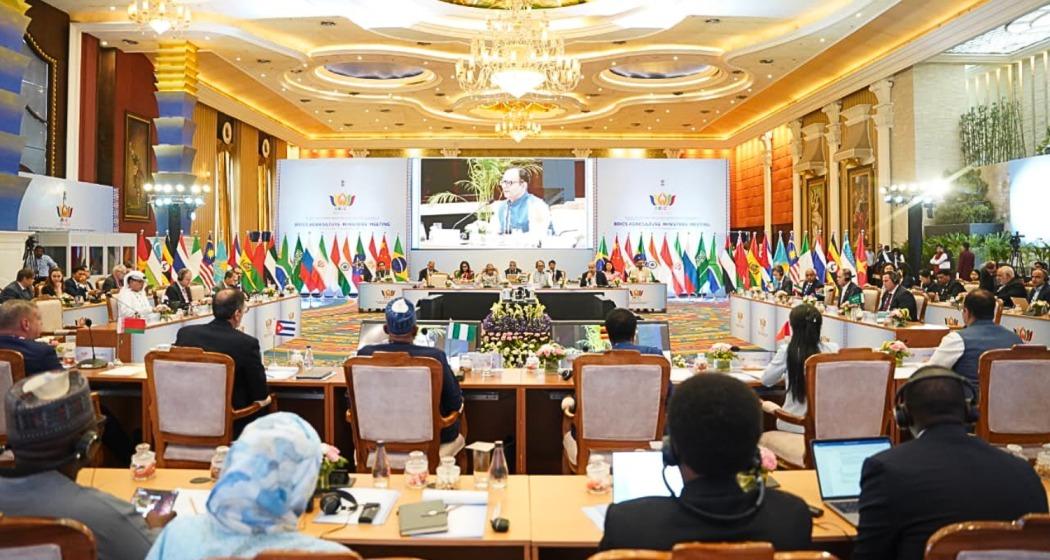
BRICS nations on Saturday announced a series of joint initiatives on food security, farmers' rights, digital agriculture and climate-resilient farming, including the creation of a new global forum to protect farmers' rights and traditional seed knowledge.
The decisions were taken during a five-day meeting of agriculture ministers and officials from BRICS countries held in Indore under India’s presidency.
Addressing reporters after the meeting, Union Agriculture Minister Shivraj Singh Chouhan said member countries had agreed on several institutional mechanisms aimed at strengthening agricultural cooperation and addressing common challenges.
Among the key outcomes was the decision to establish a Global Forum on Farmers' Rights in Seed Systems, which will focus on protecting farmers' rights and preserving traditional knowledge related to seed systems. Chouhan said India would coordinate the initiative.
The BRICS countries also agreed to create the BRICS AGRIN Network to facilitate cooperation in agricultural inputs, genetic resources and information-sharing. India will serve as the coordinating country for the network.
Also read: BRICS farm conference begins in Indore
The grouping further decided to continue discussions on operationalising the proposed BRICS Grain Exchange, an initiative aimed at strengthening foodgrain trade and supply chains among member countries.
Recognising the growing impact of climate change on agriculture, the countries agreed to establish a BRICS Centres of Excellence Network in agroecology and regenerative agriculture. Initial coordination will be undertaken by an institution under the Indian Council of Agricultural Research.
The member nations also endorsed the creation of a Digital Agriculture Network to promote the use of artificial intelligence, Internet of Things, geospatial technologies and other digital tools in agriculture. The network's initial coordination will be handled by Indian Institute of Technology Delhi.
Chouhan said the initiatives were designed to empower small and marginal farmers, improve food security and make agriculture more sustainable and resilient.
The decisions, he added, reflected the shared commitment of BRICS countries to address agricultural challenges through innovation, technology and knowledge-sharing.

 Follow us