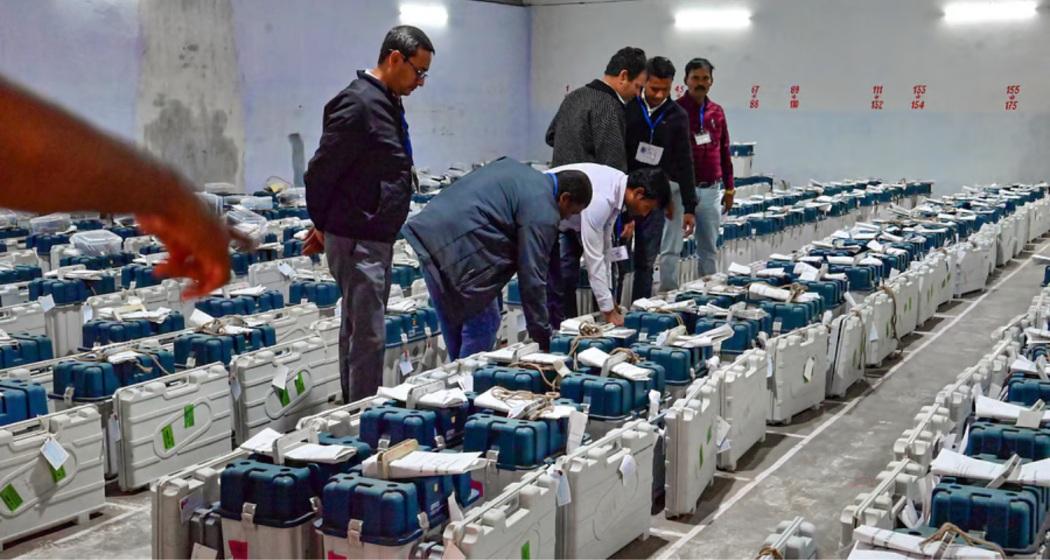
The Election Commission has completed the first round of randomisation of electronic voting machines (EVMs) and voter-verifiable paper audit trail (VVPAT) devices for the Assembly elections scheduled on April 9 in Assam, Kerala and Puducherry.
The exercise, a key procedural step ahead of polling, is aimed at enhancing transparency and building confidence among political parties and voters. The poll authority randomly allocates EVMs and VVPATs to constituencies to ensure that no fixed machine is linked to any specific location in advance.
According to the Commission, the randomisation process is conducted in two stages. In the first stage, EVMs are allocated from district-level warehouses to Assembly constituencies. In the second stage, the machines are further distributed from the constituency level to individual polling stations.
Officials said the first phase of randomisation has also been completed for Assembly by-elections in Goa, Goa, Nagaland and Tripura, which are also scheduled to be held on April 9.
Also read: Rivals regroup as Assam gears up for April 9 polls
The initial randomisation was carried out using the EVM Management System (EMS), a dedicated digital platform designed to oversee the allocation and tracking of machines. The process was conducted by district election officers in the presence of representatives of recognised national and state political parties, ensuring transparency and accountability.
As part of the protocol, the list of EVMs and VVPATs assigned during the first randomisation has been shared with political parties. This allows stakeholders to verify the allocation and raise any concerns well before polling day.
The Commission has consistently maintained that the randomisation process is a critical safeguard in the electoral system. By ensuring that machines are assigned through a computerised and unpredictable mechanism, the system seeks to eliminate any scope for bias or manipulation.
The second round of randomisation, which allocates machines to specific polling stations, will be conducted closer to the date of polling under similar supervision.
With preparations gathering pace, the Commission’s focus remains on ensuring a free, fair and transparent electoral process across all poll-bound states and constituencies.

 Follow us