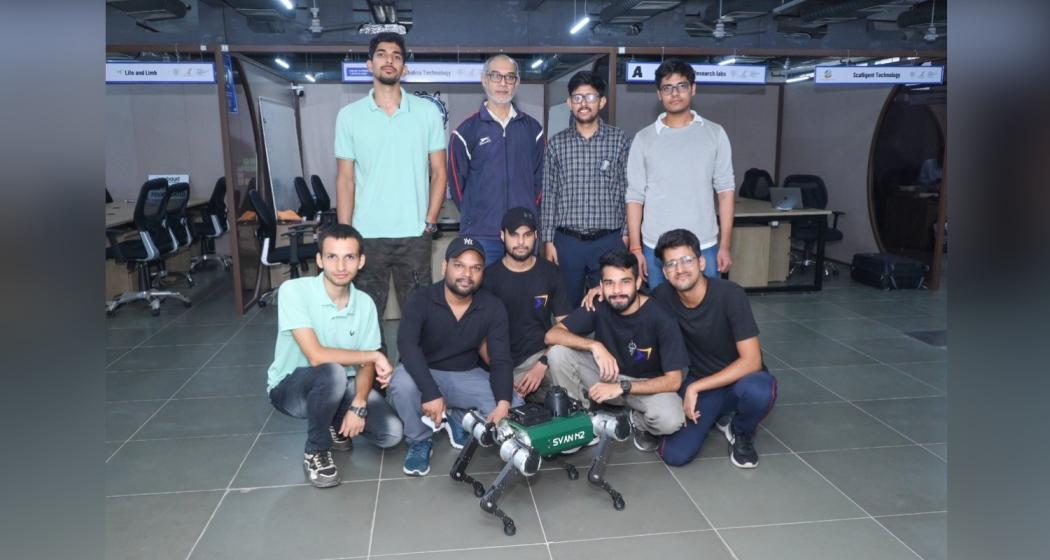
Indigenous robots emerged as the major attraction at the AI Impact Summit 2026, held from February 16-20 at Bharat Mandapam, New Delhi, even after a private university was asked to vacate the premises for claiming a Chinese-made robot as its own.
SVAN-M2 leads the charge
Kanpur-based startup xTerra Robotics drew crowds with its SVAN-M2 robot dog. Developed by IIT Kanpur students and faculty, the robot features an aluminium alloy body, LiDAR mapping, and thermal imaging, making it suitable for monitoring hazardous zones, power stations, and security tasks.
Co-founder Sakshi S Gupta said the startup is planning to scale up production to make the robot cost-competitive with similar Chinese products. xTerra Robotics is collaborating with L&T to deploy SVAN-M2 and other robots at construction sites.
Also read: Shirtless protest snowballs into nationwide furore
UNWFP robot enhances warehouse safety
Another highlight was the eight-foot-tall robot developed by the United Nations World Food Programme for India’s food storage warehouses. Equipped with sensors to detect temperature fluctuations and toxic phosphine gas, the robot can inspect fumigation zones safely, reducing human exposure. Pilot testing at Narela warehouses is underway, with wider deployment planned in one to two months.
Madhya Pradesh showcases humanoid innovation
The Madhya Pradesh pavilion displayed the state’s first 3D-printed humanoid robot, Yug Bot, developed by Class 7-8 students with support from startup Youngovator. Two feet tall, with hand-gesture recognition and artificial eyes, the robot is being tested for traffic and crowd management applications.
Despite the early controversy involving Galgotias University, India’s own robots captured attention from global leaders, AI experts, and technology giants attending the summit. The event demonstrated the growing capability of Indian startups and academic institutions to develop high-end robotics solutions with real-world applications.

 Follow us