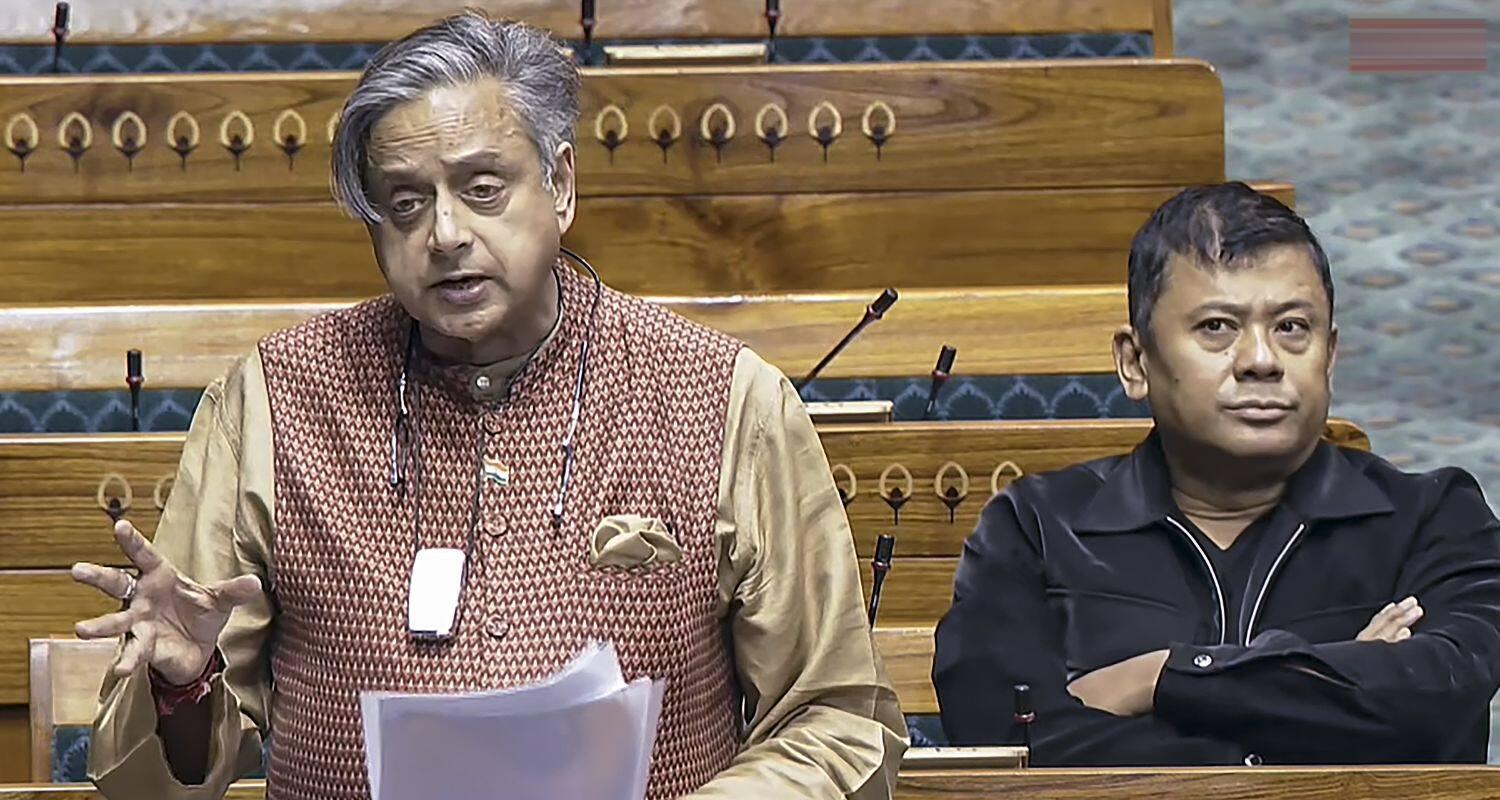
Lok Sabha on Wednesday passed the nuclear energy bill that seeks to ease private participation in India’s civil nuclear sector, even as the Opposition staged a walkout.
The Sustainable Harnessing and Advancement of Nuclear Energy for Transforming India (SHANTI) Bill was passed by voice vote, with Union minister Jitendra Singh terming the bill a “milestone legislation” that “will give a new direction to the country’s developmental journey”.
“India’s role in geopolitics is increasing. If we have to be a global player, we have to follow global benchmarks and global strategies. The world is moving towards clean energy. We too have set a target of 100 GW of nuclear energy capacity by 2047,” he said.
The Opposition, however, criticised the apparent dilution of provisions of the Civil Liability for Nuclear Damage Act, 2010, that passed on the liability for a nuclear incident on to the suppliers of nuclear equipment.
Congress MP from Kerala’s Thiruvananthapuram, Shashi Tharoor, did not mince words when he described the nuclear energy bill as a “dangerous leap into privatised nuclear expansion” without adequate safeguards and asserted that the pursuit of capital cannot be allowed to override the requirements of public safety, environmental protection and victim justice.
Participating in a debate on the SHANTI Bill on Wednesday, Tharoor joined the Opposition’s chorus, asking for the Bill to be referred to a joint parliamentary committee.
“I am not sure whether it is a nuclear bill or an unclear bill,” he said. “We cannot allow the pursuit of capital to override the non-negotiable requirements of public safety, environmental protection and victim justice.”
The most contentious of the Bill’s provisions, Tharoor said, is that the negligence of an operator or a person is recognised as a cognisable offence, but only someone duly authorised by the Centre or the Atomic Energy Regulatory Board can file a complaint.
“If a nuclear-facility operator is criminally negligent, affected communities cannot file a complaint. Civil society organisations cannot file a complaint. Even state governments cannot directly initiate criminal proceedings against the operator,” he stated.
Also Read: SHANTI Bill tabled: Your cheat sheet on India’s nuclear reform
Terming the Bill to be “full of loopholes”, the Congress MP said the Bharatiya Janata Party-led Centre spoke grandly about harnessing the immense energy released by splitting an atom, yet it seemed to have failed to expend even a fraction of that energy in drafting a bill that is coherent.
“We have mastered nuclear fusion and fission but not, apparently, legislative precision. The SHANTI Bill is a milestone but for the wrong reasons,” he said.
Pointing out its other flaws, Tharoor said the Bill “completely neglects the serious, massive and irreversible risks from radioactive leaks, long-lived nuclear waste and the potential for catastrophic accidents”.
“The full life cycle of nuclear fuel from mining to waste disposal is neither clean nor sustainable. We must be honest with the people of India about what we are asking them to accept. Section 3(1)(c) and (e) provide that any other company or any person expressly permitted by the central government is eligible to apply for a licence to set up and run nuclear facilities” the former diplomat said.
Such a “blanket opening” of the entire nuclear energy sector to private actors with “indeterminable qualification criteria” and the allowing of a single composite licence for multiple activities across the nuclear fuel cycle are troubling, Tharoor said.
“This means one entity could control mining, fuel fabrication, reactor operation and waste handling. Such concentration of control in a single operator or corporate group heightens systemic risk exponentially rather than containing that risk. When profit becomes the primary motive across the entire chain, safety checks could be compromised at every stage,” he argued.
Additionally, the capping of the total nuclear incident liability at approximately USD 460 million or ₹3,910 crore – unchanged in 15 years – shows that inflation has not been taken into consideration.
“For context, the Fukushima disaster cleanup cost has already exceeded USD 182 billion.... Chernobyl’s total economic impact has exceeded USD 700 billion. Yet we propose to cap liability at less than half a billion dollars? This is grossly inadequate,” Tharoor said.
Moreover, India’s usable uranium reserves are finite and while it does possess significant Thorium-232 reserves, thorium-based reactors remain decades away from significant deployment, he pointed out.
Tharoor said while India’s first prime minister, Jawaharlal Nehru, had laid the foundations for the country’s nuclear programme, Manmohan Singh carried the 2008 Indo-US nuclear deal across the last mile, lifting India out of isolation and leading it into an era of strategic confidence in nuclear power.
“This bill deepens uncertainty as to where India’s nuclear framework is headed,” he said.
“The name SHANTI means peace and sustainability. Let us ensure that this name is not a cruel irony in the aftermath of a preventable disaster. The promise of transforming India ought not to conflate the risk of scarring India,” he added.

 Follow us