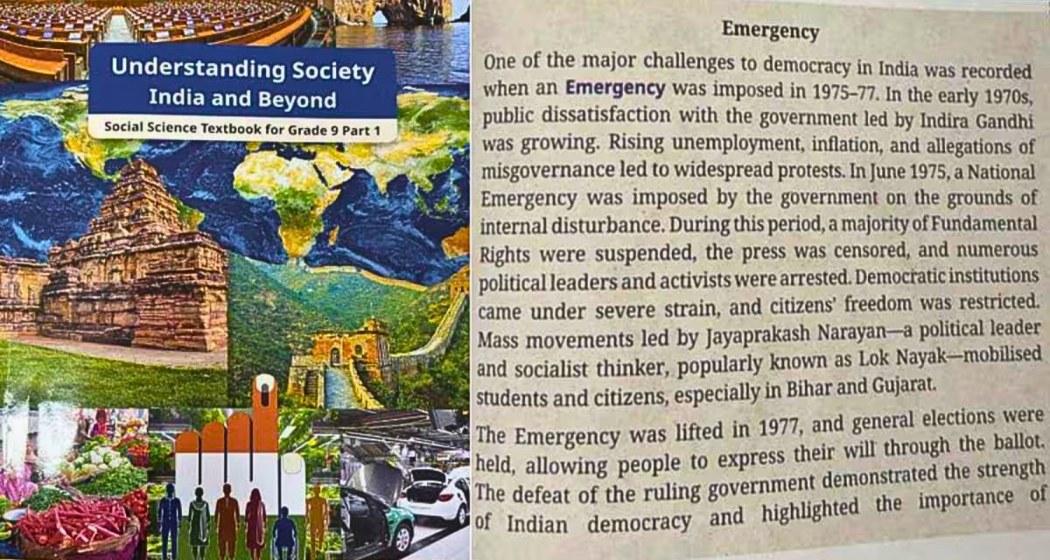
The National Council of Educational Research and Training (NCERT) has, for the first time, introduced a section on the 1975-77 Emergency in a Class 9 Social Science textbook, describing the period as “one of the major challenges” faced by Indian democracy.
The topic features in Understanding Society: India and Beyond, a newly revised textbook that examines the strengths and challenges of democracy in India. An NCERT official confirmed that this is the first time the Emergency has been included in a Class 9 textbook.
The chapter traces the political developments leading up to the Emergency and its impact on democratic institutions and civil liberties. It states that public dissatisfaction with the government led by former Prime Minister Indira Gandhi had been growing in the early 1970s amid rising unemployment, inflation and allegations of misgovernance, triggering widespread protests.
The textbook notes that a National Emergency was imposed in June 1975 on the grounds of internal disturbance. “During this period, a majority of Fundamental Rights were suspended, the press was censored, and numerous political leaders and activists were arrested. Democratic institutions came under severe strain, and citizens' freedom was restricted,” it says.
The book also highlights the role played by Jayaprakash Narayan, popularly known as Lok Nayak, in mobilising students and citizens through mass movements, particularly in Bihar and Gujarat.
Also read: NCERT judiciary chapter: SC lifts ban on 3 academics
According to the text, the lifting of the Emergency in 1977 and the subsequent general election underscored the resilience of Indian democracy. It notes that the defeat of the ruling government demonstrated the importance of democratic participation and the power of the ballot.
The inclusion comes as the country marks 50 years since the declaration of the Emergency.
Prime Minister Narendra Modi on Thursday paid tribute to those who resisted the Emergency, describing it as “one of the darkest chapters in India's history”.
“The Emergency was a direct assault on our Constitution. It witnessed the suspension of civil liberties, curbs on freedom of expression, arrests of political leaders, journalists, social workers and an assault on institutions that are the bedrock of our democracy,” Modi said in a social media post.
Beyond the Emergency, the revised textbook discusses challenges such as misinformation, fake news, poverty, regionalism, social discrimination and gender inequality. It also introduces a section titled “Democracy and You”, aimed at helping students understand their role as citizens.
The book further covers democratic institutions, the role of the media, electoral participation, grassroots governance through panchayats, and women’s political representation in local bodies.

 Follow us