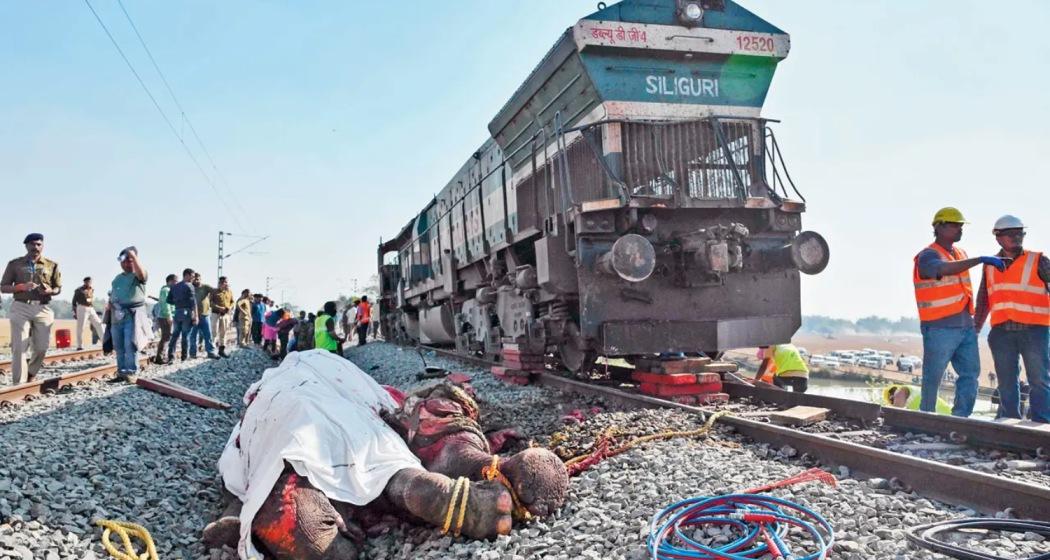
The National Green Tribunal (NGT) has issued notices to the Central Pollution Control Board (CPCB), the Assam government and other authorities following the death of seven elephants in a train collision last December.
The incident occurred on December 20, 2025, when the Sairang-New Delhi Rajdhani Express struck a herd of elephants on the Jamunamukh–Kampur section of the Lumding division in Assam. The locomotive and five coaches derailed, though no human casualties were reported. The collision sparked widespread concern over wildlife safety and the risks posed by rail lines passing through elephant corridors.
In its order dated January 5, the NGT noted: “Prima facie the facts and circumstances emerging from the news item raise substantial questions relating to the environment…” The tribunal has summoned responses from the CPCB, the Assam government’s special chief secretary for environment, the state’s principal chief conservator of forests, and the Assam State Pollution Control Board. The matter is scheduled for hearing before the tribunal’s eastern zonal bench in Kolkata on January 28.
Railway authorities said the accident occurred in the early hours as the train, travelling at high speed, encountered the elephants moving across the tracks under dense fog. Emergency braking measures were applied, but the train was unable to stop in time, resulting in the fatal impact and subsequent derailment.
Also read: PM Modi greets Assam on Magh Bihu, hails festival’s unity
Forest officials confirmed that the seven elephants, including adult males, females, and calves, were killed on the spot. Conservation teams rushed to the site to rescue any survivors, but reports suggest that most of the young elephants did not survive. The accident disrupted rail operations in the region for several hours, necessitating rerouting and restoration work.
Assam is home to one of India’s largest populations of wild elephants, and experts have long raised concerns about train collisions along migratory routes. Environmentalists have highlighted the need for enhanced safety measures, including speed restrictions in known elephant corridors, early-warning systems, and trackside monitoring technology to prevent future tragedies.
The NGT’s intervention underscores growing judicial attention to ecological and wildlife safeguards amid expanding infrastructure projects in biodiversity-sensitive areas. The tribunal is expected to examine the steps taken by rail and forest authorities, and to evaluate whether current mitigation measures are adequate to prevent similar incidents.
The case has reignited the debate on balancing developmental needs with wildlife conservation, highlighting the urgent requirement for policies that ensure the safety of both animals and human passengers along critical rail routes in the Northeast.

 Follow us