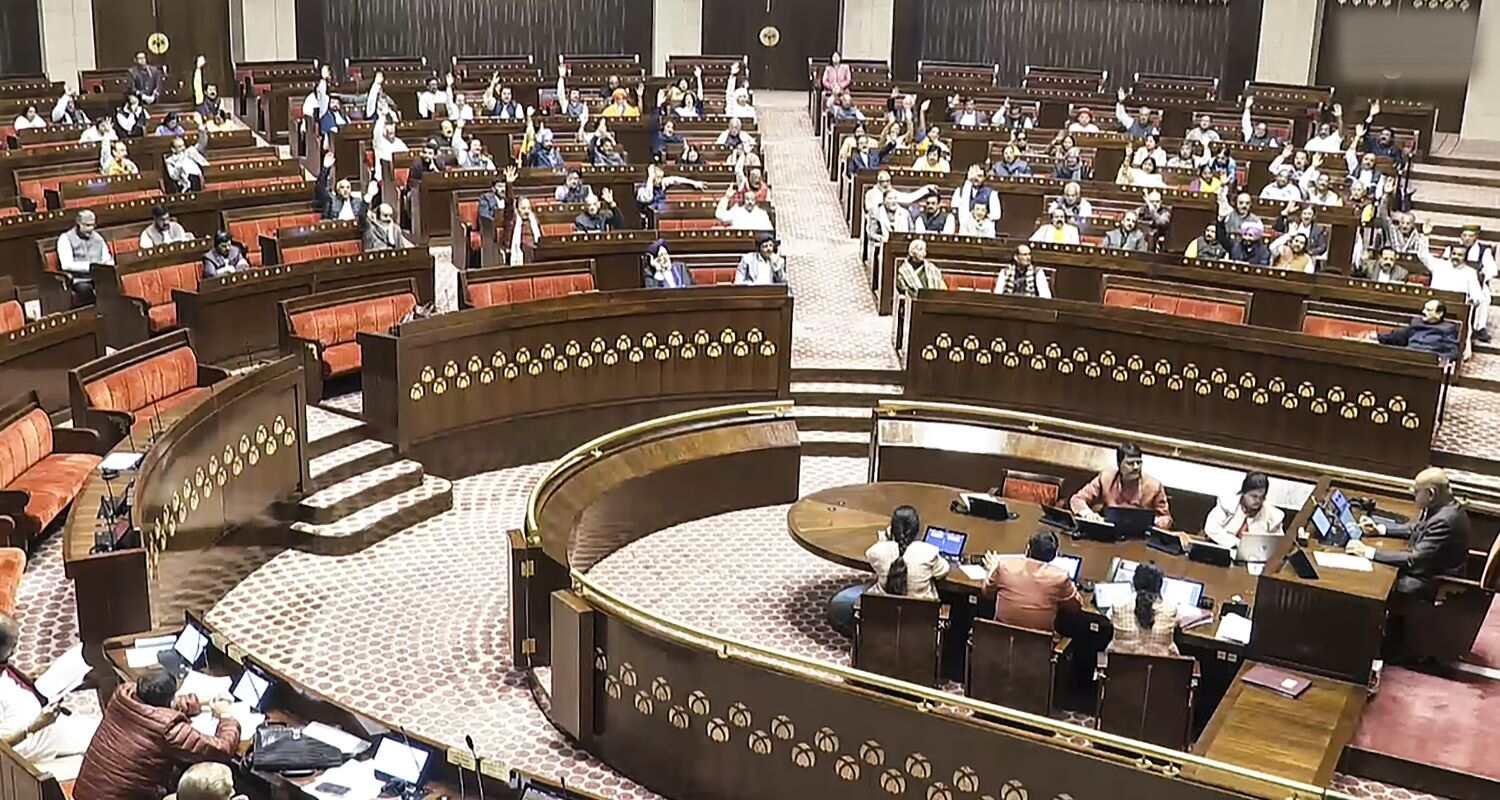
With the Rajya Sabha assenting to the nuclear energy bill on Thursday, several amendments moved by Opposition members to send the proposed legislation to a parliamentary committee got rejected.
On Wednesday, the Sustainable Harnessing and Advancement of Nuclear Energy for Transforming India (SHANTI) Bill was passed in the Lok Sabha, which opens the hitherto tightly-controlled civil nuclear sector for private participation.
Replying to a discussion on the bill, Minister of State, Department of Atomic Energy, Jitendra Singh, said it aims to make India self-reliant in nuclear energy and reduce the country’s dependence on other sources of non-renewable energy.
“This (nuclear energy) will be the most reliable, steady 24x7 source of energy, unlike some other renewable sources,” he said.
Saying that the country has already reached 8.9 GW of nuclear energy in 2025, Singh said that “if we are able to follow the roadmap that we have envisaged, we will be 100 GW by 2047”, and that “we would be contributing nearly 10 per cent of the energy requirement...”.
Defending the opening up of the tightly-controlled civil nuclear sector for private participation, Singh said the “fruits and the outcomes” of opening various sectors to private players have been very rewarding, as seen in the space sector, which has now grown to USD 8 billion economically.
“And, the pace is so fast that in the next eight to ten years, we hope to go five times, to USD 45 billion. The concept of space startups was unheard of. [But] today, we have over 300 space startups. Some in this sector have turned multi-millionaires, and some have global potential. This was possible because private sector participation was allowed. The FDI was allowed,” he said.
Also Read: LS passes bill to privatise nuclear sector amid walkout by Oppn
Insisting that safety provisions in the nuclear bill have not been compromised in any way, the minister said the SOP clearly mentions, ‘safety first, second production’.
“The safety provisions and their standard operating procedures (SOPs) are the same as in the Atomic Energy Act of 1962, which was enacted when Pandit Jawaharlal Nehru was the Prime Minister,” he added.
Allaying fears of radiation leaks, Singh said there has so far been no report of any radiation-related hazards to the public.
“In the last 10-11 years, India has assumed a global role for itself. India is no longer following others as it happened earlier...we are the first-line nation. We are no longer followers. India is offering cues for others to follow.”
With “the entire world moving towards clean energy”, Singh said it is important for India to achieve the goal in toto so that it becomes less dependent on petroleum resources or fossil fuel sources.
“Before 2014, the budget of the atomic energy department was just ₹13,879 crore, but it has now increased to ₹37,483 crore in the current year. Similarly, in 2015, the NDA government took another bold decision and opened the nuclear sector for joint ventures, but those were limited to PSUs and not to the private (players),” he informed the House.
Later, in 2017, the Cabinet, in a “bulk approval”, allowed 10 reactors to be set up, the minister added, saying the country’s nuclear power capacity has grown from just 4.7 GW in 2014 to 8.9 GW.
Dissenting with Singh’s viewpoint, IUML’s Haris Beeran said the bill dismantles the liability framework established after the Bhopal gas tragedy.
“Posterity will judge us very badly if you are going ahead with this bill,” he said.
Agreeing with him, CPI’s PP Suneer also questioned the “dangerous haste” with which the government is opening one of the most sensitive sectors of the economy to complete private control.

 Follow us