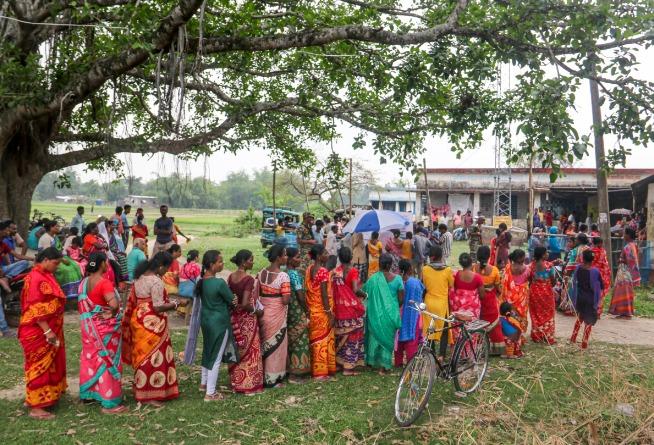
The first phase of voting in the West Bengal Assembly election recorded an unprecedented surge in voter participation, with turnout touching nearly 90 per cent by 5:00 pm—marking a historic high in the state’s electoral history.
According to data released by the Election Commission of India, the average turnout across the 152 constituencies that voted in Phase-I stood at 89.93 per cent, already surpassing the previous record of around 84 per cent set during the landmark 2011 Assembly elections. Officials indicated that the final figure could rise further once late voters are accounted for.
Among key constituencies, Nandigram—long considered a politically sensitive and high-profile seat—recorded a turnout of approximately 90.3 per cent, reflecting intense voter engagement.
West Bengal has historically recorded strong voter turnout. In 1996, participation levels were close to 83 per cent, while 2001 saw a slight dip to around 75 per cent. The trend picked up again in 2006, with turnout reaching 80 per cent during the tenure of the CPI (M)-led Left Front government under Buddhadeb Bhattacharjee.
The 2011 election, which brought Mamata Banerjee and the Trinamool Congress (TMC) to power, saw turnout peak at 84 per cent. Subsequent elections in 2016 and 2021 maintained high participation levels, hovering around 82 per cent.
What drove the surge?
Analysts point to several factors behind the record turnout this year. A key contributor is the Special Intensive Revision (SIR) of electoral rolls, which led to the removal of deceased, duplicate and ineligible voters. In many constituencies, between 20,000 and 30,000 names were deleted, with districts like Murshidabad and Malda seeing even higher figures.
This pruning has effectively boosted turnout percentages. For instance, if the number of actual voters remains unchanged but the total electorate shrinks, the turnout rate rises proportionately.
Another factor is heightened voter awareness and participation. The SIR process, which required fresh verification in many cases, re-engaged voters and created a sense of urgency to exercise their franchise. Additionally, increased participation by women and first-time voters has contributed to the surge.
Political stakes and interpretations
High voter turnout in Bengal has historically carried multiple interpretations—sometimes signaling support for the incumbent, and at other times reflecting strong anti-incumbency sentiment.
The ruling TMC has interpreted the surge as a mandate for continuity, citing the popularity of welfare schemes such as ‘Lakshmir Bhandar’ and ‘Yuva Sathi’.
The opposition BJP, however, views the high turnout as evidence of a wave for change, suggesting that voters have turned out in large numbers to express dissatisfaction with the current government.
Political observers note that Bengal’s consistently high turnout is driven by three key factors—strong booth-level party organisation, widespread public enthusiasm for elections, and the high-intensity nature of political contests in the state.
Despite the record participation, experts caution that turnout alone does not predict electoral outcomes. Rather, it reflects the electorate’s willingness to engage actively in the democratic process.
As the state awaits the remaining phases, all eyes are now on whether this near-90 per cent turnout will translate into continuity or change when results are declared on May 4.
By Pranab Mondal

 Follow us