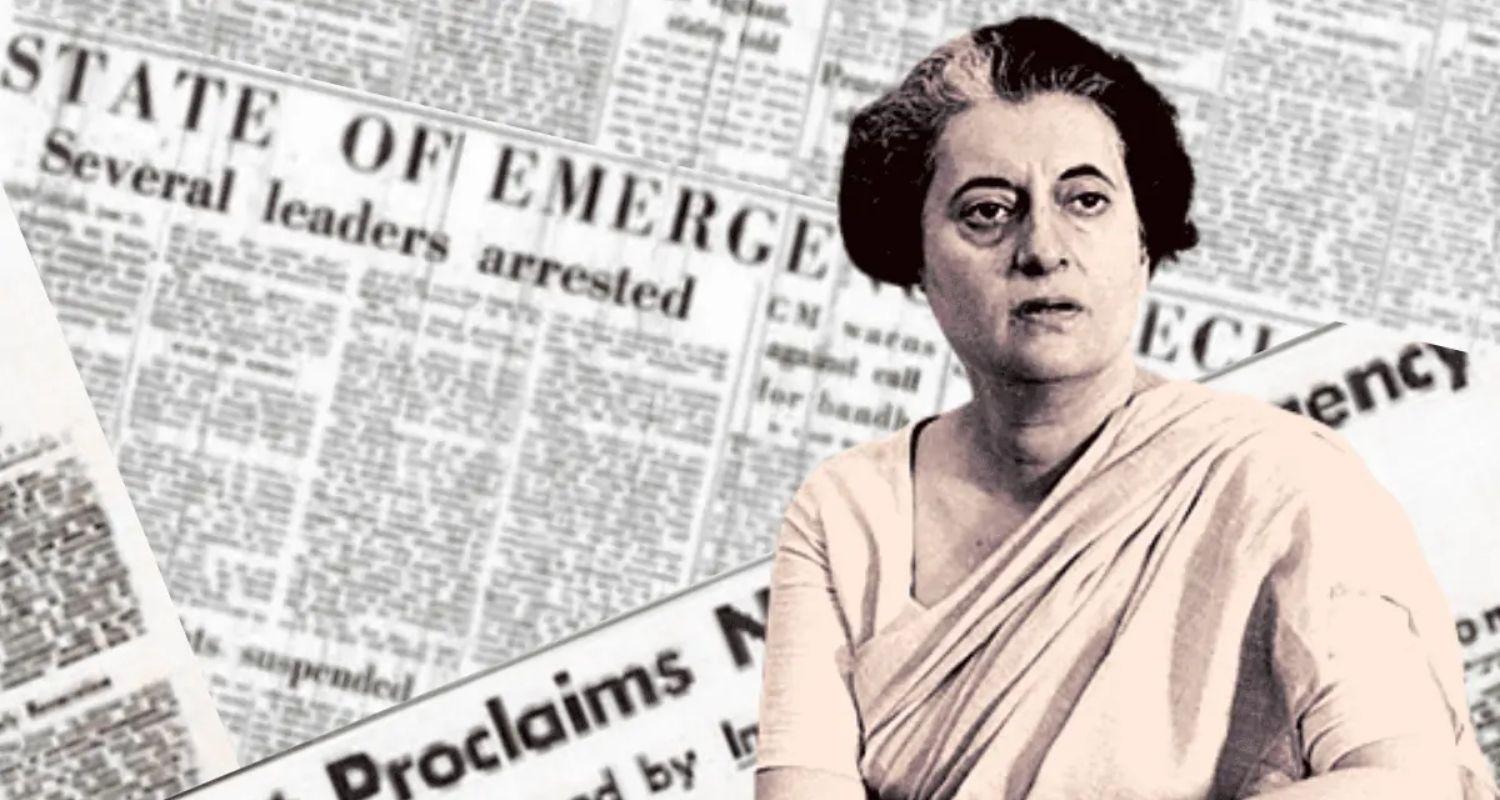
Indira Gandhi is indeed among the best Prime Ministers of the country. She was daring and decisive. No other Prime Minister before or after her so far, can match her when it comes to taking bold decisions in the interests of the country. However, one particular decision that obviously came out of her daring nature was imposing National Emergency on June 25, 1975. While the reason given was the “internal disturbances” across the country, the real reason was the political opposition.
The Bharatiya Janata Party led National Democratic Alliance government has declared June 25 as the “Murder of Democracy Day”. Democracy indeed was murdered on this day in 1975, when fundamental rights and civil liberties were suspended just because the Prime Minister and her government could not face the onslaught of a robust and aggressive opposition.
Emergency, in a way, served as a warning signal for the then young democracy India was at that time. India had been independent for just 28 years when Emergency was imposed. Thankfully, the emergency lasted for just 18 months and it was the same Ms Gandhi, who called for General Elections within less than two years of imposing it.
There can be no justification for such an action like imposition of “Emergency” without any credible internal or external reasons. There were none; neither internal nor external. Yes, Ms Gandhi was being challenged by an aggressive and combative opposition, apparently because she was growing more powerful and more popular.
Ms Gandhi had taken some revolutionary steps after becoming Prime Minister. She had also taken complete control of the Congress party by sidelining the old guard, called the “syndicate”. Her decisions like the nationalisation of banks, abolition of the privy purses and creation of Pakistan, had obviously made her immensely popular.
Just ahead of the 1971 War, which saw creation of Bangladesh, Ms Gandhi had led her party to a landslide victory in the General Elections winning 352 of the 518 parliamentary seats. Bangladesh victory had made her more popular and the election results before that had already made her more powerful.
Ms Gandhi had gradually started concentrating all the powers in the Prime Minister’s Office, where a select set of bureaucrats led by her Principal Secretary PN Haksar, along with her son Sanjay Gandhi were dictating terms. Her cabinet colleagues were rendered powerless. That is obvious and understandable when the leader becomes so powerful and when the others in the party know and realise that their existence and survival is dependent on the leader’s popularity alone. Her cabinet colleagues were willing and compliant in submitting to her will.
Under such circumstances misuse of power and corruption is a natural phenomenon to take place. There was some initial resentment, which kept on growing. Ms Gandhi, because of her immense popularity and a brute majority did manage to ward off all challenges. But the final blow came when the Allahabad High Court cancelled her 1971 election against Raj Narain for misuse of official machinery. The judgement was upheld by the Supreme Court, with one minor relief that she could continue to be the Prime Minister till the pending of her appeal.
In the meantime, the opposition led by the charismatic socialist leader Jai Prakash Narain, also known as JP turned quite strong and aggressive. The opposition protests were attracting more and more crowds. The agitation turned into a movement and was popularly known as the ‘JP Movement’. The entire opposition had united together.
Ms Gandhi succumbed to the temptation of invoking article 352 of the Indian Constitution and declare national emergency for the reason of widespread internal disturbances. What happened subsequently is history with tens of thousands of political leaders and workers, journalists, civil society activists, students and others being put behind bars. Ms Gandhi and her close coterie of people, led by her son Sanjay, ruled the country with an iron fist.
Also read: Has Shyama Prasad Mukherjee got his due?
But the resistance against the Emergency did not stop. Eventually, in March 1977, within less than two years of the imposition of the Emergency, Ms Gandhi called for General Elections. She was swept out of power with the combined opposition getting more than two-thirds majority. Among the first things the new government, it was the first non-Congress government in thirty years of the history of independent India, was to bring in 44th amendment to the constitution, thus making it difficult to impose Emergency once again.
Interestingly, the government that was formed in reaction to the Emergency could not survive even for three years. The internal squabbles hit it so hard that within two years Prime Minister Morarji Desai had to resign and was replaced by Chaudhary Charan Singh. He also did not last for more than six months. The government did not last for the full five years. Midterm elections were held in 1980, which saw Ms Gandhi return to power within three years and within less than five years of imposing the emergency.
There were many lessons to be drawn. One, people of India did not approve of the emergency, autocracy and dictatorship that it had led to. They threw out Ms Gandhi with a huge mandate to the opposition that opposed and resisted the Emergency. The second lesson, probably more important one, was that people expected and wanted a stable government. That is why they gave mandate again to Ms Gandhi despite the Emergency of 1975.
These should hold important lessons for the political leaders across the aisle that people would not tolerate any authoritarianism, no matter how popular you are and how many achievements you have to your credit. They can simply throw you out. At the same time, the people will not take any chances about the political stability in the country. It may sound contradictory, but it is a historical fact.

 Follow us